

In today’s competitive manufacturing and retail environment, packaging does much more than protect a product. It influences purchasing decisions, strengthens brand recognition, improves operational efficiency, and determines how successfully products move through the supply chain.
For manufacturers throughout St. Louis, Missouri, investing in professional secondary packaging services can make a significant difference in product presentation, distribution efficiency, and overall profitability.
Whether you’re preparing consumer goods for retail shelves, assembling promotional product bundles, organizing products for distribution, or managing high-volume packaging requirements, secondary packaging plays an essential role in getting products market-ready.
At Elite Printing & Packaging, Inc., businesses can explore packaging and co-packing solutions designed to support their production and distribution needs.
Understanding how secondary packaging works—and why outsourcing these services can benefit manufacturers—is the first step toward building a more efficient and scalable packaging operation.
Secondary packaging refers to the additional packaging used to group, organize, protect, display, or distribute products that are already enclosed in their primary packaging.
While primary packaging comes into direct contact with the product, secondary packaging typically surrounds one or more individually packaged items.
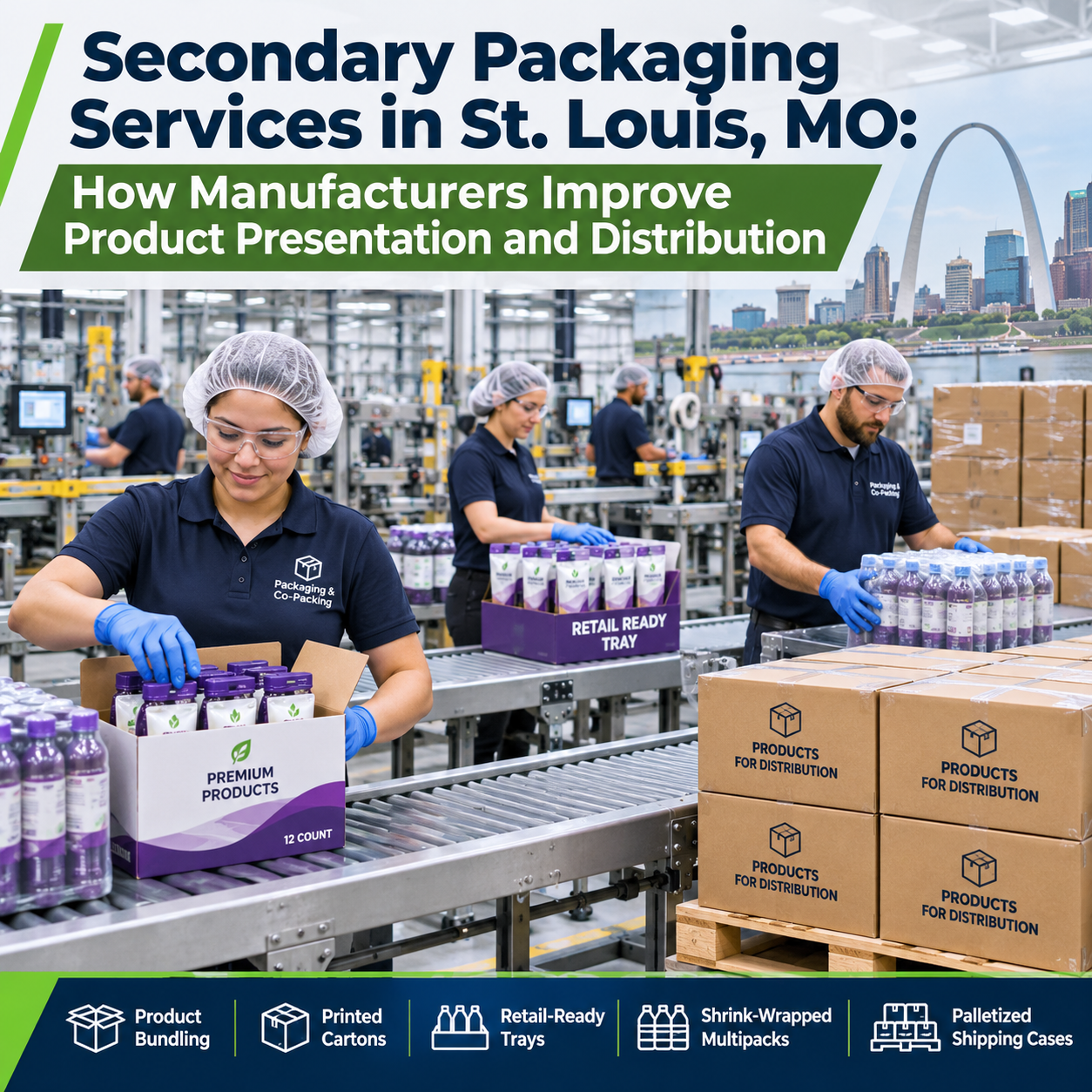
For example, a beverage bottle represents primary packaging, while the printed carton holding multiple bottles is considered secondary packaging.
Other common examples include:
Retail display cartons containing individually packaged products
Multi-pack product bundles
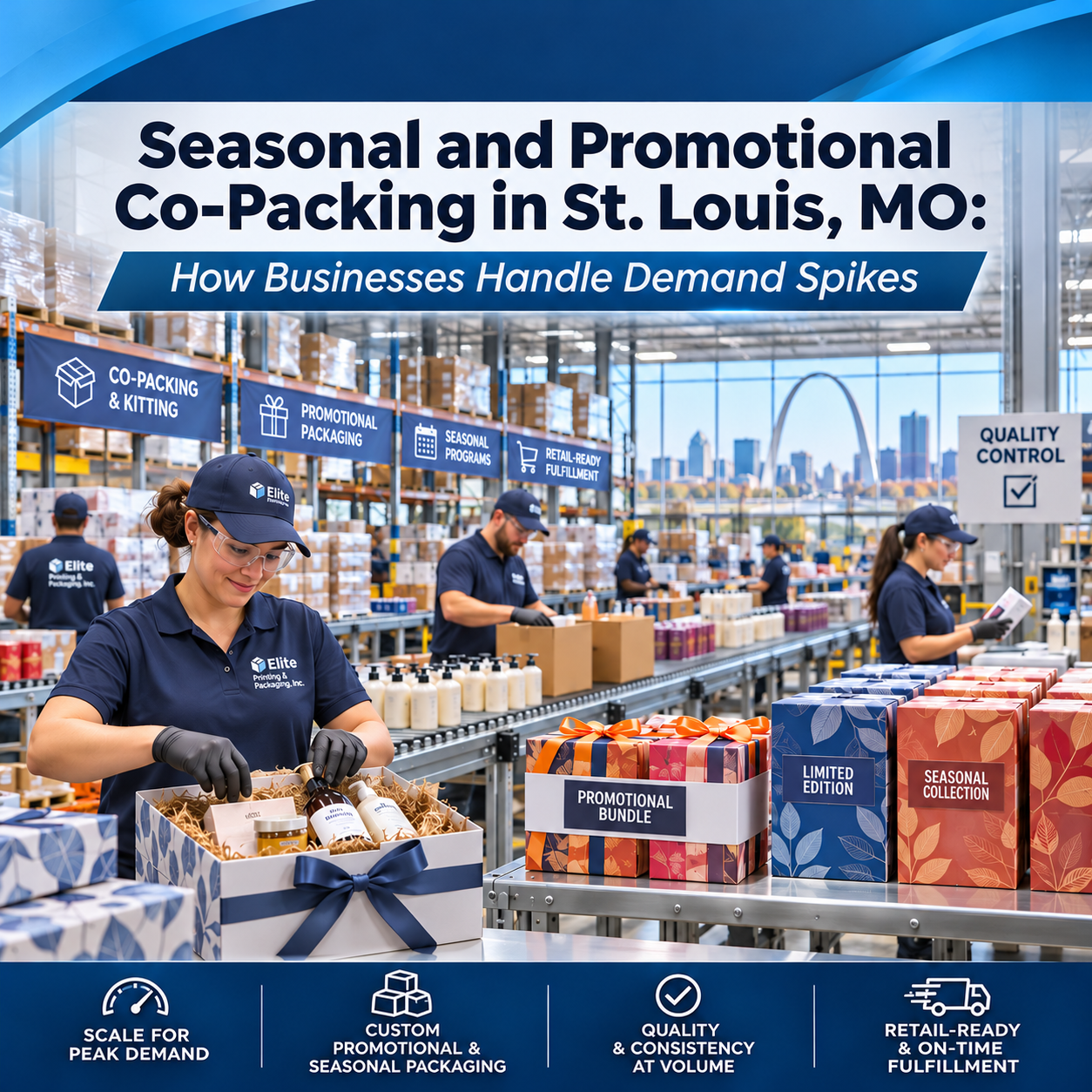
Promotional gift sets and seasonal packaging
Printed cardboard sleeves and outer cartons
Shrink-wrapped product combinations
Corrugated shipping cases containing packaged products
Retail-ready packaging designed for store shelves
Product kits containing multiple individual items
Secondary packaging serves several important functions, including improving product presentation, simplifying inventory management, protecting goods during handling, and preparing products for retail distribution.
For manufacturers in St. Louis, MO, professional secondary packaging services can help bridge the gap between manufacturing and final distribution.
Manufacturers often focus heavily on product development, production efficiency, and quality control. However, the packaging process can become a bottleneck when products need additional preparation before reaching retailers, distributors, or customers.
Effective secondary packaging helps address these challenges.
Packaging is often the first physical interaction customers have with a product.
Even when the product itself is high quality, poorly designed or inconsistent secondary packaging can create a negative impression.
Professional secondary packaging helps manufacturers present products in a more organized, attractive, and recognizable way.
Custom-printed cartons, branded sleeves, retail displays, and promotional bundles can reinforce brand identity while making products stand out in competitive retail environments.
For example, a St. Louis manufacturer launching a new consumer product might use branded multi-pack packaging to communicate product benefits, highlight promotional offers, and create a more cohesive retail presentation.
Secondary packaging also provides additional space for product information, marketing messages, barcodes, and handling instructions.
When executed correctly, packaging becomes an extension of a company’s marketing strategy rather than simply an operational expense.
Distribution efficiency is another major benefit of secondary packaging.
Manufacturers frequently ship products through multiple channels, including wholesale distributors, retail stores, e-commerce fulfillment centers, and regional distribution networks.
Each channel may have different packaging requirements.
Secondary packaging can help standardize how products are grouped, labeled, counted, and transported.
For example, organizing individually packaged products into clearly labeled master cartons can simplify warehouse handling and inventory verification.
Retail-ready cartons can also reduce the amount of unpacking and preparation required when merchandise arrives at a store.
For St. Louis businesses distributing products throughout Missouri, Illinois, and the broader Midwest, consistent secondary packaging can support smoother movement through regional supply chains.
Packaging operations can require significant labor, especially when products need to be assembled into multi-packs, promotional kits, or custom retail configurations.
Manufacturers handling these tasks internally may need additional employees, specialized equipment, warehouse space, and production scheduling.
Outsourcing secondary packaging to a qualified co-packing provider can help reduce these operational pressures.
Instead of diverting manufacturing employees toward packaging activities, businesses can keep their teams focused on core production responsibilities.
A contract packaging partner can handle labor-intensive activities such as product bundling, carton assembly, labeling, and packaging preparation.
This approach may also reduce the need for manufacturers to invest in dedicated equipment for packaging projects that fluctuate throughout the year.
Different products and distribution channels require different packaging configurations.
Understanding the most common secondary packaging services can help manufacturers determine which solutions best fit their operations.
Product bundling involves combining multiple individually packaged items into one sellable unit.
Common applications include beverage multi-packs, personal care product combinations, household product bundles, and promotional retail packages.
Bundling can help manufacturers introduce new product combinations, increase average order value, and simplify inventory handling.
It can also create opportunities for seasonal promotions and retailer-specific product offerings.
Kitting involves assembling multiple products or components into a single package.
Examples include subscription boxes, product sample kits, promotional packages, and multi-component retail products.
Professional co-packing and packaging solutions can help businesses organize these projects while maintaining consistent assembly standards.
For manufacturers managing multiple product variations, outsourced kitting can provide flexibility without disrupting regular production schedules.
Retail-ready packaging is designed to make products easier to stock, display, and sell.
Instead of requiring store employees to unpack individual products and arrange them manually, retail-ready packaging can allow products to move more directly from shipping cartons to store shelves.
Examples include perforated display cartons, shelf-ready trays, and branded counter displays.
This packaging format can be particularly valuable for manufacturers supplying grocery chains, convenience stores, big-box retailers, and specialty retail businesses.
Shrink wrapping is commonly used to secure multiple packaged products together.
It can help maintain product groupings during storage and transportation while providing a clean, organized appearance.
Depending on the product, secondary packaging may also incorporate protective inserts, dividers, corrugated materials, or additional cushioning.
Selecting the appropriate materials is important for minimizing product movement and reducing damage during distribution.
Seasonal promotions often require manufacturers to create limited-edition product combinations or specialized packaging.
Holiday gift sets, promotional bundles, and retail marketing campaigns may involve packaging requirements that differ significantly from standard production.
Outsourced secondary packaging can help manufacturers manage these projects without permanently expanding internal packaging operations.
For St. Louis manufacturers experiencing seasonal demand fluctuations, flexible co-packing support can be particularly valuable.
Secondary packaging influences multiple stages of the supply chain, from finished production to retail delivery.
When packaging configurations are standardized and properly managed, manufacturers can improve product handling, inventory visibility, and shipping preparation.
Grouping products into consistent packaging units makes inventory easier to count, store, and track.
Clearly labeled cartons can communicate product quantities, SKU information, lot identification, and other important handling details.
This organization helps warehouse teams verify shipments and identify products more efficiently.
It can also support inventory accuracy when products move between manufacturers, third-party logistics providers, and distribution centers.
Packaging dimensions affect how efficiently products can be stored and transported.
Poorly sized cartons may create unnecessary empty space, while inconsistent package dimensions can complicate pallet stacking.
Thoughtfully designed secondary packaging can help manufacturers improve carton configurations and pallet utilization.
For businesses shipping large volumes of products, even modest improvements in packaging efficiency may contribute to lower transportation and storage costs.
Inconsistent product packaging can increase the likelihood of incorrect counts, misplaced inventory, and shipment preparation mistakes.
Standardized packaging processes help establish consistent procedures for product grouping, labeling, and final inspections.
Quality checks during secondary packaging can also identify incorrect configurations before products enter distribution.
Although packaging cannot eliminate every supply chain issue, a structured process can help reduce preventable errors.
Many manufacturers eventually reach a point where handling secondary packaging internally becomes inefficient.
Production facilities may lack sufficient space, labor availability, or equipment to manage expanding packaging requirements.
Partnering with a local contract packaging provider offers several potential advantages.
Demand for packaging services can fluctuate based on seasonal promotions, new product launches, and changes in customer orders.
Outsourcing allows manufacturers to access additional packaging capacity without necessarily expanding their permanent workforce or facility footprint.
This flexibility can be particularly useful for businesses managing unpredictable production volumes.
Managing packaging internally often involves coordinating employees, materials, equipment, scheduling, and quality control.
A secondary packaging partner can take responsibility for defined packaging activities, helping manufacturers simplify their operations.
Clear project specifications and communication remain essential, but outsourcing can reduce the number of packaging tasks that production managers must coordinate directly.
When secondary packaging is integrated into a well-organized production and fulfillment workflow, manufacturers may be able to prepare finished products for distribution more efficiently.
This can be especially important for time-sensitive retail promotions and product launches.
A reliable packaging provider should establish realistic production timelines, maintain quality standards, and coordinate packaging requirements with distribution schedules.
Working with a packaging provider in the St. Louis metropolitan area may reduce transportation distances for regional manufacturers.
Local partnerships can also make communication, production coordination, and project oversight more convenient.
St. Louis offers access to major transportation corridors, including Interstate 70, Interstate 64, Interstate 44, and Interstate 55.
For manufacturers distributing products throughout the Midwest, this regional connectivity can support efficient logistics planning.
However, the actual benefits depend on facility locations, shipment volumes, transportation arrangements, and distribution destinations.
Understanding the different packaging levels helps manufacturers select the right solutions for their products.
Packaging type | Primary purpose | Common examples |
|---|---|---|
Primary packaging | Contains and directly protects the product | Bottles, jars, pouches, individual wrappers |
Secondary packaging | Groups, presents, and organizes packaged products | Multi-pack cartons, display boxes, retail bundles |
Tertiary packaging | Supports bulk handling, storage, and transportation | Pallets, stretch wrap, bulk shipping units |
These packaging levels work together to protect products and support efficient distribution.
For example, a manufacturer might fill individual bottles, group them into branded cartons, and then arrange those cartons on stretch-wrapped pallets for shipment.
Each stage serves a distinct purpose.
Manufacturers that coordinate all three levels can create a more consistent packaging and distribution process.
Secondary packaging is used across a wide range of industries throughout St. Louis and the surrounding region.
Food and beverage manufacturers frequently use secondary packaging for multi-packs, retail displays, promotional combinations, and distribution cartons.
Packaging must be appropriate for the products and comply with applicable handling and labeling requirements.
Cosmetics, skincare products, and personal care manufacturers often rely on attractive secondary packaging to improve retail presentation.
Gift sets, promotional bundles, and branded cartons are common applications.
Manufacturers of household products, cleaning supplies, and everyday consumer merchandise use secondary packaging to group products and prepare them for retail distribution.
Online retailers and subscription businesses may require kitting, product assembly, branded cartons, and specialized packaging configurations.
Secondary packaging can help maintain a consistent customer experience while simplifying order preparation.
Manufacturers of industrial components and commercial supplies may use secondary packaging to organize parts, protect individually packaged items, and improve inventory handling.
The appropriate packaging method depends on product characteristics, handling conditions, and customer requirements.
Selecting the right secondary packaging provider requires more than comparing prices.
Manufacturers should evaluate whether a potential partner can consistently meet their operational and distribution requirements.
Important considerations include:
Packaging capabilities: Can the provider accommodate your specific product configurations, quantities, and materials?
Quality control: What procedures are used to verify product counts, labels, assembly accuracy, and finished packaging?
Production flexibility: Can the provider handle seasonal fluctuations or changing order volumes?
Project communication: Will you receive clear timelines, expectations, and updates?
Distribution requirements: Can the packaging process support the specifications established by your retailers or distributors?
Cost transparency: Are labor, materials, setup, storage, and other applicable charges clearly explained?
Manufacturers should also discuss project lead times, minimum quantities, packaging materials, and any product-specific compliance requirements before selecting a provider.
A strong secondary packaging relationship should support both current operational needs and future business growth.
For manufacturers seeking secondary packaging services in St. Louis, MO, finding a dependable local partner can simplify the process of preparing products for market.
Elite Printing & Packaging, Inc. serves businesses seeking packaging-related solutions, including co-packing support.
Manufacturers evaluating Elite for a secondary packaging project can discuss their specific requirements, such as product quantities, packaging configurations, labeling needs, production timelines, and distribution objectives.
Whether your business is preparing products for a retail promotion, exploring outsourced product bundling, or looking for ways to streamline packaging operations, a project-specific consultation can help determine the appropriate approach.
Rather than treating packaging as an afterthought, manufacturers can incorporate secondary packaging into their broader production and distribution strategies.
Visit Elite Printing & Packaging, Inc. to learn more about the company and discuss your packaging needs.
Secondary packaging groups, organizes, protects, and presents products that are already enclosed in primary packaging. It helps manufacturers prepare products for retail display, warehouse handling, and distribution.
Secondary packaging describes a specific level of packaging, while co-packing refers to outsourcing packaging-related activities to a third-party provider. Co-packing services may include secondary packaging, bundling, kitting, labeling, and other product preparation tasks.
Yes, in some cases. Proper carton sizing, efficient product grouping, and improved pallet configurations can reduce wasted space and improve transportation efficiency. Actual savings depend on product dimensions, shipping volumes, and logistics arrangements.
Manufacturers, consumer packaged goods companies, food and beverage businesses, health and beauty brands, e-commerce retailers, and industrial suppliers commonly use secondary packaging.
Look for a local contract packaging or co-packing company that can accommodate your product requirements, order volumes, quality standards, and distribution needs. Request a detailed project evaluation before committing to a packaging partner.
Secondary packaging is an essential part of modern manufacturing and distribution.
From creating attractive retail displays to organizing products for shipment, effective secondary packaging helps businesses improve product presentation, streamline operations, and prepare goods for the marketplace.
For St. Louis manufacturers, outsourcing these activities can provide additional flexibility while reducing the operational burden of managing packaging in-house.
As product demand grows and distribution requirements become more complex, choosing the right packaging partner becomes increasingly important.
Looking for secondary packaging services in St. Louis, MO?

Bring your vision to life with custom flexible packaging, labels, and retail-ready design.

Premium materials and finishes that elevate your brand.

Efficient, compliant, and versatile co-packing for pet and human products.

From warehouse to doorstep — done right, every time.
Bring your vision to life with custom flexible packaging, labels, and retail-ready design.
Premium materials and finishes that elevate your brand.
Efficient, compliant, and versatile co-packing for pet and human products.
From warehouse to doorstep — done right, every time.