

Seasonal demand can create tremendous growth opportunities for manufacturers, retailers, and consumer product brands. However, when orders suddenly increase during the holidays, promotional campaigns, product launches, or major retail events, businesses often discover that their existing packaging operations cannot keep up.
What happens when a company that typically processes 5,000 units per week suddenly needs to package 25,000 units in the same timeframe?
For many businesses, the answer involves seasonal and promotional co-packing services in St. Louis, MO.
Rather than investing in additional equipment, expanding warehouse space, or hiring temporary employees, businesses can partner with an experienced co-packing company to manage fluctuating packaging demands efficiently.
At Elite Printing & Packaging, Inc., businesses can explore flexible packaging solutions designed to support changing production requirements, promotional campaigns, and seasonal increases in demand.
Understanding how seasonal co-packing works can help companies prepare for peak periods, reduce operational bottlenecks, and maintain product quality without unnecessary overhead.
Seasonal co-packing refers to outsourcing packaging operations during periods when product demand increases beyond normal production capacity.
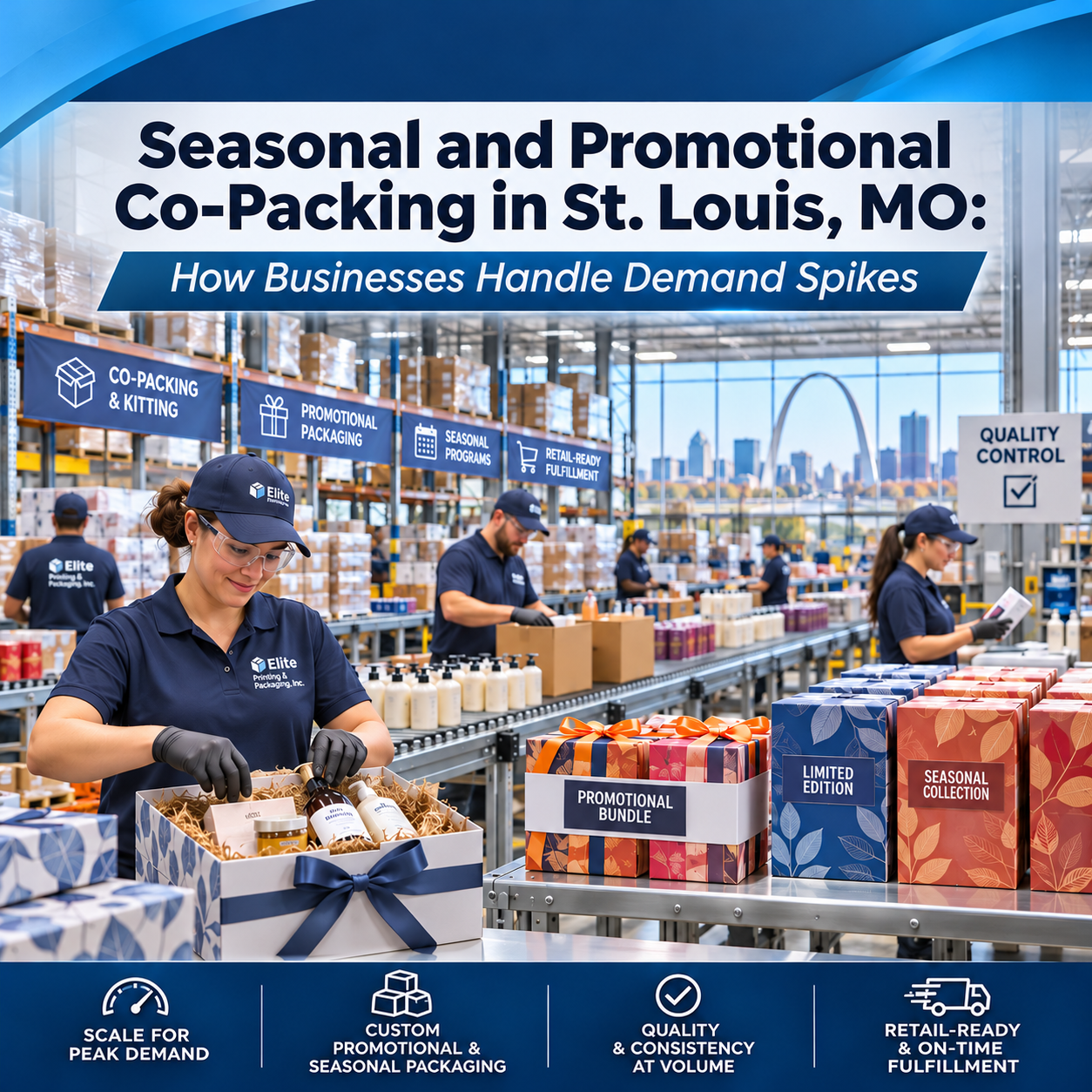
Promotional co-packing focuses on preparing products for marketing campaigns, special retail promotions, limited-time offers, and other sales initiatives.
Both services help businesses respond to changing market conditions without permanently expanding their internal packaging infrastructure.
Common seasonal and promotional co-packing services include:
Product kitting and assembly
Promotional product bundling
Holiday gift set packaging
Retail display preparation
Custom labeling and relabeling
Shrink wrapping and protective packaging
Subscription box assembly
Multipack packaging
Product sorting and repackaging
Retail-ready packaging preparation
For companies operating throughout St. Louis, St. Charles, Chesterfield, Maryland Heights, and surrounding Missouri communities, working with a regional co-packing provider can simplify coordination and improve visibility throughout the packaging process.
The primary advantage is flexibility: businesses can increase packaging capacity when demand rises without maintaining those additional resources throughout the entire year.
Demand spikes can happen quickly, particularly when businesses introduce new products, launch promotions, or prepare for major retail shopping periods.
Although increased sales are generally positive, rapid growth can expose weaknesses in packaging operations.
Manufacturers often design their packaging operations around average production volumes.
When demand suddenly doubles or triples, existing packaging lines may struggle to keep up.
This creates bottlenecks that can delay shipments and disrupt relationships with distributors and retailers.
For example, a St. Louis consumer goods manufacturer might have sufficient production capacity to manufacture additional inventory but lack the personnel or packaging equipment necessary to prepare products for distribution.
A seasonal co-packing partner can help bridge that gap by handling packaging tasks outside the manufacturer’s normal operations.
Hiring additional employees for short-term packaging projects can be expensive and time-consuming.
Businesses must recruit, onboard, train, and supervise temporary workers, sometimes for projects lasting only a few weeks.
When the seasonal rush ends, the need for additional employees disappears.
Outsourcing packaging to an established co-packing company reduces the need to build a temporary internal workforce.
Seasonal packaging operations frequently require additional space for incoming products, packaging materials, assembly stations, and completed orders.
Companies operating near full warehouse capacity may find it difficult to accommodate these requirements.
Working with a contract packaging provider can help reduce pressure on existing facilities by moving eligible packaging activities to an external operation.
Retailers and distributors frequently establish strict delivery schedules for promotional merchandise.
Missing a deadline can mean missing an entire selling opportunity.
Holiday products arriving after the holiday, for example, may lose much of their commercial value.
Professional co-packing services help businesses develop packaging schedules that align with important promotional and distribution deadlines.
Seasonal co-packing provides businesses with an adaptable approach to packaging operations.
Instead of managing every production increase internally, companies can outsource specific packaging activities based on project requirements.
One of the most valuable benefits of outsourced packaging is the ability to adjust capacity according to demand.
A business may require additional packaging support for only six weeks during the holiday season or several months during a major retail promotion.
A co-packing partner can evaluate the project and determine an appropriate combination of personnel, equipment, workflows, and production scheduling.
This approach allows businesses to scale packaging activity without committing to permanent infrastructure expansion.
During peak seasons, packaging speed directly affects how quickly products reach retailers and customers.
Co-packing companies can organize workflows around specific packaging requirements, including product assembly, labeling, bundling, and carton preparation.
By assigning these activities to a dedicated packaging operation, manufacturers can keep their internal teams focused on core production responsibilities.
Seasonal packaging projects often involve multiple moving parts.
Products must arrive on schedule, packaging materials must be available, instructions must be followed, and finished goods must meet customer requirements.
An experienced co-packing partner helps coordinate these activities through defined procedures and production planning.
This can reduce the operational burden placed on internal manufacturing, warehouse, and logistics teams.
Expanding internal packaging capacity often involves significant upfront expenses.
Businesses may need to purchase equipment, lease space, hire additional employees, or pay overtime.
Outsourced co-packing converts many of these requirements into project-based expenses.
Although actual costs depend on product complexity, quantities, materials, and labor requirements, businesses can compare co-packing proposals against the full cost of performing the work internally.
Different industries experience demand spikes at different times of the year.
Seasonal and promotional co-packing services can support a wide range of product categories and marketing initiatives.
The holiday shopping season is one of the busiest periods for retailers and consumer product manufacturers.
Businesses frequently introduce gift sets, multipacks, and limited-edition product combinations designed to increase average order values.
These projects often require assembling several individual products into one retail-ready package.
For example, a company selling personal care products might combine shampoo, conditioner, and styling products into a single holiday gift set.
A co-packing provider can assist with organizing, assembling, labeling, and preparing these bundles for distribution.
Marketing campaigns frequently require customized packaging configurations.
Examples include buy-one-get-one promotions, bonus product offers, limited-edition bundles, and special promotional packs.
These campaigns may require products to be combined, relabeled, shrink-wrapped, or packaged in custom cartons.
Promotional co-packing allows companies to execute these initiatives without disrupting their regular packaging lines.
Back-to-school promotions create significant seasonal demand for educational supplies, office products, and consumer merchandise.
Retailers may request special product bundles, promotional kits, or display-ready packaging.
St. Louis-area manufacturers and distributors can use co-packing services to prepare merchandise for these seasonal sales periods.
Introducing a new product often creates temporary packaging requirements that differ from normal production.
A company might need 10,000 promotional sample kits assembled for a launch campaign.
Rather than purchasing dedicated equipment for a one-time project, the business can outsource the assembly process.
This approach is particularly valuable when promotional products involve multiple components or customized packaging instructions.
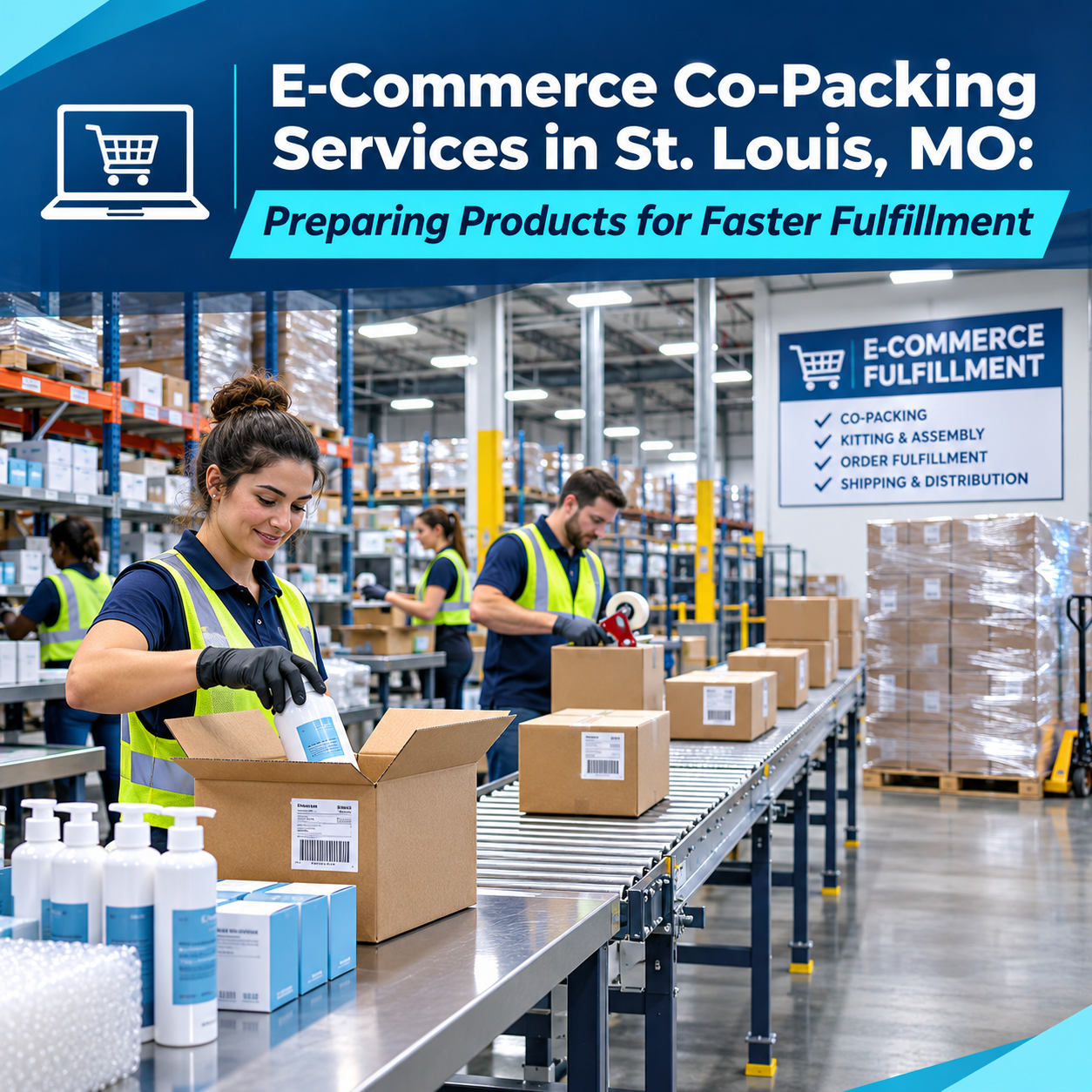
Online retailers experience significant order increases during Black Friday, Cyber Monday, holiday promotions, and flash sales.
These campaigns may require promotional inserts, bundled products, subscription kits, or specially packaged merchandise.
Co-packing can help prepare these products in advance so they are ready for downstream fulfillment operations.
For businesses seeking e-commerce co-packing services in St. Louis, MO, preparing promotional inventory before demand peaks can reduce last-minute packaging pressure.
Kitting and assembly are among the most important components of seasonal co-packing.
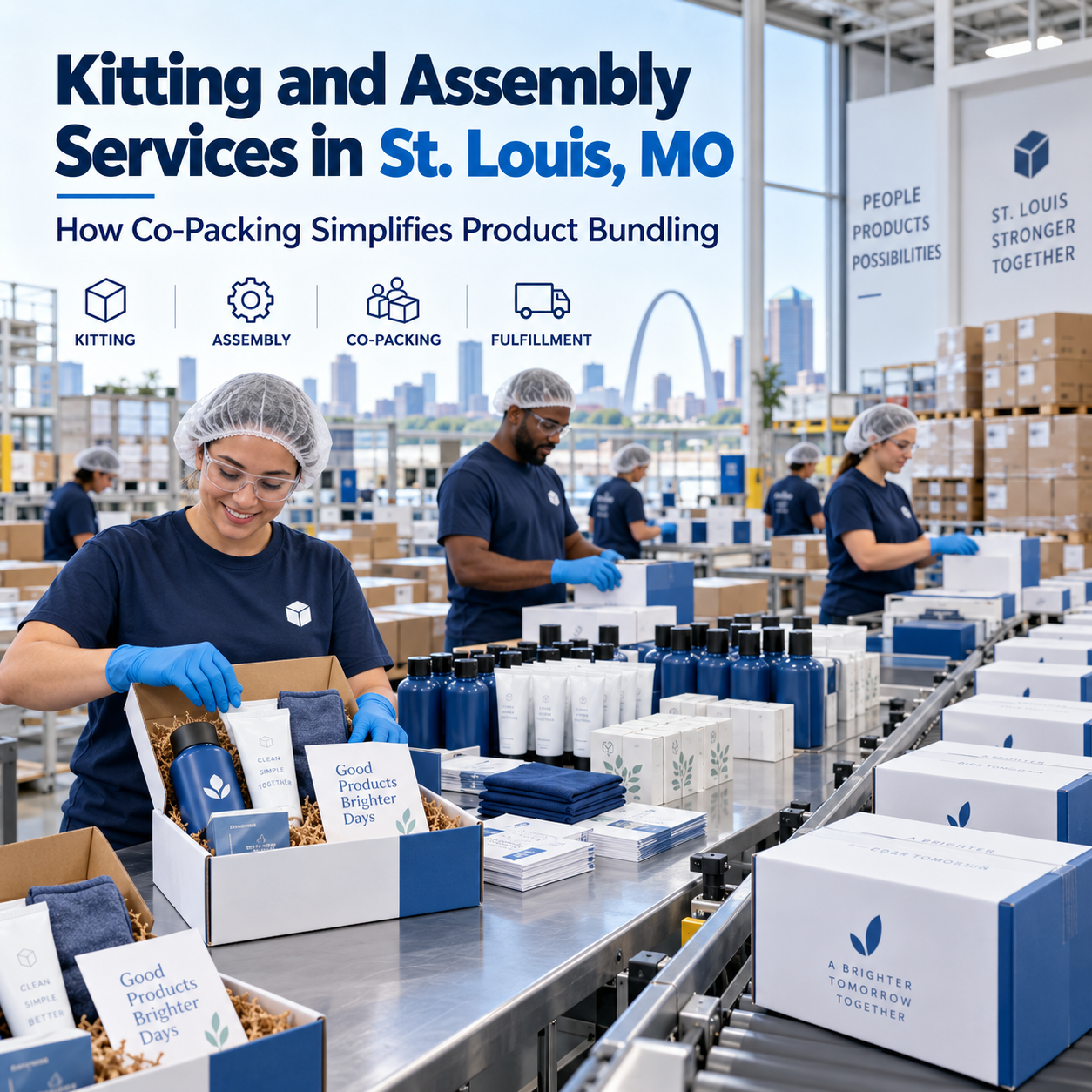
Kitting involves combining multiple individual products into a single package or sellable unit.
Assembly may include folding cartons, inserting products, attaching labels, arranging components, or preparing finished packages.
These processes are especially useful for seasonal promotions because businesses frequently sell products in combinations that differ from their standard inventory.
Consider a hypothetical St. Louis manufacturer preparing 20,000 promotional kits.
Each kit contains three individual products, one printed promotional insert, and a custom carton.
Completing the project internally would require dedicated labor, assembly space, packaging materials, quality checks, and production scheduling.
A co-packing partner can organize these tasks into a structured assembly process.
The result is a more manageable project that allows the manufacturer to concentrate on producing its core products.
One frequently overlooked challenge in seasonal packaging is coordinating printed materials with packaging operations.
Promotional campaigns often require custom labels, printed cartons, inserts, sleeves, and branded packaging components.
When printing and co-packing are managed by separate vendors, businesses may need to coordinate multiple schedules, shipments, and production requirements.
Working with a provider that offers both services can simplify the process.
Potential advantages include:
Better coordination between printed materials and packaging schedules
Fewer handoffs between vendors
Easier communication regarding packaging specifications
More consistent branding across promotional materials
Reduced risk of delays caused by missing printed components
For companies searching for printing and co-packing solutions in St. Louis, Missouri, an integrated service approach can be particularly valuable during time-sensitive seasonal campaigns.
Elite Printing & Packaging, Inc. offers an opportunity for businesses to discuss printing and packaging needs through a coordinated service relationship.
Not every seasonal packaging project requires the same production approach.
Some projects are best suited for manual assembly, while others may benefit from automated packaging equipment.
Manual co-packing is often appropriate for projects involving multiple components, unusual product shapes, customized packaging, or frequent configuration changes.
Examples include promotional gift baskets, subscription boxes, sample kits, and specialty retail bundles.
Manual operations can provide flexibility when products require careful placement or individualized assembly instructions.
Automated packaging can be beneficial for high-volume projects involving consistent product sizes and standardized packaging configurations.
Depending on available equipment, automation may support repetitive processes such as wrapping, labeling, sealing, or carton preparation.
However, automation is not automatically the best option for every seasonal project.
Setup requirements, production quantities, product characteristics, and project deadlines all influence the decision.
Businesses should evaluate the following factors before selecting a packaging method: project volume, product complexity, packaging specifications, required turnaround time, available equipment, and total project cost.
In some cases, combining manual assembly with automated packaging processes offers the most practical solution.
Successful seasonal packaging requires preparation well before the first products arrive at the packaging facility.
Businesses that plan early generally have more flexibility when coordinating materials, production schedules, and distribution requirements.
Start by reviewing historical sales, promotional performance, retailer commitments, and expected customer demand.
Develop realistic estimates for packaging quantities and identify possible high-demand scenarios.
For example, a business might forecast 15,000 promotional units but plan for the possibility of needing 20,000.
This allows packaging partners to evaluate potential capacity requirements in advance.
Clear packaging instructions are essential for maintaining consistency.
Specifications should identify product quantities, packaging materials, labeling requirements, assembly procedures, and quality expectations.
Providing sample packages or approved prototypes can help establish a common understanding of the finished product.
Even the most efficient packaging operation cannot meet deadlines if products or packaging components arrive late.
Businesses should confirm the availability of cartons, labels, inserts, shrink film, and other required materials.
Inventory delivery schedules should align with the agreed production timeline.
Rather than relying on a single final deadline, create milestones for material delivery, production startup, quality approval, completion, and shipment.
This makes it easier to identify potential delays before they affect the entire project.
Seasonal demand should never come at the expense of product quality.
Businesses should establish inspection criteria and communicate acceptable tolerances, packaging requirements, and labeling specifications.
Quality control procedures help reduce the risk of incorrect bundles, damaged packaging, or inconsistent presentation.
Once the promotional period ends, evaluate project performance.
Important metrics may include packaging cost per unit, completed quantities, production accuracy, turnaround time, and delivery performance.
These insights can help improve planning for future seasonal campaigns.
Choosing a regional co-packing partner can offer practical advantages for businesses throughout the Greater St. Louis metropolitan area.
Working with a nearby packaging company can make it easier to schedule facility visits, review packaging samples, and communicate project changes.
For time-sensitive promotional campaigns, direct communication can be especially valuable.
St. Louis occupies a strategic position in the Midwest, with access to major interstate highways and regional distribution networks.
Businesses serving customers throughout Missouri, Illinois, and neighboring states may benefit from coordinating packaging operations within this region.
Actual transportation savings depend on supplier locations, shipping destinations, freight arrangements, and project requirements.
Promotional campaigns do not always proceed exactly as planned.
Retailers may adjust quantities, marketing teams may revise packaging requirements, or unexpected demand may create additional orders.
A local packaging partner can make communication and coordination more convenient when changes arise.
However, additional production capacity and expedited turnaround times should always be confirmed before making commitments to customers.
Not every contract packaging provider is equipped to handle every promotional project.
Before selecting a partner, businesses should evaluate several important considerations.
Experience with similar packaging projects: Ask whether the company has handled comparable products, packaging configurations, or promotional volumes.
Production capacity and scheduling: Determine whether the provider can accommodate the required quantities within the available timeframe.
Quality control procedures: Discuss how packaging accuracy, product handling, and finished goods inspections are managed.
Printing and packaging capabilities: Evaluate whether the company can help coordinate labels, printed inserts, cartons, and other packaging components.
Transparent project pricing: Request a detailed estimate covering labor, materials, setup requirements, and any additional services.
Communication and responsiveness: Choose a partner that provides clear expectations regarding project timelines, responsibilities, and potential challenges.
The best co-packing relationship is not necessarily the one with the lowest quoted price. It is the one that provides the right combination of reliability, flexibility, quality, and operational value.
Seasonal co-packing involves outsourcing packaging activities during periods of increased demand, such as holidays, retail promotions, and special product launches. It allows businesses to access additional packaging capacity without permanently expanding internal operations.
Businesses should begin planning several weeks or months before major seasonal campaigns, depending on project complexity, material lead times, and production volume. Holiday packaging projects may require particularly early coordination.
Some co-packing companies accommodate smaller projects, while others focus on larger production volumes. Minimum order quantities and project requirements vary by provider.
Consumer goods manufacturers, retailers, e-commerce brands, distributors, and businesses launching promotional products can benefit from outsourced packaging services.
Seasonal co-packing may reduce expenses associated with temporary labor, equipment purchases, overtime, and facility expansion. Actual savings depend on project specifications, volume, and the provider’s pricing structure.
Businesses searching for seasonal co-packing, promotional packaging, and contract packaging services in the St. Louis area can contact Elite Printing & Packaging, Inc. to discuss their packaging requirements and available solutions.
Seasonal demand spikes can create significant opportunities for business growth, but only when packaging operations are prepared to respond.
Whether your company is preparing holiday gift sets, launching a promotional campaign, assembling product bundles, or managing increased retail demand, having the right co-packing partner can make a meaningful difference.
By outsourcing seasonal packaging activities, businesses can reduce pressure on internal operations, improve production planning, and maintain consistent packaging standards during busy periods.
For manufacturers, retailers, and growing brands throughout St. Louis, Missouri, flexible co-packing solutions can provide the operational support needed to navigate changing demand.
Don’t let packaging bottlenecks slow down your next seasonal promotion.
Contact Elite Printing & Packaging, Inc. to discuss your upcoming seasonal or promotional packaging project and discover how the right co-packing solution can help your business prepare for increased demand.

Bring your vision to life with custom flexible packaging, labels, and retail-ready design.

Premium materials and finishes that elevate your brand.

Efficient, compliant, and versatile co-packing for pet and human products.

From warehouse to doorstep — done right, every time.
Bring your vision to life with custom flexible packaging, labels, and retail-ready design.
Premium materials and finishes that elevate your brand.
Efficient, compliant, and versatile co-packing for pet and human products.
From warehouse to doorstep — done right, every time.