
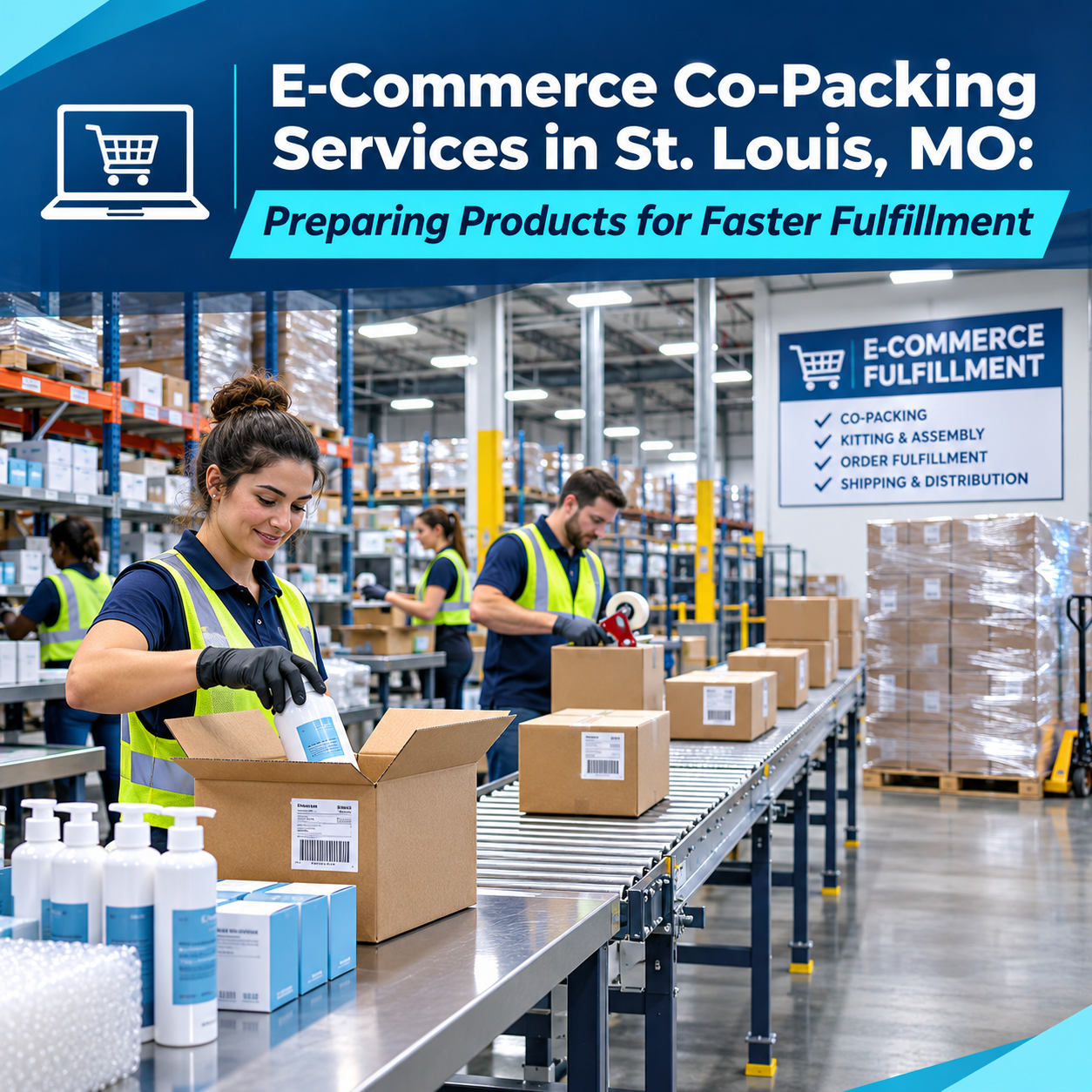


The rapid growth of e-commerce has transformed how businesses package, prepare, and distribute their products. Today’s online shoppers expect fast shipping, accurate orders, secure packaging, and a seamless delivery experience. For growing brands, meeting these expectations while controlling operational costs can become increasingly challenging.
That’s where e-commerce co-packing services in St. Louis, MO can make a significant difference.
Instead of managing every aspect of product preparation internally, businesses can partner with an experienced co-packing company to streamline packaging operations, improve efficiency, and prepare products for faster fulfillment.
From product kitting and assembly to labeling, bundling, and retail-ready packaging, co-packing services help businesses eliminate unnecessary bottlenecks before products enter the fulfillment process.
For companies operating in Missouri and throughout the Midwest, working with a regional packaging partner offers additional advantages, including improved coordination, shorter transportation distances, and greater supply chain flexibility.
At Elite Printing & Packaging, Inc., located in Hazelwood, Missouri, we understand that efficient packaging is an essential component of successful product distribution. By combining packaging expertise with customized solutions, we help businesses prepare their products for the demands of modern commerce.
Let’s explore how e-commerce co-packing works, why it matters, and how St. Louis businesses can leverage these services to support faster, more efficient fulfillment.
E-commerce co-packing, short for contract packaging, involves outsourcing specific packaging and product preparation activities to a specialized third-party provider.
Rather than investing in additional equipment, warehouse space, and internal labor, businesses work with a co-packing partner to prepare products according to their operational requirements.
These services are particularly valuable for companies that sell products through online marketplaces, direct-to-consumer websites, subscription services, and omnichannel retail operations.
Common e-commerce co-packing services include:
Product kitting and assembly: Combining multiple individual products into a single packaged unit.
Product bundling: Creating promotional packages, multipacks, and special product combinations.
Labeling and relabeling: Applying product labels, barcodes, and identification information.
Custom packaging: Preparing products using branded boxes, inserts, sleeves, and other packaging materials.
Shrink wrapping and protective packaging: Securing products for handling, storage, and transportation.
Retail-ready packaging: Preparing products for distribution through retail and e-commerce channels.
Quality control inspections: Checking packaging accuracy, presentation, and product preparation before shipment.
By outsourcing these processes, businesses can concentrate on marketing, product development, customer acquisition, and other revenue-generating activities.
More importantly, products can arrive at fulfillment facilities properly packaged, organized, and ready for the next stage of distribution.
When businesses think about faster e-commerce fulfillment, they often focus on shipping carriers, warehouse automation, and delivery speeds.
However, fulfillment efficiency begins long before a customer clicks the checkout button.
Products must first be properly packaged, labeled, organized, and prepared for inventory management.
If these processes are inefficient, even a well-managed fulfillment center can experience delays.
For example, imagine an e-commerce brand selling bundled skincare products. Each order requires three individual items, a promotional insert, branded packaging, and a barcode label.
If warehouse employees must assemble these components after receiving each customer order, the process can create unnecessary labor requirements and slow order processing.
Now imagine those same products arriving at the fulfillment center as completed, preassembled kits.
Instead of assembling each bundle individually, warehouse employees can select the finished product and prepare it for shipment.
This simple operational change can reduce handling requirements, improve consistency, and support faster order processing.
The key advantage of e-commerce co-packing is that it moves time-consuming packaging activities upstream, allowing fulfillment operations to focus on shipping orders rather than assembling products.
Packaging bottlenecks occur when products cannot move efficiently through the supply chain because they require additional preparation.
These delays frequently involve manual assembly, labeling, repackaging, or sorting.
For growing e-commerce brands, packaging bottlenecks can become particularly problematic during seasonal demand increases.
A professional St. Louis co-packing company can help address these challenges by establishing repeatable packaging workflows.
Instead of requiring fulfillment employees to complete packaging tasks individually, products can be prepared in larger batches before entering the distribution process.
This approach helps businesses maintain more predictable workflows and reduces the number of tasks required during order fulfillment.
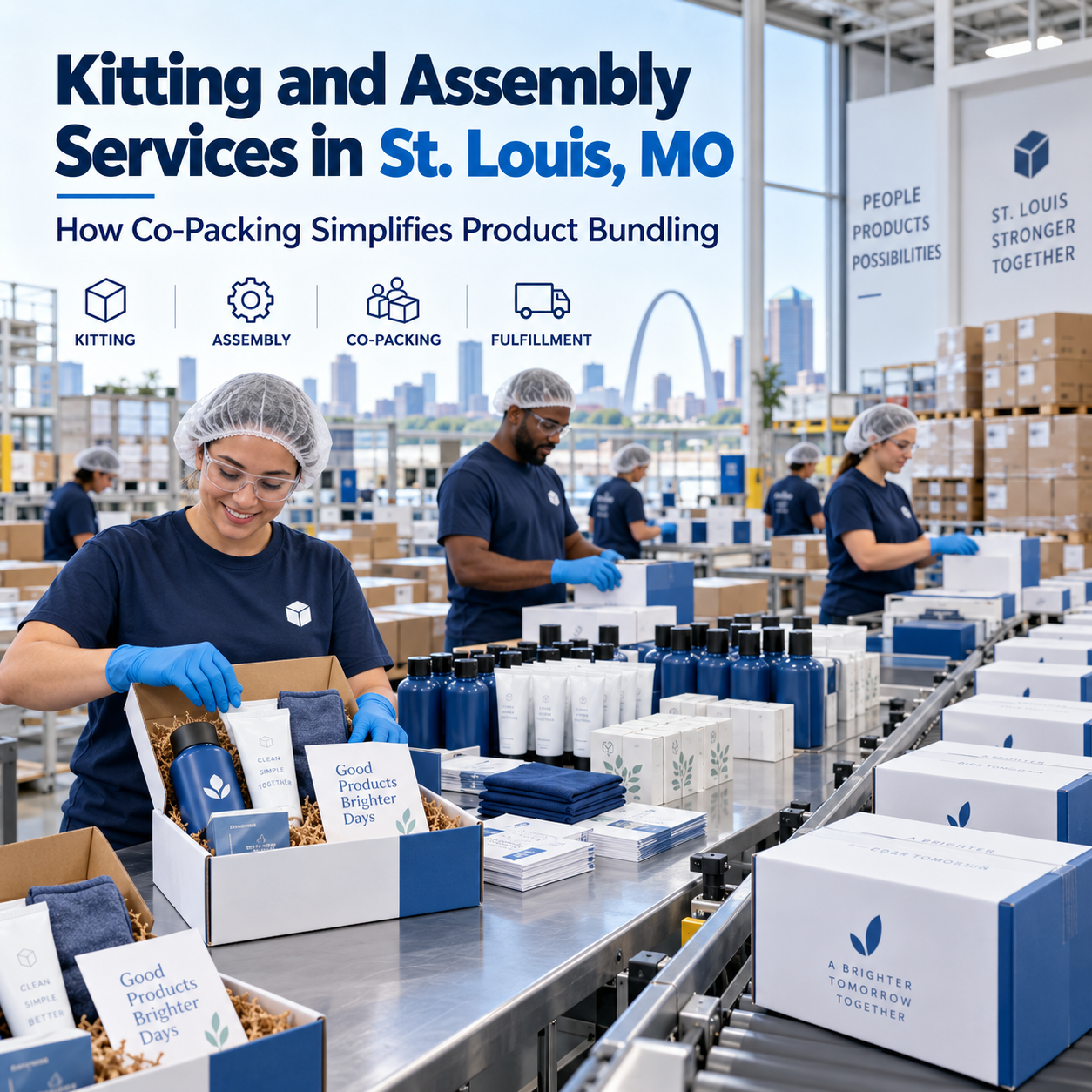
Product kitting is one of the most valuable services for e-commerce businesses offering bundled products.
Kitting involves combining multiple products or components into one finished unit.
Examples include subscription boxes, promotional gift sets, starter kits, sample collections, and seasonal product bundles.
For businesses selling these combinations online, preparing kits in advance can dramatically simplify fulfillment operations.
A properly assembled kit can be assigned a unique SKU, allowing warehouse teams to process it as a single inventory item.
This reduces the need to locate and assemble multiple individual components after an order is placed.
Professional product kitting services in St. Louis, MO can also help businesses maintain consistency across large quantities of bundled products.
Order accuracy is essential to customer satisfaction.
Incorrect product combinations, missing components, damaged packaging, and labeling mistakes can result in returns, customer complaints, and additional operational expenses.
Co-packing providers can incorporate quality control checkpoints throughout the packaging process.
These checkpoints may include verifying product quantities, inspecting packaging materials, confirming barcode placement, and reviewing completed kits.
Standardized procedures help reduce variation between packaged units.
For e-commerce businesses, consistent product preparation can translate into fewer fulfillment complications and a more reliable customer experience.
Managing packaging operations internally requires employees, training, supervision, equipment, and dedicated workspace.
As order volumes increase, businesses may need to hire additional employees or expand existing operations.
These investments can create significant overhead, particularly when demand fluctuates throughout the year.
Outsourcing packaging activities to a contract packaging provider allows businesses to access specialized capabilities without necessarily expanding their internal workforce.
For example, a growing consumer products brand may need thousands of promotional kits assembled for a holiday campaign.
Instead of temporarily hiring and training additional employees, the company can work with a co-packing partner to complete the project.
This flexibility allows internal teams to concentrate on core business activities while packaging specialists handle product preparation.
E-commerce demand is rarely consistent throughout the year.
Black Friday, Cyber Monday, holiday shopping, product launches, and promotional campaigns can create sudden increases in packaging requirements.
Businesses that rely exclusively on internal packaging resources may struggle to respond to these fluctuations.
Co-packing services provide an opportunity to prepare inventory ahead of anticipated demand.
For example, a brand planning a major online promotion can have bundled products assembled and packaged before the campaign begins.
When orders increase, fulfillment teams can process prepared inventory rather than completing additional assembly work.
This approach helps reduce last-minute packaging pressure and supports more efficient promotional execution.
In e-commerce, packaging is often the first physical interaction customers have with a brand.
A poorly packaged product can undermine an otherwise positive purchasing experience.
Conversely, professional packaging can reinforce brand recognition, product quality, and customer confidence.
Co-packing services can help businesses maintain consistent packaging presentation across large production runs.
This may include branded packaging components, promotional inserts, product sleeves, custom labels, and coordinated product bundles.
Consistency is especially important for brands selling through multiple distribution channels.
A standardized packaging process helps ensure customers receive products that reflect the company’s intended brand experience.
E-commerce packaging involves multiple operational stages, including product manufacturing, packaging material procurement, assembly, inventory preparation, and distribution.
When these activities are managed independently, communication gaps and transportation delays can develop.
Working with a regional co-packing provider can simplify coordination between suppliers, packaging operations, and fulfillment partners.
For businesses operating throughout Missouri and the Midwest, St. Louis e-commerce co-packing services provide a strategically located option for preparing products before distribution.
By reducing unnecessary handling and improving communication, businesses can create a more organized product preparation process.
St. Louis offers several geographic and logistical advantages for businesses seeking regional packaging support.
Located near the center of the United States, the St. Louis metropolitan area provides access to major interstate highways, rail networks, freight transportation infrastructure, and regional distribution facilities.
These connections make the region an attractive location for manufacturers, distributors, and consumer products companies serving markets throughout the Midwest and beyond.
St. Louis connects to major transportation corridors, including Interstates 70, 44, 55, and 64.
This infrastructure supports the movement of products between manufacturing facilities, packaging providers, distribution centers, and shipping networks.
For businesses transporting products to fulfillment centers, geographic proximity and efficient transportation routes can help reduce unnecessary logistical complexity.
Missouri and neighboring Midwestern states support a diverse manufacturing economy.
Businesses producing consumer goods, household products, promotional merchandise, and other packaged items may benefit from working with a nearby co-packing provider.
Regional partnerships can make it easier to coordinate packaging specifications, production schedules, and inventory preparation.
Working with a local packaging partner can also simplify communication.
When necessary, businesses may be able to arrange facility visits, review packaging samples, discuss production requirements, and resolve operational questions more efficiently.
For companies seeking co-packing services in Hazelwood, MO, or the greater St. Louis area, a regional partner can provide a practical alternative to managing packaging projects across multiple distant locations.
Although co-packing and order fulfillment are closely related, they serve different purposes.
Understanding the distinction helps businesses determine which services they need.
E-Commerce Co-Packing | Order Fulfillment |
|---|---|
Product assembly and kitting | Customer order processing |
Bundling and multipack preparation | Picking products from inventory |
Product labeling and relabeling | Packing customer orders |
Custom packaging preparation | Shipping label generation |
Packaging quality inspections | Carrier handoff and delivery coordination |
Preparing inventory for distribution | Returns processing, when offered |
Co-packing focuses primarily on preparing products for distribution, while fulfillment focuses on processing and shipping customer orders.
Some logistics providers offer both capabilities, but businesses should confirm exactly which services are available.
For example, a co-packing company may assemble 10,000 promotional kits, while a separate fulfillment provider stores those kits and ships individual orders as customers make purchases.
When these operations are properly coordinated, businesses can improve overall supply chain efficiency.
Co-packing is not limited to large manufacturers or established consumer brands.
Businesses of different sizes can benefit from outsourcing product preparation activities.
DTC businesses often rely on distinctive packaging to create memorable customer experiences.
Co-packing services can support branded product bundles, promotional inserts, and consistent packaging presentation.
Subscription businesses frequently require multiple products to be assembled into recurring monthly or quarterly packages.
Outsourcing assembly can help simplify these repetitive packaging operations.
CPG companies may require multipacks, promotional combinations, product relabeling, or packaging modifications for different sales channels.
Co-packing allows businesses to adapt packaging configurations without necessarily changing their core manufacturing operations.
Businesses selling through online marketplaces may need products prepared according to specific labeling, packaging, and identification requirements.
A qualified co-packing partner can help complete applicable preparation tasks before inventory is transferred to a marketplace fulfillment network.
However, sellers should verify current marketplace requirements and confirm that their packaging provider can meet them.
Promotional merchandise businesses frequently manage projects involving multiple products, branded materials, and customized packaging.
Co-packing can simplify assembly while helping maintain consistent presentation across large quantities.
Not every packaging provider offers the same capabilities.
Selecting the right partner requires evaluating more than price alone.
Businesses should consider several important factors.
Packaging capabilities: Determine whether the provider can handle the required kitting, bundling, assembly, labeling, or custom packaging processes.
Production capacity: Confirm that the provider can accommodate expected order volumes and anticipated seasonal fluctuations.
Quality control procedures: Ask how packaged products are inspected and how errors are identified and corrected.
Communication and project management: Look for a provider that establishes clear expectations, production timelines, and communication procedures.
Packaging material coordination: Determine whether the company can assist with packaging components, printed materials, and related production requirements.
Location and logistics: Consider the provider’s proximity to manufacturing facilities, warehouses, and distribution partners.
Pricing transparency: Request a detailed quotation that explains labor, materials, setup fees, minimum quantities, and additional services.
The best co-packing relationship should help simplify operations rather than introduce additional complexity.
One often-overlooked opportunity in e-commerce packaging is the ability to coordinate printing and packaging operations.
Many products require printed components such as labels, inserts, sleeves, promotional materials, or branded packaging elements.
When printing and co-packing are managed through separate vendors, businesses may face additional coordination requirements.
Packaging materials must arrive at the correct location, meet production specifications, and be available before assembly begins.
A provider that can coordinate printing and packaging services may help streamline this process.
For example, a consumer products company launching a promotional bundle may require printed inserts, custom labels, and product assembly.
Coordinating these activities through one packaging partner can reduce the number of vendor relationships involved and simplify project communication.
For growing brands, this integrated approach can support more predictable packaging schedules and consistent presentation.
Before outsourcing packaging operations, businesses should clearly define their project requirements.
Start by identifying the products that require assembly, bundling, labeling, or packaging modifications.
Next, document the packaging specifications for each product.
These specifications should include product quantities, packaging dimensions, labeling requirements, component lists, and quality expectations.
Businesses should also estimate anticipated production volumes and determine when finished products must be available for distribution.
For recurring projects, establishing a consistent packaging process can help improve planning and reduce unnecessary changes between production runs.
Finally, communicate fulfillment requirements to the co-packing provider.
If finished products will be transferred to a third-party logistics company, retailer, or marketplace fulfillment center, the packaging specifications should account for the receiving requirements of that destination.
Proper planning helps ensure products move smoothly from packaging into the next stage of the supply chain.
Businesses should evaluate their packaging operations using measurable performance indicators.
Important metrics may include:
Packaging turnaround time: How long it takes to complete a defined packaging project.
Cost per finished unit: The total packaging expense divided by completed units.
Packaging accuracy: The percentage of units that meet specifications without requiring corrections.
Damage and rework rates: The frequency of packaging-related defects or additional handling.
Inventory readiness: The percentage of finished units available before scheduled fulfillment deadlines.
On-time completion: The percentage of packaging projects completed according to the agreed schedule.
Tracking these indicators helps businesses understand whether their co-packing strategy is improving operational performance.
It also creates opportunities for ongoing process improvements as product volumes and business requirements change.
As e-commerce continues evolving, packaging operations will remain an important component of supply chain performance.
Businesses are increasingly challenged to balance speed, cost efficiency, packaging quality, and customer expectations.
Product customization, subscription commerce, promotional bundling, and omnichannel distribution also create more complex packaging requirements.
These developments make flexible packaging capabilities increasingly valuable.
Businesses that establish reliable co-packing relationships can position themselves to respond more effectively to changing demand.
Rather than treating packaging as a final production step, successful companies recognize it as an important part of their overall fulfillment strategy.
By preparing products efficiently before orders are processed, brands can create a stronger foundation for scalable distribution.
Faster e-commerce fulfillment doesn’t begin when a shipping label is printed. It begins with properly prepared products, efficient packaging processes, and dependable supply chain coordination.
For businesses looking to reduce packaging bottlenecks, improve product consistency, and support growing distribution demands, professional co-packing services can provide a practical solution.
At Elite Printing & Packaging, Inc., we work with businesses seeking dependable printing, packaging, and co-packing solutions in the greater St. Louis area.
Whether your business needs product kitting, assembly, labeling, bundling, or customized packaging support, our team can discuss your requirements and help identify an appropriate approach.
Located in Hazelwood, Missouri, we serve businesses seeking packaging solutions that support efficiency, quality, and long-term growth.
Ready to streamline your e-commerce packaging operations?
Visit Elite Printing & Packaging, Inc. to learn more about our capabilities and contact our team to discuss your next packaging project.
Prepare your products for faster fulfillment. Partner with a St. Louis co-packing company focused on solutions.
E-commerce co-packing involves outsourcing product preparation tasks such as kitting, bundling, labeling, assembly, and packaging to a specialized provider. These services help businesses prepare inventory for efficient distribution and order fulfillment.
Co-packing prepares products before customer orders are processed. By completing tasks such as product assembly, labeling, and bundling in advance, fulfillment teams can spend less time preparing products and more time processing shipments.
E-commerce brands, consumer packaged goods manufacturers, subscription box companies, promotional product businesses, and online marketplace sellers may all benefit from co-packing services.
No. Co-packing primarily focuses on preparing and packaging products, while third-party logistics providers typically manage inventory storage, order fulfillment, shipping, and related distribution activities. Some companies offer both services.
Elite Printing & Packaging, Inc., located at 1601 Tradeport Drive in Hazelwood, Missouri, provides packaging and co-packing solutions for businesses in the greater St. Louis region.
Visit eliteprintingandpackaging.com to learn more and discuss your packaging requirements.

Bring your vision to life with custom flexible packaging, labels, and retail-ready design.

Premium materials and finishes that elevate your brand.

Efficient, compliant, and versatile co-packing for pet and human products.

From warehouse to doorstep — done right, every time.
Bring your vision to life with custom flexible packaging, labels, and retail-ready design.
Premium materials and finishes that elevate your brand.
Efficient, compliant, and versatile co-packing for pet and human products.
From warehouse to doorstep — done right, every time.