


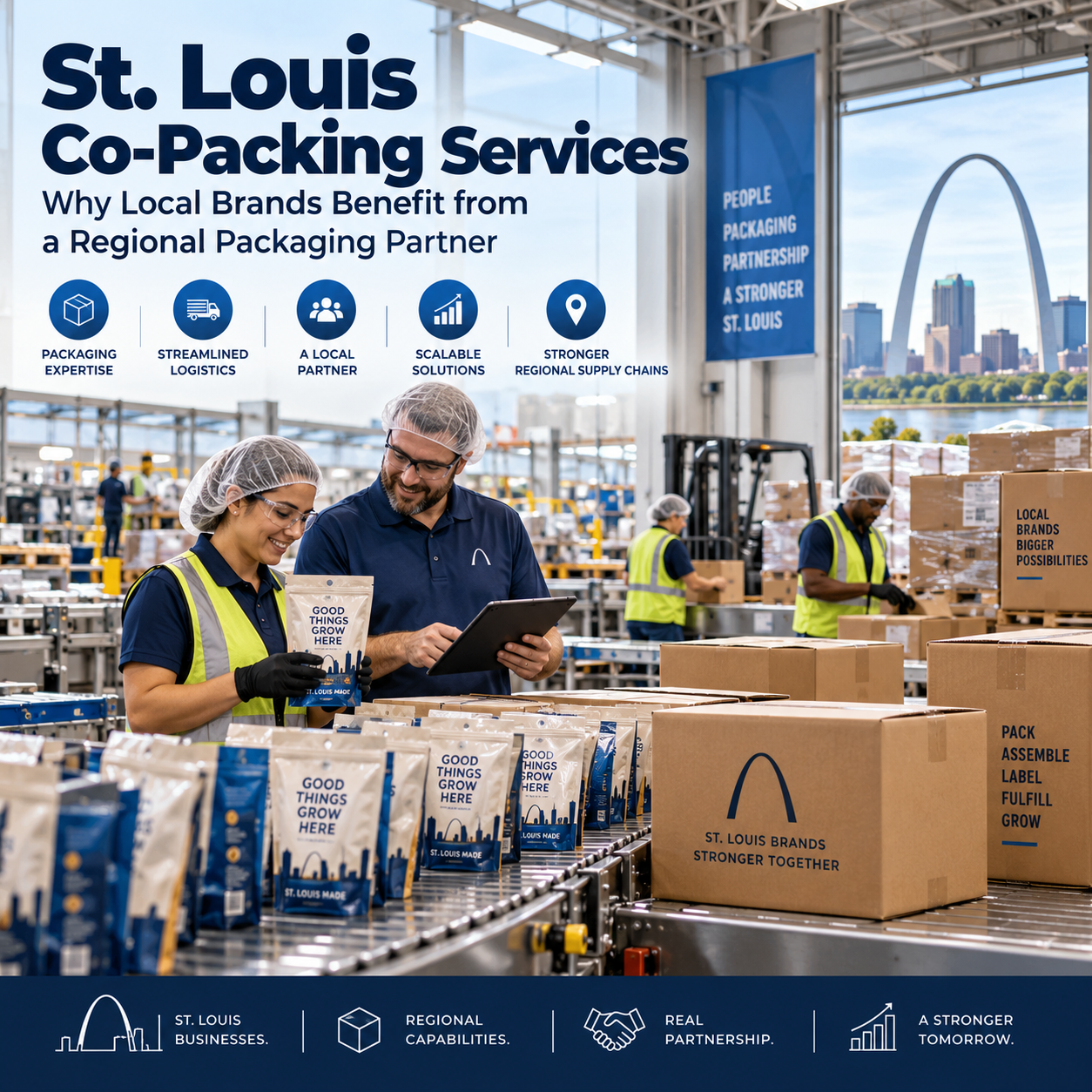

As businesses grow, packaging operations often become more complicated than anticipated. What starts as a manageable in-house process can quickly evolve into a significant operational challenge involving labor shortages, production bottlenecks, inventory management, quality control, and increasing customer expectations.
For manufacturers, consumer product brands, distributors, and retailers throughout the St. Louis metropolitan area, outsourcing packaging operations can provide a practical way to improve efficiency without investing heavily in additional equipment, warehouse space, or personnel.
However, choosing the right contract packaging company is not simply about finding someone who can put products into boxes.
The right co-packing partner should help your business operate more efficiently, maintain consistent quality, meet demanding deadlines, and scale as your business grows.
With numerous considerations involved in outsourcing packaging operations, understanding what separates an experienced contract packaging provider from an average vendor is essential.
In this guide, we’ll explore what businesses should look for when evaluating contract packaging services in St. Louis, MO, the benefits of working with a regional co-packer, and how the right partnership can create long-term operational advantages.
Contract packaging, commonly referred to as co-packing, involves outsourcing some or all of a company’s packaging operations to a specialized third-party provider.
Rather than handling every packaging-related task internally, businesses partner with a contract packaging company that manages designated processes using its own workforce, equipment, facilities, and operational expertise.
Depending on the provider’s capabilities, contract packaging services may include:
Product assembly and kitting
Retail-ready packaging
Shrink wrapping and bundling
Product labeling and relabeling
Promotional packaging and display assembly
Secondary packaging and repackaging
Cartoning and case packing
Quality inspections and product sorting
Inventory coordination and fulfillment preparation
For businesses operating in St. Louis, Missouri, these services can reduce internal operational pressure while allowing teams to focus on manufacturing, sales, product development, and customer relationships.
Contract packaging is particularly valuable for organizations experiencing seasonal demand fluctuations, new product launches, promotional campaigns, or rapid growth.
However, not every co-packing company offers the same capabilities, flexibility, or level of operational accountability.
That’s why evaluating potential partners carefully is critical.
One of the first things businesses should evaluate when selecting a contract packaging company in St. Louis is the provider’s experience with similar products, industries, and packaging requirements.
Packaging consumer goods is different from packaging industrial components, food products, cosmetics, or promotional merchandise.
Each product category presents unique considerations involving handling procedures, packaging materials, labeling, storage, and regulatory requirements.
An experienced co-packing partner should understand these differences and recommend appropriate solutions.
A provider familiar with your industry may be better equipped to anticipate common challenges, including packaging compatibility, product protection, retailer requirements, and production efficiency.
For example, a pet treat manufacturer may require pouch filling, accurate weight measurements, lot tracking, and secure sealing.
Meanwhile, a consumer goods company launching promotional bundles may need precise product assembly, custom labeling, and retail display preparation.
Although both projects involve contract packaging, their operational requirements are significantly different.
When evaluating St. Louis co-packing companies, ask about previous projects involving products similar to yours.
Questions to ask:
What industries do you regularly serve?
Have you handled products similar to ours?
What packaging formats and materials can you accommodate?
Can you provide relevant project examples?
What specialized equipment or processes are available?
A knowledgeable packaging partner should be comfortable discussing the specific requirements of your project rather than offering a one-size-fits-all solution.
Another important consideration is the range of services available.
Some contract packaging companies specialize in individual processes, while others provide integrated solutions that combine printing, packaging, assembly, warehousing, and fulfillment.
For businesses managing complex supply chains, working with a provider that offers multiple complementary services can reduce unnecessary vendor coordination.
Consider a St. Louis consumer products company preparing a new retail launch.
The project may require printed labels, flexible packaging materials, product filling, secondary packaging, case packing, and distribution preparation.
If these services are handled by multiple vendors, the business may need to coordinate several production schedules, transportation arrangements, and quality checkpoints.
An integrated provider may simplify that process by managing multiple stages within a coordinated workflow.
Potential benefits include reduced handling, fewer transportation movements, clearer accountability, and more consistent communication.
Businesses seeking contract packaging services in St. Louis, MO, should evaluate whether a prospective partner can support their immediate needs and accommodate additional services as their operations evolve.
The goal is not necessarily to outsource everything. It is to identify opportunities where coordinated packaging services improve operational performance.
Quality assurance should be a major priority when choosing a co-packing partner.
Packaging mistakes can result in damaged products, incorrect labeling, rejected shipments, customer complaints, and unnecessary rework.
For manufacturers and consumer brands, these issues can affect profitability and customer confidence.
A dependable contract packaging company should have documented procedures for maintaining consistency throughout production.
Effective quality assurance may include incoming material inspections, approved packaging specifications, in-process checks, finished-product inspections, and documented corrective actions.
For products requiring traceability, appropriate lot identification and inventory records may also be necessary.
Businesses should ask how packaging errors are identified, reported, and resolved.
For regulated products, verify which certifications, registrations, and operating controls apply to the specific facility and packaging activity. Requirements differ by product category, and a general quality claim is not a substitute for documented compliance.
A reliable co-packing partner should be able to explain its quality processes clearly and demonstrate how those processes protect your products.
One of the primary reasons businesses outsource contract packaging is to gain additional operational capacity.
However, outsourcing only creates value when the selected provider can consistently handle the required workload.
Before entering a contract packaging agreement, evaluate the company’s available equipment, workforce, production scheduling, and ability to accommodate fluctuating demand.
Imagine a St. Louis manufacturer that currently needs 10,000 products packaged monthly but anticipates increasing that volume to 50,000 units as additional retail accounts come online.
A packaging provider may be capable of handling the initial volume but struggle when demand increases.
That limitation can create new bottlenecks and potentially force the manufacturer to change vendors.
A scalable co-packing partner should discuss realistic production capacity, lead times, minimum order quantities, and the circumstances under which additional volume can be accommodated.
Businesses should also determine whether manual packaging, automated equipment, or a hybrid process is most appropriate.
The ideal approach depends on product characteristics, packaging complexity, production volume, and cost considerations.
For additional insight, explore our guide to Manual vs. Automated Co-Packing: Choosing the Right Approach for Your Product.
Location can significantly influence the efficiency of a contract packaging relationship.
For businesses operating throughout the greater St. Louis metropolitan area, working with a regional provider may reduce transportation complexity and improve operational coordination.
St. Louis offers access to major interstate highways, regional distribution infrastructure, and transportation networks connecting businesses throughout the Midwest.
A locally based co-packing partner can be particularly convenient for manufacturers operating in Hazelwood, Bridgeton, Earth City, Maryland Heights, Chesterfield, St. Charles, and surrounding communities.
Local partnerships can make it easier to conduct facility visits, review packaging samples, coordinate inventory deliveries, and address production concerns.
For businesses managing time-sensitive projects, shorter distances between facilities may also reduce certain transportation costs and delays.
However, location alone should not determine the decision.
A nearby provider without the necessary capabilities or quality standards may create more problems than a qualified provider located farther away.
The strongest choice combines operational competence with a location that supports your distribution strategy.
Price is naturally an important consideration when evaluating contract packaging companies in St. Louis.
However, selecting the lowest quoted price does not always produce the lowest overall cost.
Packaging expenses can involve more than the cost of assembling or packing individual units.
Depending on the project, businesses may need to account for setup fees, materials, equipment changeovers, storage, transportation, quality inspections, and additional handling.
A contract packaging proposal should clearly explain the pricing structure and any variables that could affect the final invoice.
For example, a provider offering a lower per-unit rate may require higher minimum volumes or additional charges for storage and changeovers.
Another provider may offer a slightly higher unit price while reducing transportation movements or providing integrated printing and fulfillment.
When comparing proposals, businesses should evaluate the complete operational cost rather than focusing exclusively on unit pricing.
A useful comparison should include internal labor savings, equipment costs avoided, freight expenses, management time, and the potential financial impact of delays or errors.
The best contract packaging partner delivers measurable value through reliability, efficiency, and consistent execution—not simply the lowest price.
Communication is one of the most overlooked factors in successful co-packing relationships.
Even a technically capable packaging company can become difficult to work with if communication is inconsistent.
Manufacturers and brands need timely information about production schedules, material availability, quality concerns, inventory levels, and shipping readiness.
A dependable co-packing partner should establish clear expectations for project updates, issue escalation, and decision-making responsibilities.
The purpose of outsourcing packaging is not to create another operation that requires constant supervision.
If your team spends hours tracking down inventory information, resolving preventable packaging mistakes, or requesting shipment updates, the relationship may not be delivering its intended value.
An effective partner should proactively communicate important developments and help resolve operational challenges.
Before choosing a provider, ask who will manage your account, how often project updates will be available, and what happens when production problems arise.
Clear communication and accountability are essential for building a productive long-term relationship.
Inventory accuracy becomes increasingly important when products move between manufacturers, contract packaging facilities, warehouses, and distribution centers.
Without reliable inventory controls, businesses may experience stock discrepancies, misplaced materials, incorrect shipments, and production interruptions.
A qualified co-packing company should have procedures for receiving, identifying, storing, tracking, and reconciling inventory.
Depending on the product, lot tracking, expiration-date management, and documented inventory movements may also be necessary.
Businesses should understand how their products and packaging materials will be tracked throughout the process.
Ask whether inventory reports are available, how discrepancies are investigated, and how finished goods are reconciled against production quantities.
For businesses requiring additional traceability, determine whether the provider’s systems can support those needs.
Strong inventory controls can help improve visibility, reduce waste, and support more predictable production planning.
Not every packaging project follows a predictable production schedule.
Retail promotions, seasonal sales, new product launches, and unexpected customer orders can create temporary increases in packaging demand.
A contract packaging partner should be able to discuss how these fluctuations affect scheduling, labor requirements, and turnaround times.
For example, a consumer brand may need additional promotional multipacks assembled before a major holiday sales period.
A manufacturer may require an urgent relabeling project to satisfy updated retailer specifications.
These projects often involve unique configurations, changing volumes, and tight deadlines.
When evaluating co-packing services in St. Louis, ask how the provider handles short-term projects, production changes, and unexpected volume increases.
Flexibility should be supported by realistic capacity planning rather than promises that cannot be consistently delivered.
The strongest contract packaging relationships are built on more than individual purchase orders.
They involve mutual understanding, consistent execution, and a shared commitment to improving operational performance.
A co-packer that understands your products, packaging specifications, seasonal patterns, and distribution requirements can become increasingly valuable over time.
That familiarity may help reduce onboarding requirements, improve production planning, and identify opportunities for process improvements.
Repeatedly changing packaging vendors can introduce additional setup costs, training requirements, transportation arrangements, and quality risks.
While businesses should periodically evaluate vendor performance and pricing, choosing partners solely on small price differences can undermine operational stability.
A dependable packaging provider should demonstrate accountability, transparency, and a willingness to address problems.
The objective is to establish a relationship that supports your business as customer expectations and production requirements evolve.
Before selecting a contract packaging provider, businesses should conduct a structured evaluation.
The following questions can help identify whether a prospective partner is suitable:
What types of products and industries do you specialize in?
Which packaging, printing, assembly, and fulfillment services do you provide?
What production volumes can your facility realistically accommodate?
How do you maintain quality control and product traceability?
What certifications or regulatory qualifications apply to our products?
How are packaging materials and finished goods tracked?
What are your standard lead times and minimum order requirements?
How do you handle seasonal demand and urgent projects?
What costs are included in your pricing proposal?
Who will manage our account and communicate production updates?
Can we tour your facility and review relevant production processes?
How do you measure performance and resolve operational issues?
The answers should help businesses compare potential partners beyond marketing claims and pricing estimates.
Whenever possible, request a facility tour, review sample work, and discuss a pilot project before committing to a large production program.
For companies searching for dependable contract packaging in St. Louis, MO, Elite Printing & Packaging, Inc. offers an integrated approach to printing, packaging, co-packing, and fulfillment.
Located in Hazelwood, Missouri, Elite works with businesses seeking coordinated packaging solutions that support product presentation, operational efficiency, and distribution readiness.
Rather than treating packaging as an isolated service, Elite emphasizes a connected workflow—from initial planning and printed packaging materials through co-packing, assembly, and fulfillment.
According to Elite’s published service information, its capabilities include flexible packaging and label printing, vertical form-fill-seal pouching, flow wrapping, jar and tube filling, kitting, assembly, inventory management, and fulfillment services.
Combining related services can help businesses simplify vendor coordination and maintain greater consistency throughout the packaging process.
For manufacturers, consumer product companies, and brands preparing products for retail or e-commerce distribution, this integrated approach can provide meaningful operational advantages.
Elite’s focus on quality, communication, flexibility, and long-term relationships reflects the qualities businesses should prioritize when selecting a contract packaging partner.
Whether your organization needs assistance with a new product launch, an existing packaging operation, or additional production capacity, the first step is understanding your specific requirements and determining which services will deliver the greatest value.
Contract packaging and co-packing are generally interchangeable terms. Both describe outsourcing packaging-related processes to a specialized third-party provider. These services can include filling, labeling, assembly, repackaging, kitting, and distribution preparation.
Contract packaging costs depend on product characteristics, packaging materials, production volume, labor requirements, equipment needs, and project complexity. Businesses should request customized proposals based on their specifications rather than relying on generalized per-unit estimates.
Manufacturers, consumer goods brands, food and pet product companies, retailers, distributors, and e-commerce businesses may benefit from contract packaging. The suitability of outsourcing depends on product requirements, production volume, and operational economics.
Some co-packing companies accommodate smaller projects, while others specialize in larger production volumes. Businesses should confirm minimum order quantities, setup costs, and scheduling availability before selecting a provider.
A local co-packer may offer logistical advantages, easier facility access, improved communication, and more convenient coordination with regional manufacturing and distribution operations.
Common indicators include increasing labor costs, limited warehouse space, production bottlenecks, inconsistent packaging quality, seasonal demand fluctuations, and difficulty meeting customer deadlines.
Choosing the right contract packaging company is an important operational decision that can influence production efficiency, product quality, customer satisfaction, and long-term profitability.
For businesses throughout St. Louis, Missouri, the ideal co-packing partner should provide more than available labor and packaging equipment.
It should deliver relevant industry experience, dependable quality control, scalable production capacity, transparent pricing, responsive communication, and effective inventory management.
A strong packaging partnership can help businesses reduce operational complexity while creating additional opportunities for growth.
Whether your organization is launching new products, expanding retail distribution, managing seasonal demand, or seeking alternatives to in-house packaging, carefully evaluating potential providers is essential.
The right co-packing partner should make your business easier to operate—not create additional problems to manage.
If your business needs reliable co-packing, custom printing, product assembly, or fulfillment solutions, Elite Printing & Packaging, Inc. is ready to discuss your packaging requirements.
Elite Printing & Packaging, Inc.
1601 Tradeport Drive, Suite 900, Hazelwood, MO 63042
(636) 561-8970
Contact Elite Printing & Packaging today to request a quote and discover how a trusted St. Louis co-packing partner can help streamline your operations, protect your products, and support your business growth.

Bring your vision to life with custom flexible packaging, labels, and retail-ready design.

Premium materials and finishes that elevate your brand.

Efficient, compliant, and versatile co-packing for pet and human products.

From warehouse to doorstep — done right, every time.
Bring your vision to life with custom flexible packaging, labels, and retail-ready design.
Premium materials and finishes that elevate your brand.
Efficient, compliant, and versatile co-packing for pet and human products.
From warehouse to doorstep — done right, every time.