

Manufacturing growth is an exciting milestone for any business. Increased orders, new retail partnerships, expanded distribution, and rising consumer demand are all signs that a company is moving in the right direction. However, growth also introduces operational challenges that can quickly overwhelm existing resources.
For manufacturers throughout St. Louis, Missouri, and the surrounding Midwest, scaling production often raises a difficult question: How can we increase output without investing heavily in additional warehouse space, equipment, labor, and infrastructure?
The answer may be simpler than many manufacturers realize.
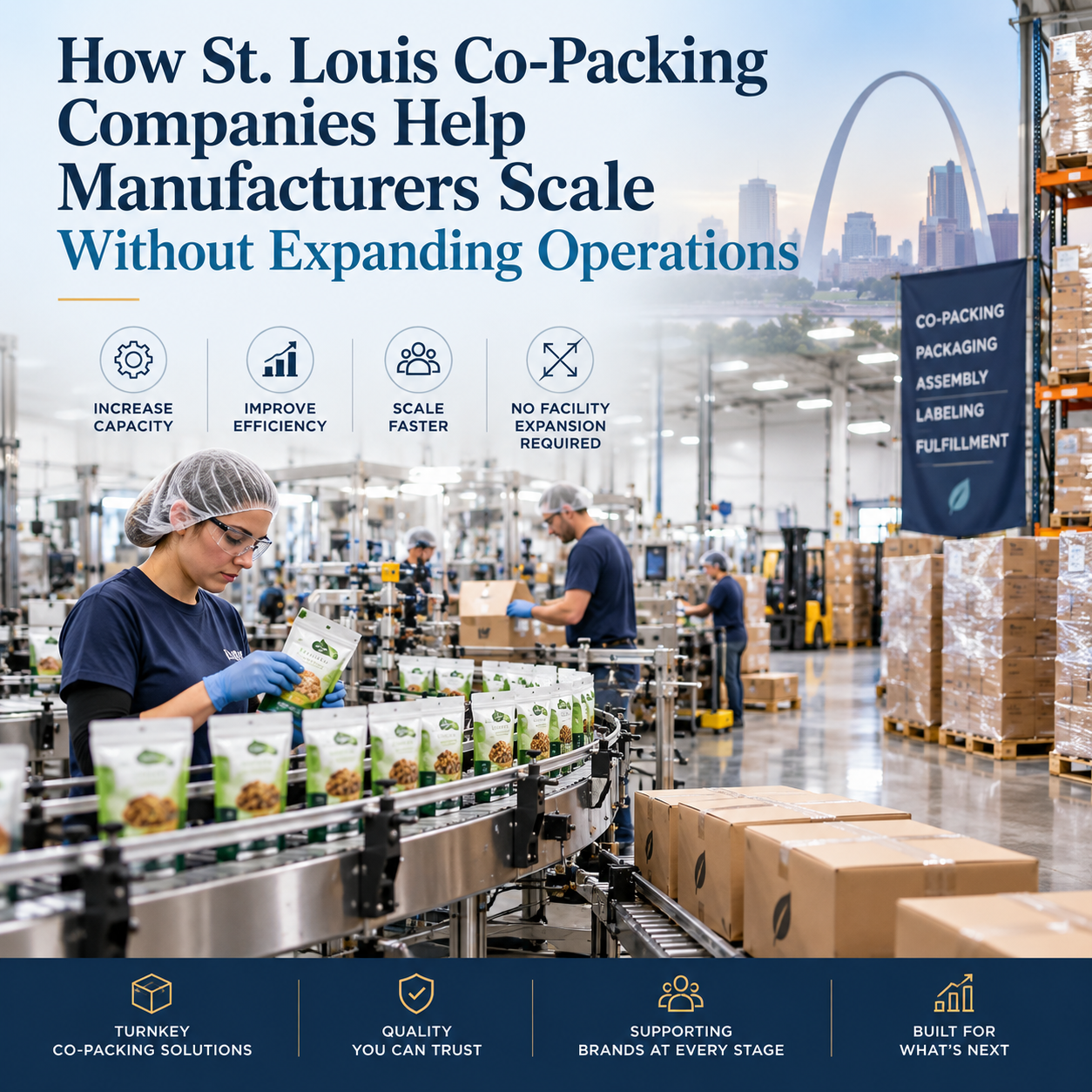
Partnering with an experienced St. Louis co-packing company allows manufacturers to expand their packaging, assembly, and fulfillment capabilities without the financial burden of expanding their own operations.
Rather than purchasing additional machinery, hiring more employees, or leasing larger facilities, manufacturers can outsource labor-intensive packaging processes to a specialized partner equipped to handle fluctuating production demands.
At Elite Printing & Packaging, Inc., located in Hazelwood, Missouri, we understand the operational challenges manufacturers face as their businesses grow. By combining professional printing, packaging, and co-packing solutions, we help businesses streamline operations, reduce unnecessary complexity, and focus on their core manufacturing capabilities.
In this article, we’ll explore how co-packing services help manufacturers scale efficiently, control operational costs, improve supply chain performance, and build a more flexible foundation for sustainable growth.
Growth creates opportunities, but it also exposes operational limitations that may not have been apparent when production volumes were lower.
A manufacturer processing 5,000 units per week may operate efficiently with its existing staff, equipment, and warehouse space. However, increasing demand to 15,000 or 25,000 units can create significant bottlenecks.
Suddenly, the business may need additional employees, packaging equipment, storage space, and shipping resources to meet customer expectations.
Common manufacturing growth challenges include:
Limited warehouse and production floor space
Rising labor and employee training expenses
Increased packaging and assembly requirements
Equipment capacity limitations
Seasonal fluctuations in customer demand
Inventory management complications
Longer order fulfillment timelines
Growing pressure from retail and distribution partners
These challenges can force manufacturers to make substantial capital investments before they have fully established whether increased demand will remain consistent.
Expanding a manufacturing facility requires more than purchasing additional square footage. Businesses must also consider utilities, insurance, equipment maintenance, staffing, technology, and ongoing operational overhead.
This is where outsourcing packaging operations to a St. Louis co-packing partner becomes a strategic advantage.
Instead of expanding every internal department to accommodate growth, manufacturers can leverage existing external infrastructure to support increased production volumes.
Co-packing, short for contract packaging, involves outsourcing specific packaging, assembly, labeling, or product preparation processes to a third-party company.
A professional co-packing company works alongside manufacturers to prepare finished products for retail distribution, e-commerce fulfillment, wholesale shipments, and other commercial applications.
Depending on the manufacturer’s requirements, co-packing services may include:
Product assembly and kitting
Custom packaging and repackaging
Product labeling and relabeling
Shrink wrapping and protective packaging
Retail display assembly
Promotional product bundling
Cartoning and case packing
Product sorting and inspection
Packaging preparation for distribution
Rather than treating packaging as an internal responsibility, manufacturers can integrate these services into their existing supply chain.
For example, a St. Louis manufacturer producing consumer goods may have sufficient production capacity to manufacture additional units but lack the labor or equipment needed to package those products efficiently.
A co-packing partner can handle the downstream packaging process, allowing the manufacturer to concentrate on production.
This division of responsibilities creates a more efficient operating model.
Manufacturers focus on making products. Co-packers focus on preparing those products for the marketplace.
The result is greater operational flexibility without unnecessary infrastructure expansion.
One of the most significant advantages of working with a St. Louis contract packaging company is the ability to increase packaging capacity without making substantial capital investments.
Traditional manufacturing expansion often requires businesses to purchase or lease additional equipment, expand facilities, and increase permanent staffing.
These investments can be expensive, especially when packaging requirements vary across product lines.
Consider the potential expenses associated with expanding internal packaging operations:
Expansion Requirement | Potential Financial Impact |
|---|---|
Additional warehouse space | Increased rent, utilities, and insurance |
Packaging machinery | Equipment purchases, installation, and maintenance |
Additional employees | Recruiting, payroll, benefits, and training |
Inventory storage | Increased handling and storage expenses |
Operational technology | Software, systems integration, and support |
Facility modifications | Construction, permitting, and infrastructure costs |
Outsourcing packaging operations can reduce the need for many of these investments.
Instead of purchasing specialized packaging equipment that may only be used periodically, manufacturers can access capabilities through an established co-packing provider.
This approach may also help preserve working capital for other strategic priorities, including product development, marketing, sales expansion, and manufacturing improvements.
For growing manufacturers, preserving capital can be just as important as increasing production capacity.
By converting certain packaging expenses from fixed overhead into variable service costs, businesses gain greater financial flexibility.
However, outsourcing is not automatically less expensive for every product or production volume. Manufacturers should compare total internal costs with co-packing quotes, including transportation, storage, setup fees, and quality requirements.
Manufacturing facilities are designed around specific production requirements.
As businesses grow, packaging operations can consume valuable floor space that could otherwise support revenue-generating manufacturing activities.
Finished products awaiting labeling, assembly, or packaging may occupy significant warehouse space. Packaging materials, shipping cartons, and promotional displays can further reduce available capacity.
A regional co-packing partner can help manufacturers reclaim valuable operational space.
By transferring eligible packaging activities to an external facility, manufacturers may be able to:
Free up production floor space
Reduce congestion around manufacturing equipment
Improve internal material flow
Minimize storage requirements for packaging supplies
Increase available capacity for core manufacturing processes
Imagine a manufacturer that needs additional space for a new production line.
Rather than leasing another building, the company could evaluate whether outsourcing secondary packaging would free enough space to accommodate the new equipment.
This strategy allows manufacturers to maximize existing facilities before committing to expensive expansion projects.
For businesses operating throughout the St. Louis metropolitan area, regional co-packing services provide an opportunity to increase effective capacity while keeping manufacturing operations focused and efficient.
Labor availability remains an important consideration for manufacturers.
Hiring, training, and retaining employees for packaging and assembly operations can become particularly challenging when production demands fluctuate.
Seasonal orders, promotional campaigns, and major retail contracts may require temporary increases in labor.
However, hiring permanent employees to accommodate short-term demand can create unnecessary overhead when production volumes return to normal.
Working with a co-packing company gives manufacturers access to additional packaging labor capacity without requiring them to manage every aspect of staffing internally.
Manufacturers can coordinate packaging requirements around changing production schedules.
For example:
During peak demand, manufacturers may outsource higher volumes of packaging work.
During slower periods, packaging orders can be adjusted based on actual business needs.
During new product launches, specialized assembly or kitting services can support temporary projects.
During promotional campaigns, additional packaging capacity can help meet deadlines.
This flexibility can be especially valuable for manufacturers serving retail, consumer goods, and seasonal markets.
It also allows internal employees to remain focused on specialized manufacturing activities rather than being reassigned to repetitive packaging tasks.
The goal is not simply to reduce labor costs. It is to allocate labor more strategically while maintaining consistent product quality and delivery performance.
Supply chain efficiency plays a major role in manufacturing profitability.
Every unnecessary transportation movement, production delay, inventory transfer, or communication breakdown can increase operational costs.
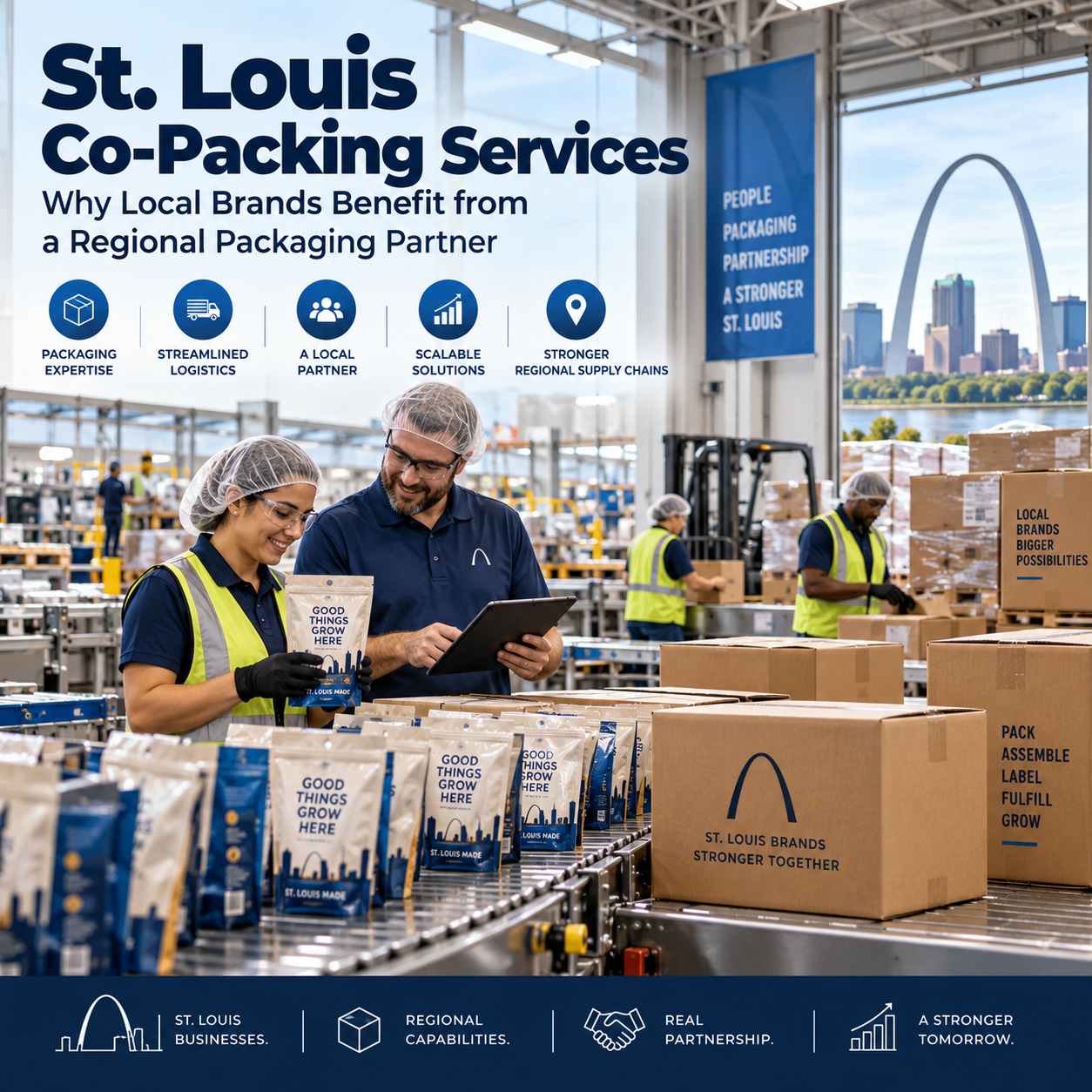
Choosing a regional co-packing company in St. Louis, Missouri, offers manufacturers the opportunity to simplify certain supply chain processes.
St. Louis provides access to major transportation infrastructure, including interstate highways, rail networks, and regional distribution routes.
Its central geographic position makes the metropolitan area an attractive location for businesses distributing products throughout the Midwest and across the United States.
Reduced transportation complexity: Working with a nearby packaging provider may shorten the distance between manufacturing facilities and packaging operations.
Faster communication: Regional partnerships make it easier to coordinate production schedules, packaging changes, and project requirements.
Greater operational visibility: Manufacturers may be able to visit their co-packing partner’s facility, review processes, and collaborate on quality expectations.
Improved responsiveness: Local relationships can make it easier to address urgent packaging requirements or changing customer demands, subject to available capacity.
Simplified coordination: Packaging, printing, and distribution preparation can potentially be consolidated through fewer vendors.
For manufacturers in Hazelwood, Earth City, Maryland Heights, Bridgeton, St. Charles, Chesterfield, and surrounding St. Louis communities, proximity can provide meaningful logistical advantages.
When evaluating co-packing companies in St. Louis, manufacturers should consider transportation routes, turnaround times, project capabilities, and communication processes.
A strategically located partner can become an extension of the manufacturer’s existing supply chain.
One frequently overlooked opportunity for manufacturing efficiency is the integration of printing and packaging services.
Many manufacturers work with separate vendors for printed packaging materials, labels, product assembly, and final packaging.
While this arrangement may work for smaller operations, coordinating multiple suppliers becomes increasingly complicated as production volumes grow.
Each additional vendor introduces another scheduling requirement, communication channel, and potential point of delay.
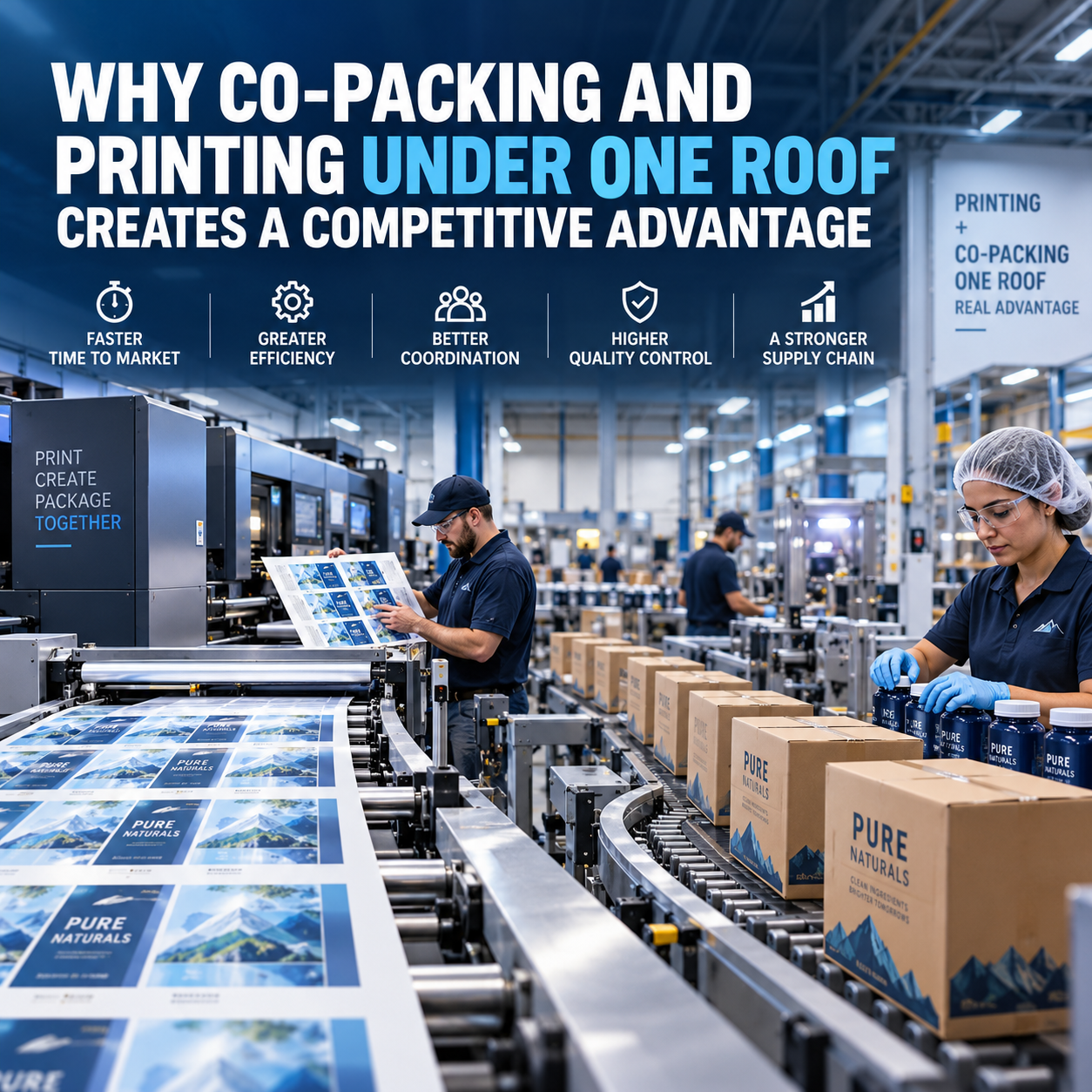
Working with a provider that offers both printing and co-packing capabilities can help simplify the process.
At Elite Printing & Packaging, Inc., our integrated approach to printing and packaging solutions is designed to help businesses reduce operational complexity.
1. Fewer vendor relationships
Manufacturers can reduce the number of suppliers involved in packaging preparation.
2. Better production coordination
Printed materials and packaging activities can be planned together, helping minimize scheduling conflicts.
3. Improved packaging consistency
Coordinated printing and packaging processes support more consistent branding and presentation.
4. Faster issue resolution
When printing and packaging teams operate through one provider, communication may become more efficient.
5. Greater scalability
Manufacturers can coordinate larger packaging programs without independently managing every supporting process.
For growing businesses, these efficiencies can translate into improved production planning and fewer administrative headaches.
The ability to coordinate printing and co-packing under one roof is particularly valuable for manufacturers managing multiple SKUs, promotional packaging programs, and retail-specific requirements.
Expanding into major retail channels creates new opportunities for manufacturers, but it also introduces additional packaging requirements.
Retailers may have specific expectations regarding labeling, barcode placement, carton configuration, display presentation, and shipment preparation.
Manufacturers entering new retail markets may suddenly need to support:
Retail-ready packaging
Promotional display assembly
Multi-product bundles
Custom product labeling
Special packaging configurations
Seasonal promotional packaging
Retailer-specific carton and shipment requirements
These activities can consume considerable internal resources.
A professional co-packing partner can help manufacturers prepare products according to documented retail packaging specifications.
For example, a manufacturer launching a promotional product bundle may need several individual items assembled into one retail-ready package.
Instead of disrupting existing production lines to accommodate the project, the manufacturer can outsource the assembly process.
This arrangement helps businesses pursue new retail opportunities while maintaining focus on their primary manufacturing responsibilities.
Importantly, manufacturers should verify that any co-packing provider has the appropriate processes, documentation, and quality controls for their products and retail channels.
Scaling successfully requires more than manufacturing additional units. It requires delivering those units in the correct packaging, on schedule, and according to customer expectations.
Rapid growth can place significant pressure on manufacturing quality standards.
As order volumes increase, packaging errors may become more costly and difficult to manage.
Incorrect labels, damaged packaging, missing components, or improperly assembled product bundles can create delays, customer complaints, and additional handling expenses.
A dependable co-packing partner should support consistent quality through documented procedures and inspection processes.
Important quality considerations include:
Packaging specifications and approved samples
Product identification and traceability
Label placement and accuracy
Assembly verification
Packaging integrity
Final inspection procedures
Documentation of nonconforming products
Manufacturers should establish clear quality expectations before beginning a co-packing project.
These expectations may include acceptable defect rates, inspection frequency, reporting requirements, and procedures for handling packaging errors.
For regulated products, businesses must also verify that their packaging partner meets applicable industry and regulatory requirements.
The right co-packing relationship should support quality standards as production volumes grow, not introduce additional uncertainty.
By defining responsibilities and maintaining consistent communication, manufacturers and co-packers can work together to improve operational reliability.
Manufacturing demand rarely increases in a perfectly predictable pattern.
A successful marketing campaign, new distribution agreement, major customer order, or seasonal sales surge can create immediate pressure on packaging operations.
Businesses that rely entirely on internal packaging capacity may struggle to respond when demand exceeds available resources.
Expanding internal operations takes time.
Equipment must be purchased, employees must be recruited, and additional space may need to be secured.
A qualified co-packing partner can provide an alternative path to increased packaging capacity.
For example, a consumer goods manufacturer preparing for a major holiday sales period may need significantly more product bundles assembled within a limited timeframe.
Outsourcing the project to a co-packing provider with available resources may help the manufacturer meet customer deadlines without permanently increasing internal overhead.
This flexibility also supports product launches, promotional campaigns, and unexpected increases in customer orders.
Of course, co-packing capacity is not unlimited. Manufacturers should communicate forecasts early and confirm lead times, staffing availability, and production schedules.
Building a relationship with a regional co-packing partner before an urgent need arises can make future scaling efforts more manageable.
Not every co-packing provider offers the same capabilities, capacity, or level of operational support.
Manufacturers should evaluate potential partners carefully before outsourcing critical packaging activities.
The lowest quoted price does not always represent the best long-term value.
A reliable packaging partner should help manufacturers reduce complexity, maintain quality, and support growth.
Can the company handle your packaging requirements?
Review its experience with similar products, packaging formats, assembly processes, and production volumes.
Does the provider have the capacity to support growth?
Discuss expected order volumes, seasonal fluctuations, lead times, and potential expansion requirements.
What quality control processes are in place?
Ask about inspection procedures, documentation, error resolution, and product handling standards.
Can printing and packaging services be coordinated?
An integrated provider may reduce the need for multiple suppliers and simplify production planning.
How does the company communicate with customers?
Clear project management, realistic timelines, and consistent updates are essential.
What is the total cost of the service?
Evaluate packaging costs alongside transportation, storage, handling, setup charges, and potential operational savings.
Is the company conveniently located?
For St. Louis-area manufacturers, regional proximity can make transportation and collaboration easier.
Selecting a co-packing company should be treated as a strategic business decision rather than a simple purchasing transaction.
The strongest partnerships are built around reliability, transparency, communication, and shared operational goals.
Manufacturers need partners who understand that packaging is more than the final step in production.
Packaging directly affects operational efficiency, customer satisfaction, brand presentation, and product distribution.
At Elite Printing & Packaging, Inc., we focus on helping businesses simplify packaging operations through professional printing, packaging, and co-packing solutions.
Located at 1601 Tradeport Drive in Hazelwood, Missouri, Elite serves as a regional resource for businesses seeking packaging support in the greater St. Louis area.
Our integrated service approach helps manufacturers explore opportunities to consolidate packaging-related processes, improve coordination, and reduce unnecessary operational complexity.
Whether your business is preparing for a product launch, managing increased customer demand, coordinating retail packaging requirements, or evaluating the benefits of outsourcing, choosing the right packaging partner can make a meaningful difference.
Rather than investing immediately in additional facilities, equipment, and staffing, manufacturers can evaluate how outsourced packaging services fit into their broader growth strategy.
The objective is simple: help manufacturers spend more time focusing on their products, customers, and business growth while reducing the burden of managing packaging operations internally.
Manufacturing success is no longer measured solely by the size of a company’s facility or the amount of equipment it owns.
Increasingly, competitive manufacturers are evaluating how effectively they utilize existing resources, manage supply chains, and respond to changing market conditions.
Operational flexibility allows businesses to pursue new opportunities without committing prematurely to expensive infrastructure investments.
Co-packing supports this approach by providing access to specialized packaging capabilities when they are needed.
For some manufacturers, outsourcing packaging may be a temporary solution during periods of increased demand.
For others, it can become a long-term operational strategy that supports consistent growth.
The most effective approach depends on production volume, product complexity, internal capabilities, and long-term business objectives.
Manufacturers should regularly evaluate which activities are best performed internally and which can be handled more efficiently by specialized partners.
When implemented thoughtfully, co-packing can help businesses achieve greater scalability while maintaining control over their core manufacturing operations.
Growth should create opportunities for manufacturers, not unnecessary operational burdens.
Expanding production capacity does not always require expanding facilities, purchasing additional equipment, or hiring a significantly larger workforce.
By partnering with an experienced St. Louis co-packing company, manufacturers can gain access to specialized packaging resources, improve operational flexibility, and reduce the complexity associated with business growth.
From product assembly and retail-ready packaging to printing coordination and distribution preparation, co-packing services can support manufacturers at multiple stages of their growth journey.
For businesses throughout St. Louis, Hazelwood, St. Charles, and the surrounding Midwest, working with a regional packaging partner may also provide valuable transportation and communication advantages.
At Elite Printing & Packaging, Inc., we believe manufacturers should be able to focus on what they do best while working with dependable partners to handle supporting packaging processes.
Discover how Elite Printing & Packaging, Inc. can help simplify your packaging processes, support increased production demand, and create a more efficient path to growth.
Contact Elite Printing & Packaging today to discuss your co-packing needs and explore packaging solutions for your business.

Bring your vision to life with custom flexible packaging, labels, and retail-ready design.

Premium materials and finishes that elevate your brand.

Efficient, compliant, and versatile co-packing for pet and human products.

From warehouse to doorstep — done right, every time.
Bring your vision to life with custom flexible packaging, labels, and retail-ready design.
Premium materials and finishes that elevate your brand.
Efficient, compliant, and versatile co-packing for pet and human products.
From warehouse to doorstep — done right, every time.