

Traditionally, businesses have relied on separate vendors for printing, packaging, product assembly, labeling, and fulfillment preparation. While this approach may seem practical, coordinating multiple suppliers often introduces unnecessary complexity, longer production timelines, increased transportation costs, and greater opportunities for errors.
In today’s competitive business environment, companies are constantly searching for ways to reduce operational costs, improve efficiency, accelerate product launches, and strengthen their supply chains. For brands managing complex packaging requirements, one of the most overlooked opportunities for achieving these goals is combining co-packing and commercial printing services under one roof.
Traditionally, businesses have relied on separate vendors for printing, packaging, product assembly, labeling, and fulfillment preparation. While this approach may seem practical, coordinating multiple suppliers often introduces unnecessary complexity, longer production timelines, increased transportation costs, and greater opportunities for errors.
An integrated approach offers a more efficient alternative.
By working with a single provider that delivers both printing and co-packing solutions, businesses can streamline operations, improve quality control, and bring products to market faster.
For companies throughout St. Louis, Missouri, and the surrounding Midwest, integrated packaging solutions can provide a meaningful competitive advantage.
At Elite Printing & Packaging, Inc., we understand that successful packaging operations require more than simply assembling products or printing materials. They require coordination, precision, accountability, and a commitment to helping customers operate more efficiently.
Let’s explore why combining co-packing and printing under one roof can transform your packaging operations and position your business for long-term growth.
Before exploring the advantages, it’s important to understand how integrated printing and co-packing services work.
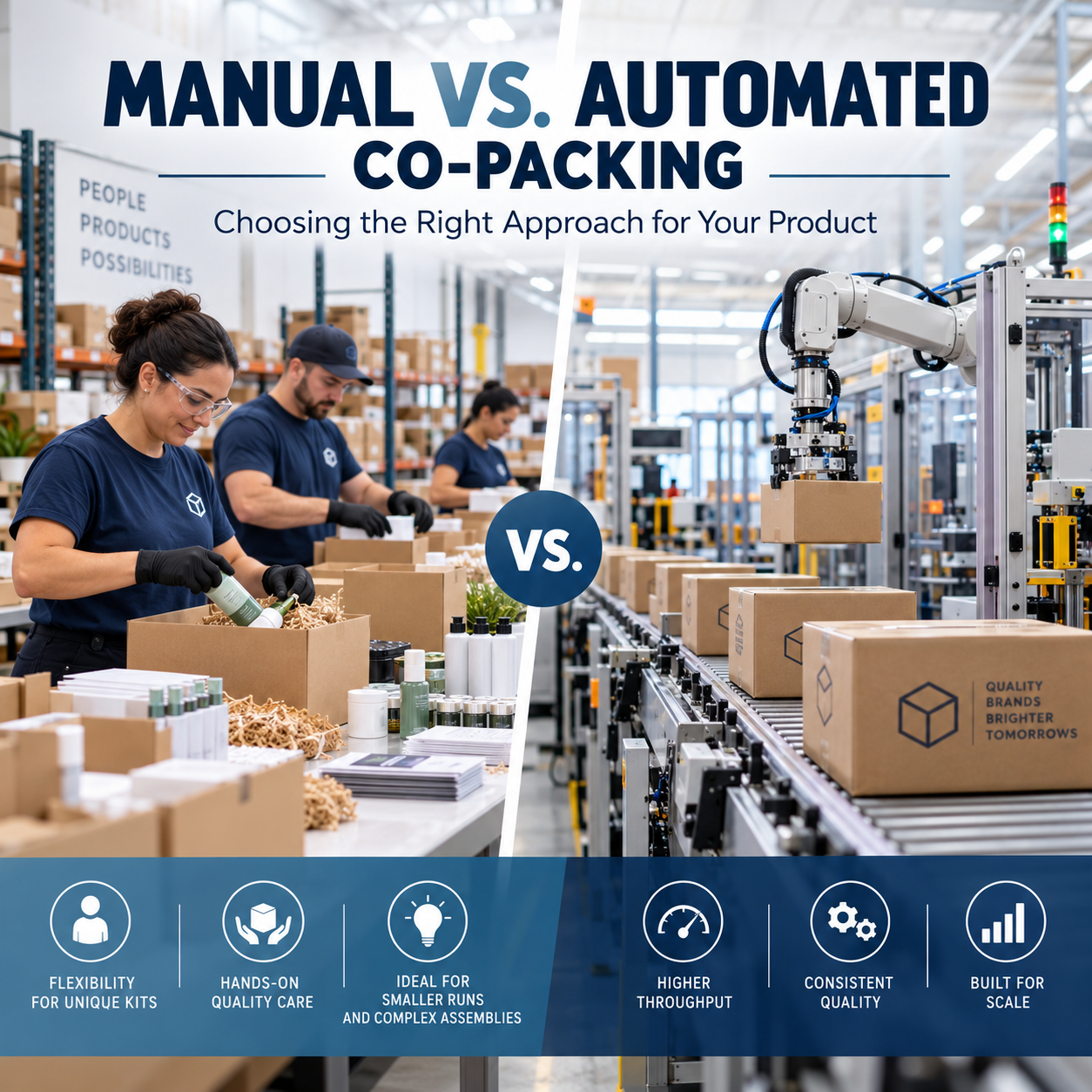
Co-packing, also known as contract packaging, involves outsourcing packaging-related operations to a specialized third-party provider.
Depending on the product and production requirements, these services may include:
Product assembly and kitting
Label application and relabeling
Shrink wrapping and bundling
Retail-ready packaging
Promotional packaging and displays
Secondary packaging
Product sorting and quality inspections
Packaging preparation for distribution
Commercial printing services, meanwhile, produce the printed materials needed to package, identify, promote, and present products.
These materials may include product labels, printed cartons, inserts, sleeves, promotional materials, and other customized packaging components.
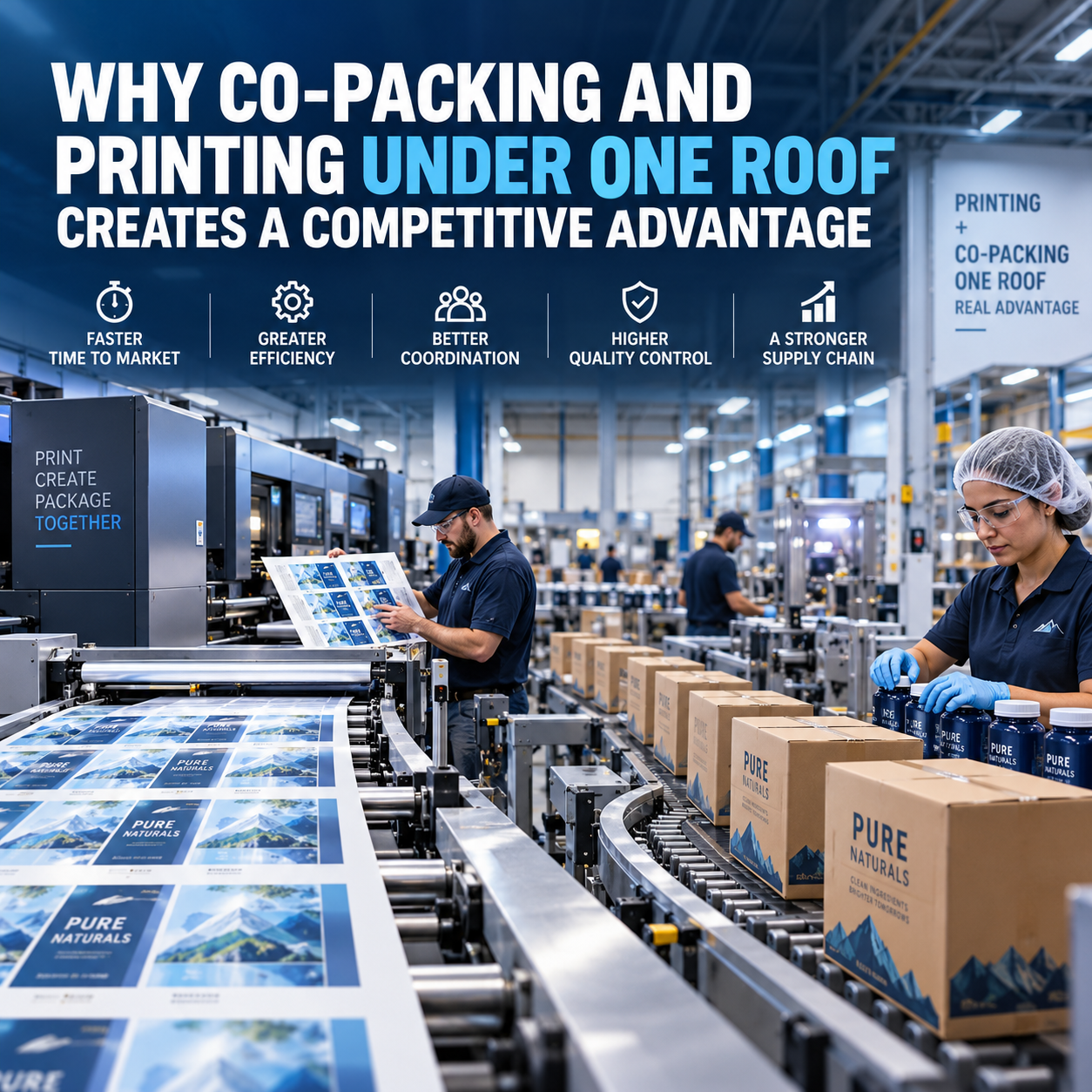
When both capabilities are managed through one provider, the printing and packaging processes become more closely connected.
Instead of coordinating with a printer, arranging transportation to a co-packer, and managing separate production schedules, businesses can work with one integrated solutions provider.
This approach reduces operational handoffs and creates opportunities for improved efficiency throughout the packaging process.
For growing brands, especially those managing multiple SKUs, seasonal promotions, or changing retail requirements, that integration can make a substantial difference.
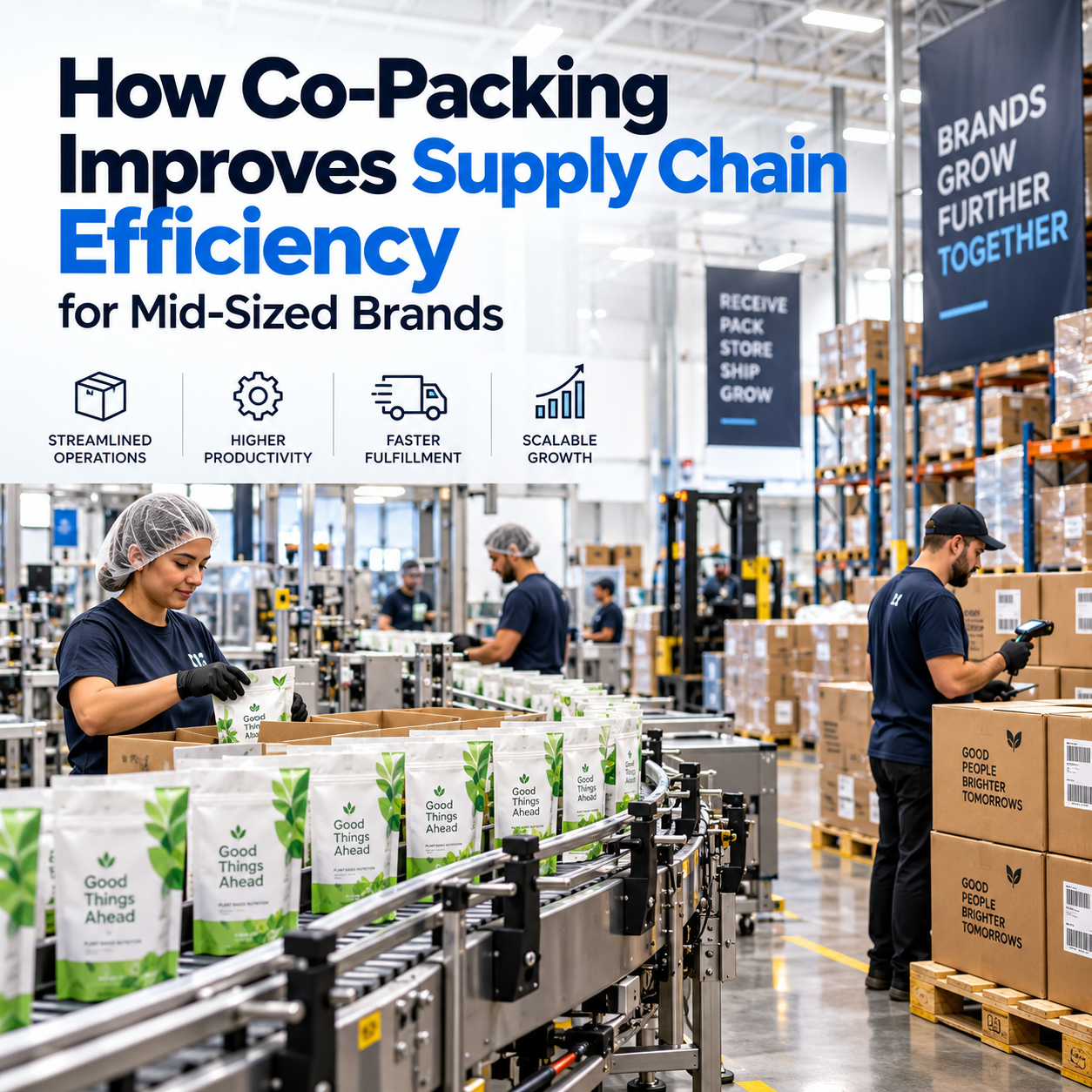
One of the biggest challenges businesses face is managing multiple vendors across their packaging supply chain.
Consider a company launching a new retail product.
The business may need to coordinate with a commercial printer for labels, another supplier for cartons, a co-packer for product assembly, and a logistics provider to transport materials between facilities.
Every additional supplier introduces another point of coordination.
Production schedules must align. Materials must arrive on time. Specifications must be communicated accurately. Unexpected delays must be resolved before they affect the final delivery date.
When printing and co-packing are handled under one roof, many of these coordination challenges can be reduced.
Working with an integrated printing and packaging company allows businesses to simplify vendor management.
Instead of communicating with multiple suppliers, teams can coordinate production requirements through a more centralized process.
This can result in:
Fewer administrative tasks and purchase order complications
Reduced scheduling conflicts between suppliers
Improved communication between printing and packaging teams
Greater visibility into production progress
Faster identification and resolution of potential problems
For businesses searching for co-packing services in St. Louis, MO, reducing supply chain complexity can help operations teams spend less time managing vendors and more time focusing on business growth.
Speed is a major competitive advantage in today’s retail and consumer goods markets.
Whether a company is launching a new product, responding to increased demand, or preparing a seasonal promotion, packaging delays can create significant operational challenges.
When printing and co-packing are outsourced to separate companies, production often follows a sequential process.
Printed materials must be completed, prepared for shipment, transported to another facility, received, inspected, and then incorporated into the packaging operation.
Each step adds time.
With printing and co-packing under one roof, businesses can potentially eliminate several of these intermediate steps.
Printed packaging components can move directly into the next production phase without requiring transportation between separate vendors.
Packaging teams can coordinate more closely with printing operations to ensure materials are available when needed.
This is particularly valuable for:
Time-sensitive promotional campaigns
Seasonal retail product launches
High-volume packaging projects
Product relabeling and rebranding initiatives
Short production runs requiring quick turnaround
Retail programs with strict delivery deadlines
An integrated workflow does not eliminate every potential production delay. However, it can remove unnecessary transitions that frequently slow down traditional packaging supply chains.
For businesses competing in fast-moving markets, even modest reductions in production lead times can create meaningful advantages.
Every time packaging materials move between suppliers, businesses incur additional expenses.
These costs may include freight charges, fuel surcharges, handling fees, receiving labor, storage expenses, and administrative overhead.
Individually, these expenses may appear manageable.
Over time, however, repeated transportation and handling requirements can significantly increase the total cost of packaging operations.
When printing and co-packing take place within the same facility, certain transportation expenses can be reduced or eliminated.
For example, printed materials that would otherwise require shipment to an outside co-packer may instead move directly into the packaging operation.
This reduces the need for separate freight arrangements and additional receiving procedures.
It can also minimize the risk of materials being damaged during transportation or handling.
Businesses often make purchasing decisions based on the lowest quoted price for individual services.
However, the cheapest printing quote or lowest co-packing rate does not necessarily translate into the lowest overall project cost.
A more complete evaluation should consider:
Printing and packaging production costs
Transportation between facilities
Inventory storage and handling
Administrative coordination
Quality-related rework
Delays and expedited shipping requirements
A slightly higher individual service rate may still deliver a lower total project cost when unnecessary expenses are eliminated.
For companies evaluating contract packaging services in St. Louis, understanding the total cost of ownership is essential to making informed outsourcing decisions.
Quality is one of the most important considerations in any packaging operation.
Incorrect labels, inconsistent printing, damaged packaging, missing components, or improper product assembly can lead to customer complaints, retailer issues, costly rework, and potential product recalls.
When printing and co-packing are managed by separate vendors, quality responsibilities may become fragmented.
A printing supplier may be responsible for artwork accuracy and print quality, while a co-packer manages label placement, assembly, and final packaging inspections.
If a problem occurs, identifying its source can require coordination between multiple companies.
An integrated printing and co-packing operation creates opportunities for better communication between production teams.
Print specifications, packaging requirements, and assembly instructions can be reviewed together before production begins.
This helps teams identify potential compatibility issues early.
For example, a printed label may meet its artwork specifications but still create problems during application because of its dimensions, material, or placement requirements.
When printing and packaging teams work closely together, these issues can potentially be identified before they affect an entire production run.
Integrated operations can also support more consistent quality checks throughout the process.
Rather than treating printing and packaging as completely separate activities, businesses can approach them as connected stages of one production workflow.
The result is greater opportunity for consistency, accountability, and quality assurance across the finished product.
Of course, integration alone does not guarantee quality. Documented procedures, trained employees, appropriate equipment, and effective inspection processes remain essential.
Communication problems are among the most common causes of packaging delays and production mistakes.
When multiple vendors are involved, even relatively simple changes can become complicated.
A revised product label may require approval from the brand, coordination with the printer, confirmation from the co-packer, and adjustments to the packaging schedule.
If one supplier receives outdated information, the entire project can be affected.
An integrated printing and packaging partner can simplify this communication process.
Instead of managing separate conversations with several suppliers, businesses can establish a more centralized point of coordination.
This helps improve alignment around:
Project specifications and artwork approvals
Production schedules and deadlines
Material availability
Packaging configuration requirements
Quality expectations
Changes to order quantities or product assortments
Greater coordination can also strengthen accountability.
When a project encounters an unexpected challenge, businesses benefit from having a partner focused on resolving the issue rather than coordinating competing explanations between vendors.
A strong co-packing and printing partner should not create additional work for its customers.
It should help remove operational problems from their desks.
That solutions-focused approach is especially valuable for companies managing demanding retail customers and complex distribution requirements.
Consumer demand changes quickly.
Retailers introduce new packaging requirements. Brands launch promotional campaigns. Products undergo redesigns. Seasonal demand creates sudden increases in packaging volume.
Businesses need packaging partners capable of adapting to these changes without introducing unnecessary disruption.
Integrated printing and co-packing services can offer greater flexibility when production requirements change.
For example, a consumer goods brand may need to update packaging artwork for a limited-time promotion.
When printing and packaging operations are coordinated, the company can potentially manage the transition more efficiently.
Similarly, businesses launching new product bundles may need both updated printed components and modified assembly processes.
An integrated provider can help align these requirements.
This approach is particularly useful for companies managing multiple product variations or frequent packaging updates.
Rather than rebuilding coordination processes across several vendors for each new project, businesses can work through an established production relationship.
For St. Louis-area brands competing in regional and national markets, that flexibility can support faster responses to customer and retailer demands.
Packaging operations frequently involve more inventory than businesses initially anticipate.
Printed labels, cartons, sleeves, inserts, promotional materials, and other components must be available in the correct quantities at the right time.
When these materials are distributed across multiple suppliers, maintaining accurate inventory visibility becomes more challenging.
Businesses may encounter situations where finished products are ready for packaging but essential printed components are unavailable.
Conversely, excessive quantities of printed materials may accumulate because purchasing teams are attempting to avoid shortages.
Combining printing and co-packing can help businesses align material production with packaging schedules.
When supported by appropriate inventory systems and operational procedures, integrated workflows can improve visibility into component requirements and upcoming production needs.
This can help reduce:
Excessive packaging material inventory
Production interruptions caused by missing components
Unnecessary material transfers
Storage and handling requirements
Waste from outdated or obsolete printed materials
For businesses managing high SKU counts or frequent product changes, improved inventory coordination can become an important operational advantage.
However, the benefits depend on effective planning and inventory controls, not simply having both services in one building.
Retailers expect products to arrive accurately packaged, properly labeled, and prepared according to their specific requirements.
Failure to meet these expectations can create costly consequences.
Depending on the retailer and agreement, packaging errors may result in rejected shipments, compliance chargebacks, delayed distribution, or additional corrective work.
For brands supplying large retail chains, packaging consistency and operational reliability are critical.
Integrated printing and co-packing services can help brands coordinate packaging artwork, labeling requirements, and final assembly processes.
This is especially valuable for retail programs involving:
Product bundles and multipacks
Promotional packaging
Display-ready cartons
Product labeling and relabeling
Seasonal retail packaging
Custom packaging inserts
Retail-specific product configurations
When printed materials and packaging execution are managed together, businesses can reduce the risk of mismatched components or outdated packaging instructions.
An experienced packaging partner should also understand the importance of reviewing customer specifications before production begins.
For companies seeking retail-ready packaging solutions in St. Louis, integrated services can support a more organized and responsive approach to meeting customer expectations.
Small and mid-sized businesses often face a difficult challenge.
They must compete with larger organizations that have more extensive internal resources, established supplier networks, and dedicated packaging departments.
However, building an in-house printing and packaging operation requires significant investment.
Equipment, warehouse space, labor, training, maintenance, and production management all introduce substantial costs.
Outsourcing to an integrated printing and co-packing provider can give growing businesses access to specialized production capabilities without requiring them to build every function internally.
Instead of investing heavily in additional packaging infrastructure, businesses can direct resources toward activities that generate growth.
These may include product development, sales, marketing, customer relationships, and expansion into new markets.
An integrated partner can also help growing brands handle packaging projects that exceed their internal capabilities.
As order volumes increase or packaging requirements become more complex, outsourcing can provide additional operational flexibility.
The goal is not simply to reduce labor or avoid equipment purchases.
It is to build a packaging strategy that supports sustainable growth.
For businesses throughout Missouri and the Midwest, choosing the right packaging partner can influence their ability to compete effectively in larger markets.
While integrated printing and co-packing offer operational benefits, geographic location also plays an important role in packaging strategy.
St. Louis, Missouri, provides access to major transportation corridors and regional distribution networks serving the Midwest and other parts of the United States.
For businesses operating throughout Missouri, Illinois, Kansas, Iowa, Indiana, and surrounding markets, working with a St. Louis-area packaging provider may help simplify regional logistics.
Partnering with a local co-packing and printing company can offer several advantages.
Businesses may benefit from easier facility visits, more direct communication, shorter regional transportation distances, and improved coordination for time-sensitive projects.
Local relationships can also make it easier to review packaging samples, discuss production requirements, and address unexpected challenges.
Located in Hazelwood, Missouri, Elite Printing & Packaging, Inc. serves as a local resource for businesses exploring printing, packaging, and co-packing solutions in the greater St. Louis area.
For companies searching for a St. Louis co-packing company, choosing a partner with integrated capabilities and convenient regional access can help create a more efficient packaging strategy.
Not every packaging company offers the same capabilities, production capacity, or operational expertise.
Before selecting a provider, businesses should evaluate more than pricing.
A successful partnership depends on the provider’s ability to understand the product, execute the required processes, and consistently meet customer expectations.
When evaluating a printing and co-packing company, consider the following questions:
1. Which printing and co-packing services are performed in-house? Confirm which operations are handled internally and which may be outsourced.
2. Can the provider accommodate your production volumes? Discuss minimum quantities, anticipated growth, and seasonal demand fluctuations.
3. What quality control procedures are in place? Ask about inspections, documentation, product traceability where applicable, and corrective action processes.
4. How are printing and packaging schedules coordinated? Understand how materials move between production stages and how delays are communicated.
5. Can the company support changing packaging requirements? Evaluate its ability to manage product variations, promotional programs, and revised specifications.
6. What experience does the provider have with your product category? Industry familiarity can be particularly valuable when handling specialized packaging requirements.
7. How does the company approach communication and problem-solving? Look for a partner that prioritizes accountability, transparency, and long-term relationships.
The right provider should function as an extension of your operation rather than simply another supplier.
A dependable packaging partner understands that its performance directly affects your ability to serve customers, protect your brand, and meet business objectives.
The advantages of combining printing and co-packing extend beyond individual projects.
Over time, businesses can benefit from more consistent workflows, stronger supplier relationships, and better coordination across their packaging operations.
As brands grow, packaging requirements often become increasingly complicated.
Additional SKUs, new retail customers, promotional campaigns, and higher production volumes create new operational demands.
A fragmented supplier network may become more difficult to manage as this complexity increases.
An integrated printing and co-packing relationship offers an alternative.
By centralizing related production activities, businesses can establish a more coordinated approach to packaging execution.
This can support better planning, improved responsiveness, and greater operational consistency.
Most importantly, it allows businesses to view packaging as a strategic component of their supply chain rather than simply a necessary expense.
Companies that approach packaging strategically are often better positioned to identify inefficiencies, control avoidable costs, and respond to changing market conditions.
In an increasingly competitive marketplace, businesses cannot afford unnecessary complexity in their packaging operations.
Managing separate printing and co-packing vendors may work for some organizations, but it can also introduce additional costs, longer lead times, communication challenges, and fragmented accountability.
Combining co-packing and printing under one roof creates opportunities to simplify these processes.
From reduced transportation requirements and improved production coordination to stronger quality control and greater operational flexibility, integrated packaging solutions can deliver meaningful business advantages.
For companies looking to improve supply chain efficiency, accelerate product launches, and strengthen their packaging operations, the right partner can make all the difference.
At Elite Printing & Packaging, Inc., we believe a packaging partner should do more than complete a task.
It should help businesses solve problems, operate more efficiently, and position themselves for continued success.
If your business is managing multiple packaging vendors, experiencing production bottlenecks, or exploring ways to improve operational efficiency, it may be time to consider a more integrated approach.
Elite Printing & Packaging, Inc. is located in Hazelwood, Missouri, serving the greater St. Louis business community.
Whether you are exploring contract packaging, printing, product assembly, or retail-ready packaging solutions, our team welcomes the opportunity to discuss your project requirements.
Simplify your packaging operations. Reduce unnecessary complexity. Build a stronger supply chain.

Bring your vision to life with custom flexible packaging, labels, and retail-ready design.

Premium materials and finishes that elevate your brand.

Efficient, compliant, and versatile co-packing for pet and human products.

From warehouse to doorstep — done right, every time.
Bring your vision to life with custom flexible packaging, labels, and retail-ready design.
Premium materials and finishes that elevate your brand.
Efficient, compliant, and versatile co-packing for pet and human products.
From warehouse to doorstep — done right, every time.