


In today’s competitive business environment, manufacturers, distributors, and consumer product brands cannot afford to lose valuable inventory because of damaged packaging, outdated labels, or changing retail requirements. Every product that becomes unsellable due to packaging-related issues represents lost revenue, wasted resources, and unnecessary operational expenses.
For businesses throughout St. Louis, Missouri, professional repackaging and relabeling services provide a practical solution to these challenges.
Rather than disposing of perfectly usable products because of packaging defects or labeling inconsistencies, businesses can work with an experienced co-packing partner to restore inventory, reduce waste, and prepare products for distribution.
At Elite Printing & Packaging, Inc., we understand the importance of protecting inventory investments while maintaining efficient packaging operations. Businesses throughout the St. Louis region can benefit from integrated packaging, printing, and co-packing solutions that help address packaging challenges without unnecessarily disrupting their existing operations.
Whether a company needs to replace damaged cartons, update product labels, reconfigure retail packaging, or prepare recovered inventory for shipment, professional co-packing services can turn costly packaging setbacks into opportunities for operational improvement.
Repackaging and relabeling are specialized services within the broader contract packaging and co-packing industry. These processes involve modifying, replacing, or correcting a product’s existing packaging or labeling to meet updated business, retail, distribution, or regulatory requirements.
Although these services are closely related, they address different operational needs.
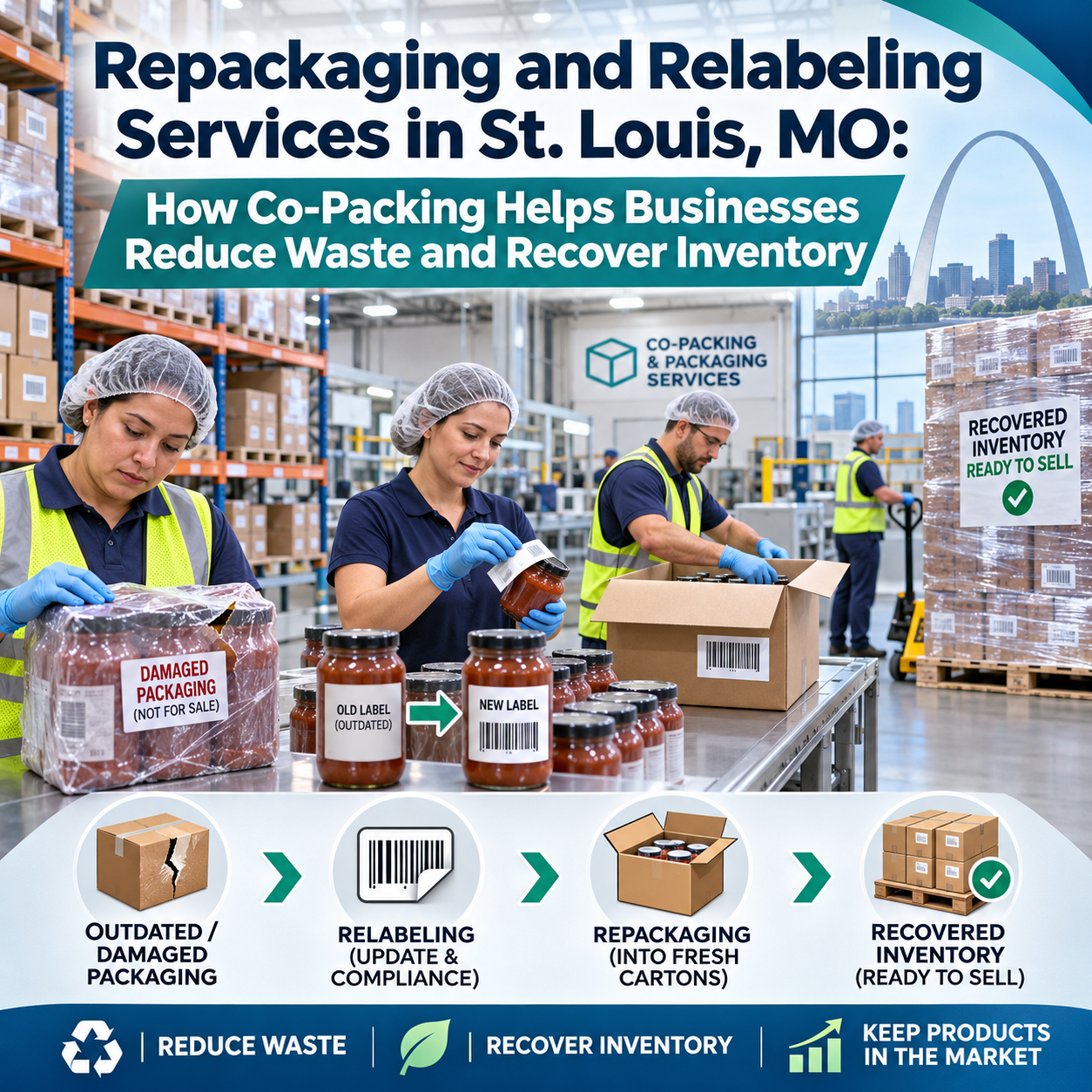
Product repackaging involves removing, replacing, repairing, or reconfiguring packaging materials while preserving the underlying product whenever possible.
Common repackaging applications include:
Replacing damaged shipping cartons or retail boxes.
Transferring products into updated packaging.
Reconfiguring product bundles or multipacks.
Replacing worn or outdated packaging materials.
Preparing products for new retail distribution channels.
Reworking packaging affected by transportation or handling.
Consolidating individual products into promotional kits.
For example, a St. Louis manufacturer may have thousands of perfectly functional products stored in cartons damaged during transportation.
Instead of discarding the entire shipment, a professional repackaging operation may be able to replace the damaged cartons, inspect the products, and prepare the recovered inventory for distribution.
The result is less waste and a greater opportunity to preserve the value of existing inventory.
Product relabeling focuses on replacing, updating, or correcting labels already applied to products or packaging.
Common relabeling applications include:
Updating product identification labels.
Correcting barcode or SKU information.
Replacing damaged or unreadable labels.
Updating retail pricing or promotional information.
Applying approved compliance labels.
Adding distributor-specific identification.
Updating packaging for different sales channels.
Correcting approved product information.
For example, a distributor may receive a large shipment with incorrect barcode labels.
Rather than returning the products to the manufacturer, the distributor may be able to use a local St. Louis relabeling service to apply corrected labels and prepare the shipment for retail distribution.
Relabeling must follow applicable product-specific requirements, particularly when products involve regulated information, expiration dates, safety warnings, or traceability.
Packaging plays a critical role in product protection, branding, retail presentation, and supply chain efficiency.
However, even well-managed businesses encounter packaging problems.
A packaging design may become outdated. A retailer may introduce new labeling requirements. A shipment may arrive with damaged cartons. A manufacturer may discover incorrect information after thousands of products have already been packaged.
These situations can create significant financial and operational challenges.
Products with damaged or incorrect packaging may be rejected by retailers, distributors, or fulfillment centers.
Even when the underlying product remains usable, packaging defects can prevent it from reaching customers.
Without an effective recovery strategy, businesses may experience unnecessary inventory write-offs.
Inventory awaiting packaging corrections occupies valuable warehouse space.
The longer products remain on hold, the more businesses may spend on storage, handling, inventory management, and administrative coordination.
For companies operating in the St. Louis metropolitan area, outsourcing packaging rework can help move recoverable inventory through the supply chain more efficiently.
Packaging defects can interrupt fulfillment schedules and prevent shipments from reaching their intended destinations.
These delays may affect retailer relationships, customer satisfaction, and future purchase orders.
Discarding products because of damaged outer packaging creates avoidable waste.
In some situations, businesses may be able to recover the product by replacing only the defective packaging components.
This approach can support sustainability goals while reducing the need to manufacture replacement inventory.
Co-packing companies provide outsourced packaging operations that help manufacturers and distributors manage product preparation, packaging modifications, assembly, and related activities.
When inventory becomes temporarily unsellable because of packaging-related problems, an experienced co-packing partner can help implement a structured recovery process.
Illustrative workflow for evaluating and recovering packaging-related inventory.
The recovery process begins by evaluating affected inventory.
Businesses must determine whether products are suitable for repackaging or relabeling.
This assessment may involve identifying packaging defects, separating damaged inventory, reviewing labeling requirements, and determining whether the underlying products remain safe and suitable for sale.
Products that cannot be verified as safe, compliant, and suitable for distribution should not be released through packaging rework alone.
Once the affected inventory has been evaluated, the business and its packaging partner can establish a rework plan.
This may include selecting replacement cartons, preparing corrected labels, determining packaging configurations, and establishing inspection requirements.
A clear strategy helps minimize unnecessary handling and maintain consistency throughout the project.
After the project requirements have been approved, packaging personnel can begin the necessary rework.
Depending on the product and packaging configuration, the process may involve manual packaging, semi-automated operations, or automated equipment.
Manual packaging is often appropriate for specialized products, mixed inventory, or projects requiring careful individual inspection.
Automated processes may be more suitable for standardized packaging configurations and larger production volumes.
Quality control is essential when recovering inventory.
Packaging teams should verify that products are packaged correctly, labels match approved specifications, and finished goods meet the applicable distribution requirements.
Barcode readability, packaging integrity, product identification, and lot traceability may also require verification.
Once packaging rework and quality checks are complete, approved inventory can be prepared for shipment or returned to the appropriate distribution process.
This may involve carton sealing, case labeling, pallet preparation, and coordination with the business’s logistics team.
The objective is to move recovered products back into sellable inventory as efficiently as possible.
Professional repackaging and relabeling services can create measurable operational benefits for manufacturers, distributors, and growing consumer brands.
One of the most significant advantages of repackaging is the opportunity to preserve usable inventory.
When the underlying product remains intact and suitable for sale, replacing damaged packaging may be substantially less expensive than manufacturing replacement products.
Consider a hypothetical St. Louis distributor with 10,000 products affected by damaged outer cartons.
If each product has a recoverable inventory value of $15, the affected inventory represents $150,000 in potential value.
If the products are eligible for recovery, repackaging may help preserve a substantial portion of that investment.
Replacing an entire product because of a defective label or damaged box may generate unnecessary waste.
Targeted packaging corrections allow businesses to replace only the materials that require attention.
For example, a product with an incorrect outer label may only need a properly approved replacement label rather than entirely new packaging.
Businesses can also evaluate recyclable or right-sized replacement materials where appropriate.
Manufacturing replacement inventory can involve raw materials, labor, equipment time, transportation, and additional packaging.
Recovering existing inventory may eliminate some of these expenses.
The actual savings depend on product condition, recovery rates, labor requirements, material costs, and inspection procedures.
Damaged or incorrectly labeled inventory often remains in storage until a correction strategy is developed.
This creates congestion and may interfere with normal warehouse operations.
Outsourcing repackaging projects can help businesses establish a dedicated workflow for resolving packaging problems.
Waste reduction has become an important consideration for manufacturers and consumer brands.
Repackaging supports sustainability initiatives by extending the commercial usefulness of products that would otherwise be discarded because of correctable packaging issues.
However, businesses should evaluate the total environmental impact, including replacement materials, transportation, and waste generated during rework.
St. Louis has a diverse business environment that includes manufacturing, distribution, consumer products, logistics, and industrial operations.
Many of these businesses encounter situations where packaging modifications become necessary.
Consumer packaged goods companies frequently update product packaging to accommodate branding changes, promotions, retailer requirements, and product configurations.
Repackaging can help businesses transition between packaging designs without automatically discarding existing inventory.
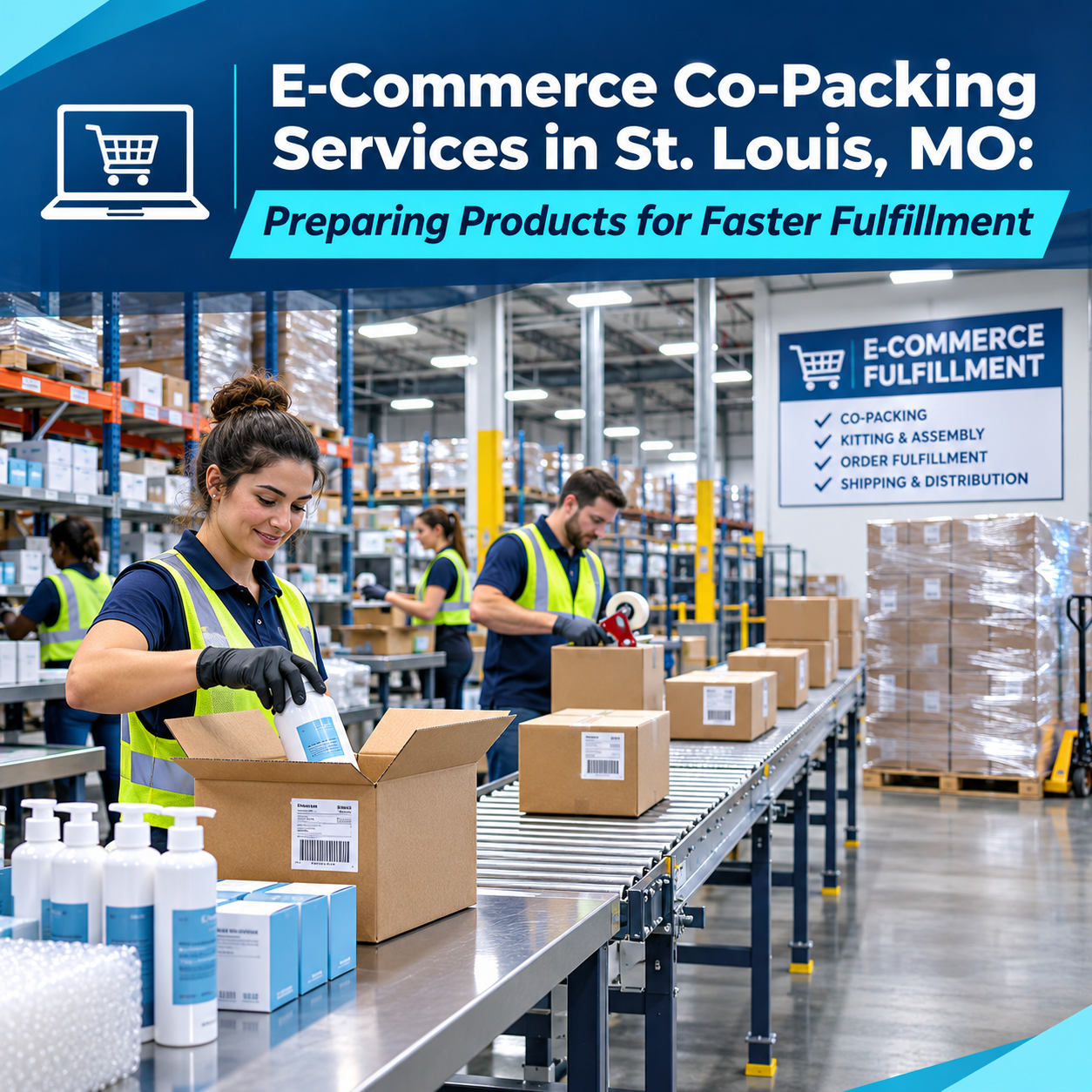
E-commerce brands and retail distributors often require specific product labels, barcodes, carton configurations, and packaging standards.
A product prepared for one distribution channel may require modifications before entering another.
Co-packing services can help businesses adapt approved packaging configurations for different fulfillment requirements.
Manufacturers of industrial components, hardware, and related products may require packaging updates when inventory is transferred between distributors or customer accounts.
Repackaging and relabeling can help organize products into new case quantities, apply updated identification, or replace damaged protective materials.
Seasonal merchandise and promotional products frequently require time-sensitive packaging changes.
Businesses may need to remove outdated promotional packaging, prepare new bundles, or update product presentation for upcoming campaigns.
Local co-packing services can provide additional packaging capacity during these transitions.
Some food, beverage, personal care, and other regulated products may require labeling corrections.
These projects demand additional attention to product safety, traceability, labeling regulations, and handling requirements.
Not every co-packing provider is equipped or authorized to handle every regulated product category. Businesses should verify a provider’s capabilities and applicable compliance procedures before proceeding.
Businesses evaluating damaged or incorrectly labeled inventory should compare the cost of recovering existing products against the expense of replacing them.
The following hypothetical example illustrates how repackaging may affect overall costs.
Cost factor | Replace inventory | Repackage inventory |
|---|---|---|
Inventory quantity | 5,000 units | 5,000 units |
Cost per unit | $12.00 | $3.00 |
Total cost | $60,000 | $15,000 |
Potential savings | — | $45,000 |
Illustrative example only. Assumes all 5,000 units qualify for recovery and the $3.00 rework cost includes applicable recovery expenses. Actual costs and savings vary by project.
Potential cost reduction in this example
In this scenario, repackaging costs $45,000 less than producing replacement inventory.
For businesses managing frequent packaging changes or large quantities of recoverable inventory, the financial impact can be substantial.
However, repackaging is not automatically the most economical option. Companies should consider inspection costs, material expenses, labor requirements, freight, compliance obligations, and the percentage of inventory that can actually be recovered.
Choosing a regional packaging partner can provide several operational advantages.
Businesses located in St. Louis, St. Charles, Chesterfield, Maryland Heights, Earth City, Bridgeton, Fenton, and surrounding Missouri communities may benefit from working with a co-packing company familiar with regional manufacturing and distribution needs.
Shipping inventory to distant packaging facilities can introduce additional freight expenses and logistical coordination.
A local co-packing partner may help reduce transportation distances and simplify inventory transfers.
Packaging rework projects often require quick decisions regarding specifications, materials, quantities, and scheduling.
Working with a regional provider can make facility visits, project discussions, and production coordination more convenient.
Unexpected packaging defects can create immediate operational challenges.
A local packaging partner may be better positioned to evaluate urgent requests and coordinate practical recovery solutions, depending on available capacity.
St. Louis occupies an important position within the Midwest transportation and distribution network.
Its access to major interstate corridors makes the region a practical location for packaging, warehousing, manufacturing, and logistics operations.
For companies distributing products throughout Missouri, Illinois, and neighboring states, regional co-packing services can complement existing supply chain strategies.
One of the challenges businesses encounter during relabeling projects is coordinating multiple vendors.
A company may need one supplier to print replacement labels, another to manage packaging materials, and a third to apply labels or complete packaging rework.
This approach can introduce additional communication requirements, transportation movements, and scheduling dependencies.
Working with a provider that offers both printing and packaging services can simplify project coordination.
When printing and packaging activities are coordinated, teams can work from consistent specifications.
This may reduce the risk of mismatched labels, incorrect dimensions, or incompatible packaging materials.
Each vendor handoff creates another opportunity for scheduling delays or miscommunication.
Integrated services can reduce unnecessary transfers between printing and packaging operations.
Coordinating printing and packaging requirements can help maintain consistent product presentation across a rework project.
This is particularly important for retail packaging, where label placement, barcode readability, and visual consistency may affect acceptance.
Businesses can benefit from a more centralized process for discussing packaging requirements, approving materials, and monitoring project progress.
For companies searching for repackaging and relabeling services in St. Louis, MO, evaluating providers with both printing and co-packing capabilities is a practical starting point.
Not every packaging correction requires an outside provider.
However, outsourcing becomes particularly valuable when packaging problems exceed a company’s available labor, equipment, or production capacity.
Businesses should consider professional co-packing support when:
Large quantities of inventory require packaging corrections.
Internal employees are needed for core manufacturing operations.
Packaging projects require specialized equipment or processes.
Retailers introduce new packaging or labeling requirements.
Inventory recovery must be completed within a defined deadline.
Seasonal demand creates temporary packaging labor shortages.
Multiple product variations require coordinated packaging changes.
Packaging rework is becoming a recurring operational expense.
Outsourcing can allow internal teams to focus on manufacturing, sales, fulfillment, and other core business activities.
It can also help businesses avoid investing in permanent packaging equipment for temporary or irregular projects.
Selecting a co-packing partner requires more than comparing service prices.
Businesses should evaluate whether a provider can handle their specific products, packaging configurations, project volumes, and quality requirements.
Determine whether the company supports the necessary repackaging, relabeling, assembly, or secondary packaging processes.
Some projects require manual handling, while others benefit from specialized equipment.
Ask how the provider verifies label accuracy, packaging consistency, barcode readability, and finished product quality.
Businesses handling regulated products should also confirm applicable compliance and traceability procedures.
Packaging recovery projects may involve hundreds, thousands, or tens of thousands of units.
A provider should be able to discuss realistic production capacity and project timelines.
If a project requires replacement labels, printed cartons, or updated packaging materials, integrated printing capabilities may simplify coordination.
A useful estimate should address applicable labor, materials, setup requirements, inspection procedures, transportation, and project timing.
Clear expectations help businesses make informed decisions about inventory recovery.
Businesses dealing with packaging challenges need practical solutions that protect product value and support operational efficiency.
At Elite Printing & Packaging, Inc., our focus is on helping businesses address printing, packaging, and co-packing needs through coordinated solutions.
For manufacturers, distributors, and consumer brands throughout the St. Louis region, evaluating available packaging services can be an important step toward reducing unnecessary inventory losses.
Whether your business is dealing with outdated packaging, changing distribution requirements, product bundling needs, or inventory that may qualify for packaging rework, the right approach begins with understanding your products and project specifications.
Our team can discuss your packaging requirements, evaluate the scope of your project, and determine which available services may be appropriate.
By approaching packaging as part of the larger supply chain, businesses can identify opportunities to improve efficiency, reduce unnecessary handling, and preserve the value of existing inventory.
Repackaging involves replacing or modifying a product’s packaging materials, such as boxes, cartons, or retail packaging. Relabeling involves correcting, replacing, or updating labels applied to products or packaging. Both services can help businesses address packaging problems without automatically replacing the underlying products.
Yes, some inventory can be recovered when damage is limited to packaging and the underlying products remain safe, functional, compliant, and suitable for distribution. Recovery eligibility depends on the product category, extent of damage, and applicable quality requirements.
Repackaging costs vary depending on product quantity, packaging complexity, labor requirements, replacement materials, and inspection procedures. Businesses should request a project-specific estimate to compare recovery costs against replacement inventory expenses.
Many co-packing companies can support high-volume relabeling projects, depending on their equipment, staffing, capacity, and product handling capabilities. Businesses should confirm production capacity and project timelines before selecting a provider.
Repackaging can reduce waste by preserving usable products and replacing only defective packaging components when appropriate. This may prevent unnecessary disposal of products that remain suitable for sale.
Manufacturers, distributors, e-commerce businesses, consumer packaged goods companies, industrial suppliers, and retail brands may require relabeling when product information, barcodes, packaging designs, or distribution requirements change.
A local provider may offer easier project coordination, shorter transportation distances, convenient facility access, and better alignment with regional supply chain operations.
Packaging defects, outdated labels, and changing retail requirements do not always mean valuable inventory must be discarded.
With the right recovery strategy, businesses can potentially restore usable products, reduce packaging waste, control operational expenses, and improve supply chain efficiency.
Professional repackaging and relabeling services in St. Louis, MO provide manufacturers, distributors, and consumer brands with an alternative to unnecessary inventory replacement.
From damaged cartons and incorrect labels to changing retail packaging requirements, co-packing solutions can help businesses manage packaging challenges while protecting existing inventory investments.
For businesses throughout St. Louis and the surrounding Missouri region, partnering with an experienced printing and packaging company can make these projects easier to coordinate.
Don’t let damaged packaging, outdated labels, or packaging-related inventory problems create unnecessary costs for your business.
Elite Printing & Packaging, Inc. can help you explore printing, packaging, and co-packing solutions tailored to your operational needs.
Whether you’re evaluating an inventory recovery project, preparing products for retail distribution, or looking to streamline your packaging operations, we’re ready to discuss your requirements.
Contact Elite Printing & Packaging, Inc. today to discuss your project and request a quote.

Bring your vision to life with custom flexible packaging, labels, and retail-ready design.

Premium materials and finishes that elevate your brand.

Efficient, compliant, and versatile co-packing for pet and human products.

From warehouse to doorstep — done right, every time.
Bring your vision to life with custom flexible packaging, labels, and retail-ready design.
Premium materials and finishes that elevate your brand.
Efficient, compliant, and versatile co-packing for pet and human products.
From warehouse to doorstep — done right, every time.