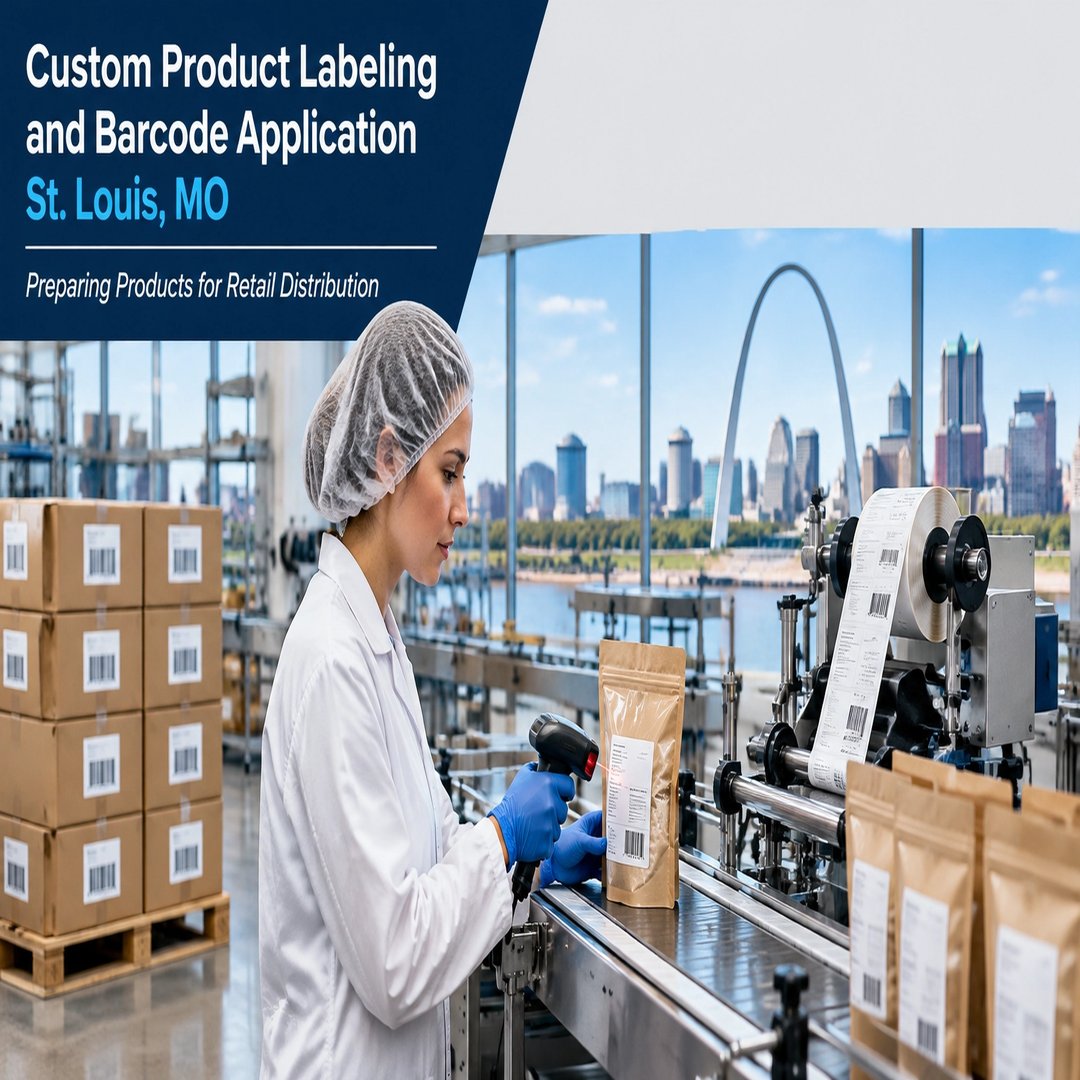




That’s where custom product labeling and barcode application services in St. Louis, MO become an important part of preparing products for retail distribution. They help connect accurate product information with the right label, package, and shipping unit.
However, label programs can fail when nobody owns the data behind them. A correct-looking barcode may still point to the wrong SKU, and a case label may not match the shipment details a retailer expects.
Professional co-packing services in St. Louis, Missouri can help simplify these operational challenges.
At Elite Printing & Packaging, Inc., we understand how printing, packaging, co-packing, and fulfillment work together. Our one-stop model can help brands coordinate more of the process, from printed labels and packaged products to kitting and shipment preparation.
In this article, we’ll explain how custom product labeling and barcode application work, what to prepare for a retail run, and how to evaluate a labeling partner in the St. Louis area.
Custom product labeling means producing and applying labels designed for a specific product, package, brand, or retailer. A custom printed label may carry branding and product information, while a variable-data label includes details that change from unit to unit or batch to batch, such as a lot number, date code, or serialized identifier.
Barcode application is the process of printing or applying a scannable barcode in the correct location and verifying that it can be read. A UPC barcode is commonly used at retail point of sale. The GTIN, or Global Trade Item Number, identifies the product; brands obtain GTINs through GS1, while retailers specify the required barcode format and shipping-label rules.
“Retail ready” means that a product and its shipping units are prepared to meet the retailer’s applicable requirements for identification, handling, receiving, and shelf presentation. The exact specifications vary by retailer and product.
A labeling run can involve product labels, shipping labels, or both. A typical workflow includes:
Label specification and artwork review. Confirm label dimensions, content, placement, approved files, and retailer instructions.
UPC/GTIN assignment and verification. Match the product identifiers to the correct SKU and confirm the intended barcode format.
Print proofing. Review a proof for text, graphics, codes, and version accuracy before production.
Material and adhesive selection. Choose a label stock and adhesive that suit the package surface and conditions.
Label printing. Print approved labels, including variable information where required.
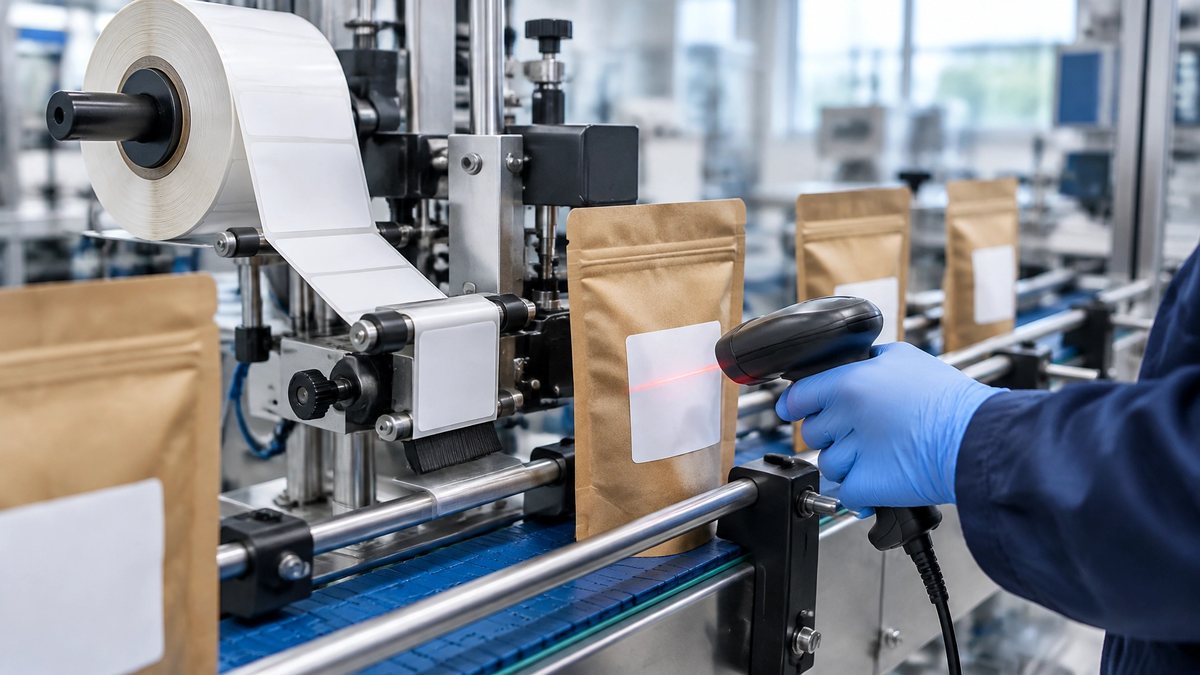
Application. Apply labels by hand, with a semi-automatic applicator, or using an automatic application system, depending on the product and run.
Verification and scan testing. Check label placement and readability using the agreed inspection method and scanners.
Case and pallet labeling. Apply case codes and pallet labels according to the retailer’s routing and shipment instructions.
Finished-goods audit. Check SKU identity, label version, code legibility, case contents, and required shipment information.
Shipment. Release approved goods for pickup, fulfillment, or retail distribution.
Label or barcode type | Where it goes | Why it matters |
|---|---|---|
Primary product label | Product container or package | Identifies the brand and product and presents required information. |
UPC/GTIN retail barcode | Consumer unit | Supports product identification and scanning at checkout. |
Lot and date code | Product or package | Supports inventory rotation and traceability. |
Nutrition and ingredient panel | Food or supplement package | Presents product information; content must be reviewed for applicable requirements. |
Case code (ITF-14 or GS1-128) | Shipping case | Identifies case-level product information in the format required by the retailer. |
Pallet label (SSCC) | Pallet or shipping unit | Identifies a logistics unit; data should match shipment documentation when required. |
Promotional or price sticker | Product package | Supports a temporary price, promotion, or retailer-specific program. |
Tamper-evident seal | Closure or package opening | Helps show whether a package has been opened or disturbed. |
For logistics labels and shipping-unit identification, consult the GS1 Logistics Label Guideline and the retailer’s own specifications. The required barcode, placement, and data fields can vary, so do not assume one label format will work for every program.
A labeling issue can affect more than shelf appearance. If required case or pallet information is missing or inconsistent, a distribution center may have trouble receiving or routing a shipment. If an advance ship notice (ASN), the electronic notice of what is being shipped, does not match the physical shipment, the retailer’s receiving process may be disrupted and chargebacks may apply under its vendor terms.
At the store, a barcode that will not scan can delay checkout or require manual intervention. Missing or unreadable lot codes can also make it harder to trace affected product. And when the error is found after products are packed, rework may mean opening cases, sorting units, applying new labels, and repeating inspection steps.
Common error | Control that helps catch it |
|---|---|
Wrong artwork version | Use a controlled approval process and remove superseded files from the run materials. |
Barcode too small, low contrast, or missing a required quiet zone | Review the code against the relevant specification and scan-test representative labels before the run. |
Adhesive unsuitable for cold or damp conditions | Test the label stock and adhesive on the actual surface under expected handling conditions. |
Wrinkling or flagging on a flexible pouch | Confirm label position and material, then assess application on the filled package rather than a flat sample alone. |
Missing or illegible lot code | Define code placement and format in the run instructions and check code legibility during production. |
Mixed SKU labels in a kitting run | Separate and identify SKU-specific materials, then verify kit contents and labels at changeover. |
Case label mismatched to contents | Reconcile the SKU and case-pack specification with the label data before applying and during the finished-goods audit. |
Label behavior depends on the package. A label on a jar or tube must work across a curved surface; one on a squeezable container needs to stay attached as the package flexes. Condensation, surface texture, fill conditions, and storage temperatures may also affect adhesion and readability.
Flexible pouches can wrinkle or shift during handling, so the label position and adhesive should be evaluated on the finished pouch. With cartons, teams should check that labels do not cover seams, openings, or important printed information. Shrink sleeves are different from pressure-sensitive labels: they fit around the package and rely on heat to conform. Their graphics must register correctly with the container and any required product information.
Decide early whether labeling will happen on the packaging line or in a separate labeling run. Applying a label during production may reduce later handling, but it needs to fit the line setup and package design. A separate run can offer flexibility for finished inventory, but it adds another handling step. Early review helps avoid rework and supports a more accurate cost estimate. Learn more about Elite’s label printing, flexible packaging, and shrink sleeves and tamper bands.

Labeling costs depend on the number of SKUs and units, label size and materials, variable data requirements, application method, setup, inspection needs, and whether case preparation, kitting, or fulfillment is included. Hand application may suit some lower-volume or variable projects, while automated application may require equipment setup and compatible packaging. Actual costs depend on project complexity, quantities, and materials.
St. Louis connects I-44, I-55, I-64, and I-70, routes that support distribution planning to markets such as Kansas City, Chicago, Indianapolis, and Memphis. The region includes business communities in St. Charles, Chesterfield, Maryland Heights, and Hazelwood. The St. Louis Regional Freightway provides additional information about the area’s interstate connections.
When labeling and fulfillment can be coordinated in the same region, products may avoid an unnecessary trip between separate vendors before distribution. The best arrangement depends on the brand’s inventory locations, retailer destinations, carrier options, and schedule.
Before requesting a quote or booking production time, assemble a clear project brief:
Product list and SKU matrix: Identify every product, size, flavor, and label variation.
GTIN/UPC data and GS1 documentation: Provide the assigned product identifiers and supporting information.
Retailer label and case-marking requirements: Share current routing guides, label layouts, and shipment instructions.
Approved artwork and version control: Mark the final files clearly and identify who can approve revisions.
Label material and adhesive specification: Include known requirements for surfaces, temperature, moisture, or storage.
Application method and surface: Describe the package and where each label belongs.
Lot and date coding rules: Specify format, placement, and any traceability needs.
Case pack and pallet configuration: State units per case and pallet patterns, if specified.
Scan-test expectations: Identify the retailer’s barcode standards and the checks you expect from the provider.
Quantities and lead times: Share run quantities, material availability, and required ship date.
Some businesses print labels in-house; others work with a print provider or a co-packer that coordinates printing and application. Ask what is included: label production, application, variable-data handling, scan testing, case and pallet labeling, and final inspection may be separate services.
A prospective partner should explain its barcode verification and scan-testing process, how proofs and artwork versions are controlled, and how it prevents SKU mix-ups. If variable data or serialization is required, clarify how data is supplied, checked, and tied to the correct product. Also ask whether label application can be included in a co-packing run and how lot traceability is maintained.
For products with specific food or supplement handling needs, ask which certifications and procedures apply to the facility and project. Elite lists Certified Organic, Kosher, GMP, Blue Food Safety, and MARS credentials. FDA requirements depend on the product and activity; FDA is not a single blanket certification. Confirm the scope of any credential and the requirements relevant to your product.
Finally, discuss flexible minimums, realistic lead times, references, and how the provider handles a first run or changed artwork. A label printing provider should be able to explain its capabilities clearly, including whether labels are printed in-house or sourced from another supplier. Elite’s label printing services include barcode label options, while its kitting and assembly services list labeling and compliance support. Confirm the specific application and verification requirements for your project.
As a product line grows, SKU proliferation, retailer-specific label variations, and seasonal promotions can multiply the number of files and materials that need to stay organized. A change that is simple for one product may affect its case label, kit configuration, or shipment documentation too.
One partner coordinating print, label, pack, and ship can reduce handoffs and create clearer checkpoints for label approval and SKU control. Elite connects printing, packaging, co-packing, and fulfillment, with services that can include kitting and shipment preparation. The right scope depends on the product and the retailer’s requirements.
Getting products retail ready means aligning the product label, barcode data, case markings, and shipping plan before the appointment or ship date. Clear specifications and defined verification steps help teams find issues before finished goods are on the move.
Elite Printing & Packaging, Inc. brings printing, packaging, co-packing, and fulfillment together, with traceable lot control, flexible minimums, and experience serving pet and human food brands.
Ready to review your next production run? Visit Elite Printing & Packaging, Inc. to discuss your product, labeling needs, and retail distribution requirements.
Custom product labeling is the creation and application of labels tailored to a product, package, brand, or retailer. Labels may include printed artwork, product details, barcodes, lot codes, or other variable information.
Barcode application is placing a scannable barcode on a product, case, or pallet in the required location and format. A scan test can help check that the printed code is readable.
Many retailers require a UPC barcode on consumer products, but exact requirements vary by retailer and product. Confirm the required GTIN and barcode format with the retailer before printing labels.
Some co-packers can apply product labels or shipping labels as part of a packaging or kitting run. Confirm that the provider can meet your label placement, data, verification, and retailer-specific requirements.
Costs vary based on quantities, label materials, number of SKUs, variable data, application method, setup, and inspection requirements. Request a quote based on your product specifications and the full scope of work.
Search for a St. Louis-area product labeling company or co-packing provider, then compare its printing, application, scan-testing, traceability, and fulfillment capabilities. Ask how it will handle your retailer’s label and shipment specifications.


