
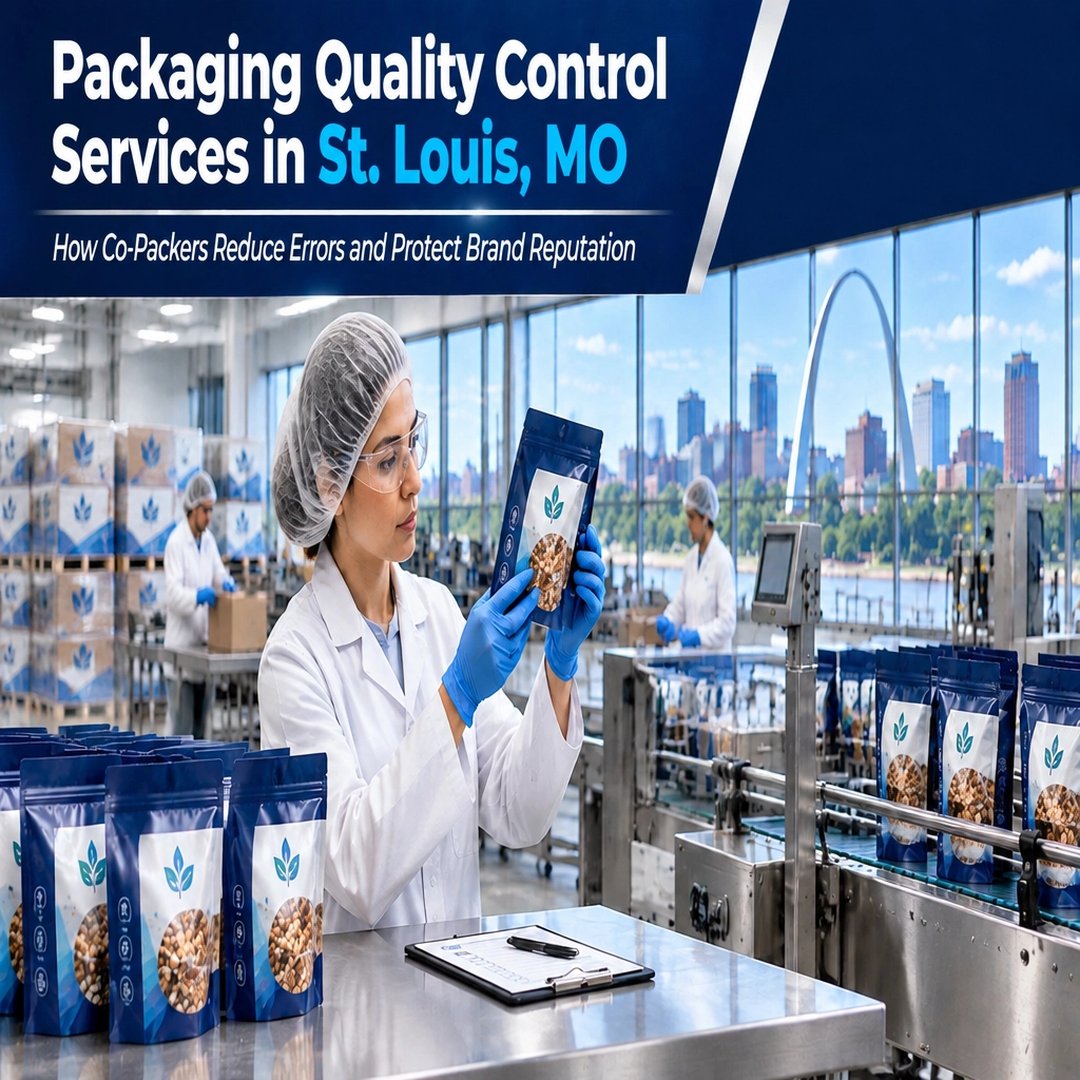


A single mislabeled lot can stop a production run, trigger a retailer chargeback, or pull product off the shelf while a brand investigates what happened. For manufacturers and brands filling pouches, jars, sachets, or kits, packaging errors rarely stay small, and the cost is measured in more than scrap.
That’s where packaging quality control services in St. Louis, MO become an operational safeguard rather than a line item.
Packaging quality control combines the inspections, documentation, and process checks that confirm a finished package matches its approved specification before it ships. From fill weight and seal integrity to label version and lot code accuracy, these checks protect both the product and the reputation behind it.
However, having a quality process on paper is only part of the equation.
Brands must also confirm that the process runs consistently across every lot, every SKU, and every changeover, from a first production run to a seasonal demand spike.
Professional co-packing services in St. Louis, Missouri can help simplify these operational challenges.
At Elite Printing & Packaging, Inc., we understand how packaging operations and brand reputation work together. By integrating printing, packaging, co-packing, and fulfillment under one roof, businesses can reduce errors while protecting the experience shoppers have with the product.
In this article, we’ll explore how packaging quality control works inside a co-packing facility, why it matters, and how St. Louis businesses can build a more reliable quality process.
Packaging quality control is the inspection and testing of packaging materials and finished products to confirm they meet agreed specifications. Quality assurance is the broader system of procedures and controls designed to prevent problems and make the process reliable.
Unlike a single visual check at the end of a line, an established program builds verification into each stage of the run, so a problem surfaces at the machine rather than in a retailer’s distribution center.
Inside a co-packing facility, QC can cover incoming materials, production setup, filling and sealing, printed components, finished goods, and shipment documentation. The specific checks depend on the product, packaging format, customer requirements, and applicable food or supplement rules.
For example, a project involving VFFS pouching may need checks for fill weight, seal quality, and code legibility. A kit assembly project may require a different inspection plan to ensure every package contains the correct components.
A defined sequence helps teams identify issues early and document how each production lot was handled. A typical quality control program may involve several stages:
Inspect incoming materials. Packaging components are checked against specifications for quantity, condition, identity, and relevant certificates or documentation. Printed materials can be compared with the approved artwork version.
Approve setup and first article. Before a run continues, the team checks an initial finished unit, often called a first article, against the approved sample and specifications. That can include fill, seal, label placement, print, and coding.
Run in-process checks. During production, operators or quality staff verify items such as fill weight, seal integrity, code and date accuracy, label or sleeve placement, and print registration. Checks should be performed at documented intervals and after relevant adjustments.
Sample finished goods. A co-packer may use an AQL, or acceptable quality limit, sampling plan to inspect a defined sample from a lot. AQL is a statistical sampling method, not a guarantee that every unit is defect-free; the criteria and acceptance rules should be agreed in advance.
Maintain lot traceability. Lot coding links finished cases to relevant production records and, where applicable, incoming components. This helps the parties identify affected product if an investigation is needed.
Document results and address deviations. Inspection records show what was checked and what was found. If a check falls outside specification, the affected product may be held while the team investigates, documents a corrective action, and determines whether the product can be released, reworked, or rejected.
An AQL plan should define the sample size, defect categories, and acceptance criteria for the particular project. There is no single inspection plan appropriate for every product. Brands should agree on the plan with their co-packer and quality or regulatory team before production.
Common packaging error | What may cause it | Control that can catch it |
|---|---|---|
Underfill or overfill | Filler setup, product variation, or equipment drift | Startup approval and scheduled fill-weight checks |
Weak or contaminated seal | Incorrect temperature or pressure, product in the seal area, or unsuitable settings | Seal inspection and agreed seal-integrity tests |
Wrong label or artwork version | Outdated files, mixed materials, or inadequate line clearance | Controlled artwork approval and label verification at setup and during the run |
Missing or incorrect lot code | Printer setup, code changes, or poor legibility | Code and date verification against written rules |
Print color drift | Press or material variation across a run or reprint | Approved color reference and documented visual or instrumental comparison |
Mixed SKUs in a kitting job | Incorrect component staging or assembly | Component counts, line clearance, and finished-kit checks |
Damaged cases in transit | Insufficient case protection, pallet configuration, or handling | Case and pallet inspection before shipment, plus review of transit damage |
These controls are examples, not a universal checklist. The right checks depend on the product’s risks, packaging design, customer specifications, and distribution requirements.
A package is part of the customer’s experience and the retailer’s evaluation of a product. A leak, misprint, or incorrect label may lead to complaints, returns, delayed orders, or chargebacks. For a food or supplement brand, a coding or labeling problem may also require a more formal investigation.
QC records can help a business establish what was produced, which checks were completed, and how a deviation was handled. This documentation supports investigation and communication across the brand, co-packer, and distribution partners. It does not replace a brand’s own quality responsibilities, but it can make shared processes clearer.
Quality checks should cover the package as a whole, not just the product inside it. For printed packaging, businesses should discuss color consistency across reprints, registration, dieline alignment, scuff resistance, and whether flexible film’s sealant performance is suitable for the intended application. For shrink sleeves, placement and coverage should be checked against the approved sample.
These requirements can be coordinated with a provider offering flexible packaging printing, label printing, or shrink sleeves and tamper bands. The brand should supply controlled artwork files and confirm which version is approved for production.
Additional care may be needed for:
Pet food and human food: Confirm product segregation, allergen controls, cleaning procedures, and label verification appropriate to the products and facility.
Supplements and powders: Establish fill-weight tolerances, product handling requirements, and checks suited to the formula and packaging format. Powder filling may require specifications particular to the product’s flow and filling process.
Organic and Kosher products: Confirm documentation, approved materials, and handling requirements for the relevant certification and product scope.
Food safety and GMP programs: Ask how procedures align with applicable FDA requirements and the facility’s documented GMP program. FDA’s current good manufacturing practices guidance provides background for food and dietary supplement businesses.
Certifications and registrations have specific scopes. Ask a provider to show current documentation and explain which products, activities, and facility locations are covered. Elite lists Certified Organic, Kosher, FDA, GMP, Blue Food Safety, and MARS credentials; buyers should verify which apply to their project.
Co-packing, also known as contract packaging, involves outsourcing packaging-related operations to a specialized service provider.
For quality-focused programs, co-packing can extend beyond filling and sealing to include printed component verification, kitting checks, code and date control, and shipment preparation.
This integrated approach helps businesses coordinate multiple checks without managing every step internally.
Incoming film, pouches, labels, cartons, and closures are checked against specifications for quantity, condition, identity, and supporting documentation. Printed components are compared with the approved artwork version, so an outdated label is caught before it ever reaches a line.
Before a run continues, the team checks an initial finished unit against the approved sample and specification. Fill level, seal appearance, label placement, print, and coding are verified together, because setup errors tend to compound quickly at production speed.
During production, operators and quality staff verify fill weight, seal integrity, code and date accuracy, label or sleeve placement, and print registration at documented intervals, and again after any machine adjustment. These checks catch drift before it becomes an entire lot.
Lot coding links finished cases to production records and, where applicable, incoming components. If an investigation is ever needed, that record shows what was produced, which checks were completed, and how a deviation was handled.
A thorough handoff gives the co-packer a clear basis for setup, inspection, and decisions if something does not meet specification. Before production, prepare:
A written specification sheet for the product, package, and finished case.
An approved golden sample, meaning the reference unit used to confirm the expected finished appearance and construction.
Signed-off artwork proofs and the controlled version number.
Fill-weight and seal-strength tolerances, where applicable.
Code and date rules, including format, location, and legibility expectations.
Case-pack quantity and pallet configuration.
The agreed AQL level, sampling plan, defect categories, and acceptance criteria.
An escalation contact for time-sensitive questions or deviations.
Written instructions for how deviations are held, investigated, and dispositioned, such as approved rework, rejection, or release by an authorized party.
During planning, ask how incoming components will be checked, how often in-process inspections occur, how records are retained, and who authorizes release. For multiproduct projects, ask how the team prevents SKU or component mix-ups. If the project includes assembly, kitting and assembly should follow a documented component list and verification method.
A review after production can show whether the controls are working and where the process may need adjustment. Useful measures include:
First-pass yield: The share of units completed correctly without rework.
Deviation count: The number and type of documented departures from specification.
Rework and scrap rate: Product or materials that required correction or could not be used.
On-time-in-full performance: Whether the complete order shipped on schedule.
Complaint rate: Customer or retailer complaints associated with the product or packaging.
Cost of poor quality: Costs tied to inspection, rework, scrap, returns, claims, or chargebacks.
Review trends with the co-packer, rather than treating a single measure as a complete picture. If problems recur, agree on a documented corrective action and how its effectiveness will be checked on later runs.
St. Louis offers practical advantages for businesses coordinating production and quality programs throughout Missouri and neighboring states. Located near major interstate corridors, including I-44, I-55, I-64, and I-70, the region supports distribution planning for markets such as Kansas City, Chicago, Indianapolis, and Memphis.
A local or regional co-packing relationship can make quality coordination more direct. Brands may be able to visit the facility, review a golden sample in person, and discuss a deviation with the production team without relying solely on remote communication. If product needs rework, proximity may also make coordination faster, although turnaround depends on capacity, materials, and scheduling.
For businesses in St. Louis, St. Charles, Chesterfield, Maryland Heights, and surrounding Missouri communities, regional freight may involve fewer handling steps than a longer route, which can help reduce exposure to transit damage. Actual freight time and condition depend on the origin, destination, carrier, packaging, and route.
When searching “co packing near me,” compare providers by process and fit, not distance alone. A nearby provider should still demonstrate appropriate capabilities, clear documentation, and a QC approach matched to the product.
When comparing co packers in St. Louis or a contract packaging company serving the metro area, ask:
What incoming, startup, in-process, and finished-goods inspections are documented?
How are fill weight, seal integrity, codes, dates, and label versions checked?
What sampling plan and defect acceptance criteria would apply to this project?
How are lots identified and traced from incoming components through finished cases?
How are nonconforming products held, investigated, and dispositioned?
What experience does the facility have with the product category and packaging format?
Which certifications or registrations apply to the specific facility and service?
Can printing, packaging, co-packing, and fulfillment be coordinated through one partner?
What quality records are available after a run, and who reviews them?
A packaging company in St. Louis should be able to explain its process in practical terms and identify where the customer’s specifications or approvals are needed.
As food, pet, and supplement brands expand, quality operations often become more complicated.
A brand may begin with a single SKU in a single pouch, then add sizes, multipacks, retailer-specific assortments, and seasonal programs within a few years. Each variation adds a specification, an approval, and a place for an error to enter the run.
Coordinating printing, packaging, co-packing, and fulfillment through separate vendors can introduce additional handoffs and the uncertainty that comes with them.
An integrated approach may combine flexible packaging printing, fill and seal, kitting, quality checks, lot tracking, warehousing, and shipping into a more organized workflow.
The goal is not simply to inspect finished product.
It’s to build a packaging process that supports the brand’s broader growth strategy, one where quality is designed in rather than inspected in at the end.
A strong packaging program protects more than the product inside the package.
It protects the retailer relationship, the launch date, the promotion, and the customer experience that keeps a brand growing.
At Elite Printing & Packaging, Inc., we recognize the important relationship between packaging operations and brand reputation. Businesses preparing for a first production run or evaluating an existing quality process can benefit from reviewing how printing, packaging, co-packing, and fulfillment fit together.
Our St. Louis-focused packaging solutions are designed to help businesses explore efficient approaches to their packaging and production needs, with traceable lot control, flexible minimums, and experience across pet and human food products.
Ready to review your next production run?
Visit Elite Printing & Packaging, Inc. to learn more about our packaging solutions and contact our team to discuss your quality control, co-packing, and retail-ready packaging requirements.
Let us help you build a packaging process that supports your products, your retailers, and your next growth opportunity.
Packaging quality control is the inspection and testing used to confirm that materials and finished packages meet agreed requirements. It may include checks for fill, seals, labels, codes, print, and case configuration.
Packaging errors can cause customer complaints, retailer issues, product holds, or costly rework. Documented checks help reduce the risk of errors reaching customers and support a clear response if a deviation occurs.
Many co-packers include quality checks as part of production, but the scope varies. Ask which inspections are performed, how often, what records are retained, and whether finished-goods sampling is available.
Look for credentials relevant to the product and process, and confirm their current scope. Depending on the project, buyers may ask about Certified Organic, Kosher, GMP, Blue Food Safety, or MARS; clarify how FDA requirements or registrations apply rather than treating FDA as a single blanket certification.
Costs depend on the product, run size, packaging complexity, testing requirements, sampling plan, and documentation requested. Ask for a project-specific quote that distinguishes standard production checks from additional inspection or testing.
Search for co-packing near me and compare providers serving the St. Louis metro by location, product experience, traceability, quality procedures, and service scope. A facility visit and review of its inspection records can help assess fit.

Bring your vision to life with custom flexible packaging, labels, and retail-ready design.

Premium materials and finishes that elevate your brand.

Efficient, compliant, and versatile co-packing for pet and human products.

From warehouse to doorstep — done right, every time.
Bring your vision to life with custom flexible packaging, labels, and retail-ready design.
Premium materials and finishes that elevate your brand.
Efficient, compliant, and versatile co-packing for pet and human products.
From warehouse to doorstep — done right, every time.