
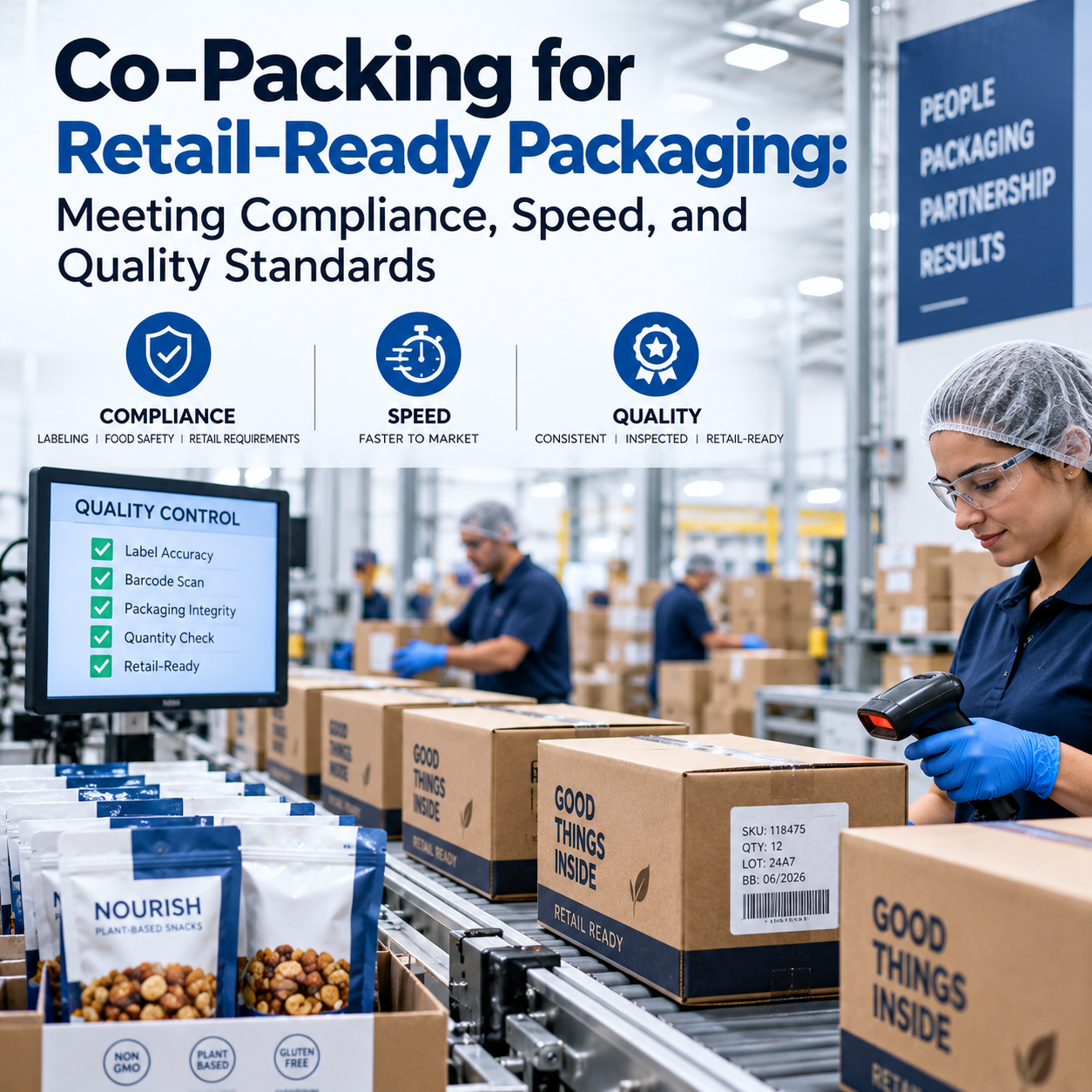
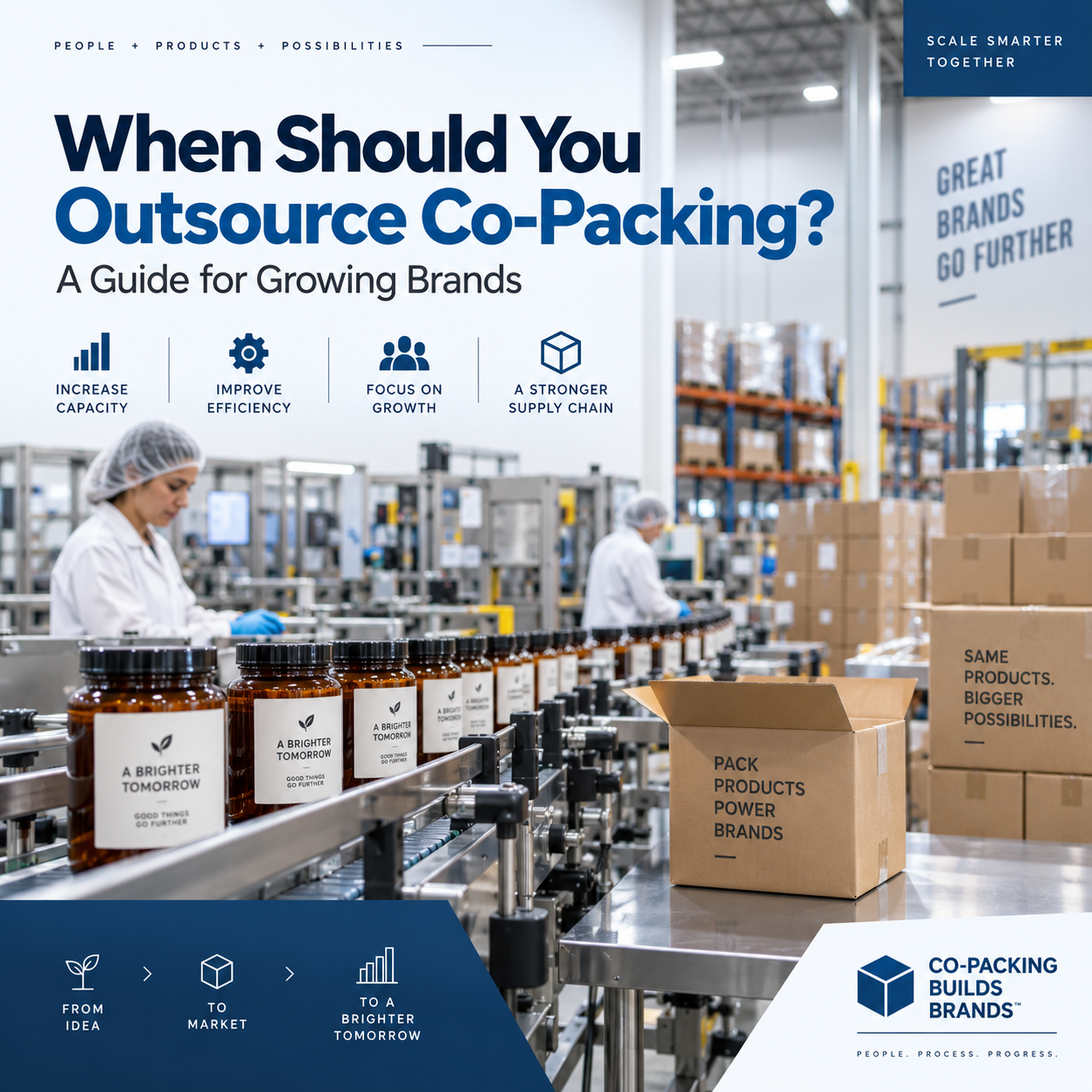
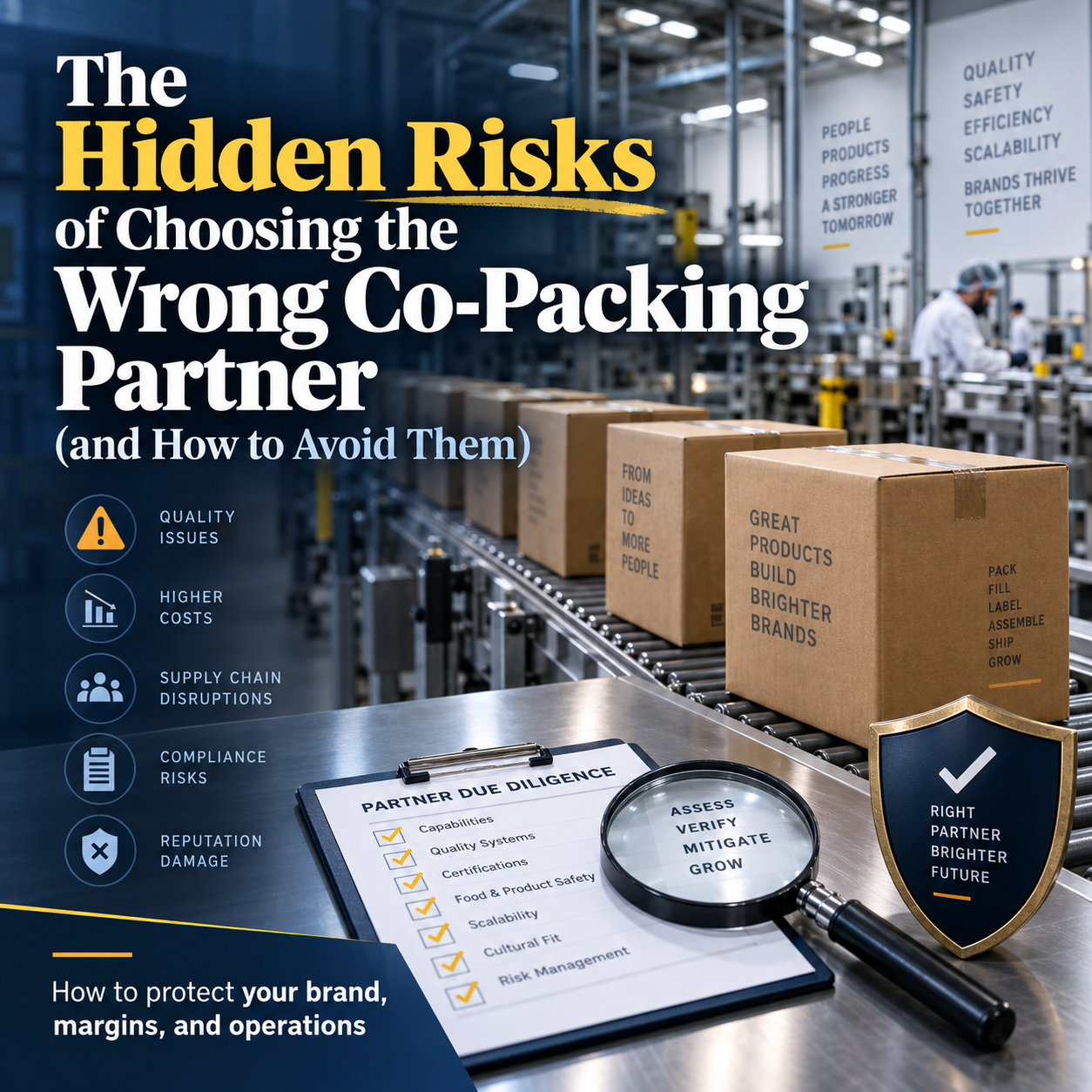

Retailers expect products to arrive packaged, labeled, assembled, and prepared according to specific requirements. A labeling mistake, damaged package, incorrect configuration, or missed deadline can create costly problems throughout the supply chain. For growing brands, managing these requirements internally can quickly consume valuable labor, warehouse space, equipment, and management resources.
Getting a product onto a retail shelf involves far more than putting it into a box and shipping it to a distribution center.
Retailers expect products to arrive packaged, labeled, assembled, and prepared according to specific requirements. A labeling mistake, damaged package, incorrect configuration, or missed deadline can create costly problems throughout the supply chain. For growing brands, managing these requirements internally can quickly consume valuable labor, warehouse space, equipment, and management resources.
That is where an experienced co-packing partner can make a significant difference.
For businesses looking for co-packing services in St. Louis, Missouri, Elite Printing & Packaging provides packaging solutions designed to help brands prepare products for retail while maintaining a focus on compliance, speed, consistency, and quality.
Whether you are preparing for a regional retail launch, fulfilling a major purchase order, assembling promotional packages, or scaling an existing retail program, the right co-packing operation can help turn packaging from an operational challenge into a competitive advantage.
Retail-ready packaging, sometimes referred to as shelf-ready packaging, describes packaging prepared to move efficiently through the retailer’s supply chain and ultimately into the hands of consumers.
Depending on the product and retailer, retail-ready packaging may involve:
Product labeling and relabeling
Shrink wrapping
Bundling and multipacks
Kitting and assembly
Display packaging
Repacking
Promotional packaging
Barcode and label application
Carton preparation
Variety packs
Subscription or specialty kits
Case packing
Inspection and quality control
The exact requirements vary considerably from one retailer, product category, and program to another.
What remains consistent is the need for accuracy, repeatability, and speed.
A retailer may specify how many units belong in each case, where a barcode should appear, how products should be oriented, what information needs to appear on a label, or how cartons and pallets should be configured.
Those details matter.
When thousands of units are involved, even a seemingly minor packaging error can turn into a major operational problem.
Retailers build packaging and shipping requirements around the way their distribution and merchandising systems operate.
When a supplier fails to follow those requirements, the consequences can extend well beyond unattractive packaging.
Noncompliant products can potentially lead to rejected shipments, rework, delays, added freight costs, retailer penalties or chargebacks, inventory disruptions, and missed selling opportunities.
Most importantly, repeated problems can damage the relationship between the brand and the retailer.
That makes packaging compliance an important part of protecting the entire retail program.
An experienced retail co-packing company should build retailer and customer specifications directly into its production process rather than treating compliance as a final inspection step.
Before production begins, the co-packer should understand exactly what the finished product is expected to look like and how it must be prepared for shipment.
A strong co-packing program begins before the first unit enters production.
Specifications should be translated into a clear workflow that production teams can consistently execute.
That may include identifying:
Finished package configuration
Unit counts
Label placement
Barcode requirements
Packaging materials
Assembly sequence
Case quantities
Carton markings
Pallet configurations
Inspection standards
Shipping requirements
The objective is straightforward: eliminate ambiguity from the production floor.
If operators have to guess how a product should be assembled or packaged, quality becomes dependent on individual interpretation.
A documented process creates consistency.
It also makes scaling easier. Whether a project involves 1,000 units or 100,000 units, defined procedures allow additional labor and production capacity to be added without sacrificing the expected finished result.
Retail operates on deadlines.
Product launches, promotions, seasonal programs, resets, and purchase orders all have specific windows. Missing those windows can mean much more than a late shipment.
A delayed packaging project can affect distribution appointments, promotional schedules, inventory availability, retailer commitments, and revenue.
This is one of the major reasons brands outsource packaging.
A capable St. Louis co-packing partner can provide additional production capacity when internal operations cannot keep pace with demand.
Instead of purchasing equipment, hiring temporary employees, rearranging warehouse operations, or asking existing staff to work excessive overtime, brands can transfer packaging-intensive work to an operation already structured to handle it.
This becomes especially valuable during periods of rapid growth.
Growth creates an interesting challenge.
Winning a major retail account is great news—until your team realizes how much additional work is required to fulfill the order.
Suddenly, a business may need more:
Warehouse space
Packaging equipment
Production employees
Supervisors
Inventory staging space
Shipping capacity
Quality-control processes
Building that infrastructure internally requires capital and time.
Outsourcing to a co-packing company in St. Louis gives brands another option.
Instead of building permanent infrastructure around demand that may fluctuate, companies can use an external packaging operation as an extension of their existing supply chain.
That creates flexibility.
Production can expand during major retail programs and adjust when volumes change.
For brands with seasonal products, promotions, special editions, or unpredictable retail demand, that flexibility can be extremely valuable.
Consumers rarely see the manufacturing facility or distribution center behind a product.
They see the package.
A crooked label, torn carton, poor seal, damaged display, incorrect multipack, or visibly inconsistent package can immediately influence how someone perceives the brand.
Packaging quality is therefore closely connected to brand reputation.
The challenge is that quality becomes harder to control as production volumes increase.
If a brand is assembling thousands of retail units under a tight deadline, small inconsistencies can quickly multiply.
An effective co-packing operation incorporates quality checks throughout production.
That can include verifying components before production, inspecting initial finished units, monitoring production during the run, checking label placement and package integrity, confirming case quantities, and performing final inspections before shipment.
Quality control should not simply ask:
“Is the product packaged?”
It should ask:
“Is the product packaged correctly and consistently according to the customer’s requirements?”
That distinction matters.
Retail-ready packaging often requires multiple components to become one finished retail unit.
This is where kitting and assembly services become particularly valuable.
A kit might contain a primary product, accessory, printed insert, promotional item, instruction sheet, coupon, or sample.
Each component must be included correctly.
When thousands of kits are being assembled, even a small error rate can create hundreds of incorrect packages.
A structured kitting process uses clearly defined component counts, assembly sequences, inspections, and finished-product standards.
Professional co-packing helps brands turn multiple inventory components into consistent retail-ready units without tying up their internal teams.
Not every product arrives at the warehouse in the configuration required by the retailer.
Sometimes existing inventory must be modified before it can be sold through a new channel.
That may require repacking or relabeling services.
For example, products might need to be removed from existing cases, labeled for a specific program, combined into multipacks, placed into new cartons, or prepared for promotional displays.
A flexible co-packing operation can perform these secondary packaging processes without requiring the manufacturer to change its primary production line.
This can be especially helpful when companies need to adapt existing inventory for different customers or sales channels.
Geography plays an important role in logistics.
For companies shipping products across the United States, a centrally located packaging operation can help simplify transportation and distribution.
The St. Louis, Missouri region provides convenient access to major transportation networks and markets throughout the Midwest and beyond.
For businesses throughout Missouri and neighboring states, working with a St. Louis co-packing company can also make communication and coordination easier.
Brands may be able to ship bulk products or packaging components to the co-packer, complete secondary packaging locally, and then route finished goods to distribution centers, retailers, or other destinations.
Reducing unnecessary product movement can help create a more efficient supply chain.
Packaging operations depend heavily on inventory accuracy.
A production line cannot run if one component is missing.
Imagine preparing 20,000 promotional kits that each require five different components. Four components arrive on time, but the fifth is short by 2,000 units.
The entire project can be affected.
That is why inventory management and communication are critical elements of successful co-packing.
A strong packaging partner should understand what materials are required, what has arrived, what is still outstanding, and whether available inventory matches the planned production quantity.
This visibility helps identify problems before they reach the production line.
Equipment and warehouse space are important, but communication is equally critical.
Brands need to know what is happening with their inventory and production.
Are all components available?
Has production started?
Is the project on schedule?
Did a quality issue appear?
Will the shipment meet the retailer’s deadline?
A good co-packing partner should reduce the number of problems sitting on the customer’s desk.
The goal is not to create another vendor that requires constant supervision.
The goal is to become a reliable extension of the customer’s operation.
When communication is proactive, brands can focus more of their attention on sales, marketing, product development, and growth rather than chasing packaging updates.
Retail volume is rarely perfectly consistent throughout the year.
Holiday programs, seasonal products, promotions, new product launches, retail resets, and special events can create sudden spikes in packaging demand.
Internal operations built around average volume may struggle when those spikes occur.
This is another area where outsourced co-packing services can provide flexibility.
Rather than maintaining excess labor and equipment year-round, brands can use external capacity when needed.
This approach can be particularly effective for:
Holiday packaging
Promotional bundles
Retail displays
Limited-edition products
Seasonal multipacks
New product launches
Sampling programs
The ability to scale production quickly can help brands take advantage of retail opportunities without permanently increasing overhead.
Outsourcing is not automatically the right choice for every company.
At very low volumes, internal packaging may still be practical.
The equation changes when packaging begins consuming resources needed elsewhere in the business.
It may be time to consider a co-packing partner when:
Retail volume is increasing rapidly.
Your warehouse is running out of space.
Employees are spending too much time on manual packaging.
Retailer specifications are becoming more complicated.
Seasonal volume overwhelms your existing team.
You need specialized packaging equipment.
Quality inconsistencies are increasing.
Retail deadlines are becoming difficult to meet.
You are launching into new retail channels.
Packaging is distracting your team from core business activities.
The decision should ultimately come down to capacity, cost, risk, and operational focus.
If building additional internal packaging infrastructure costs more than outsourcing—or prevents your team from focusing on higher-value activities—co-packing deserves serious consideration.
Choosing the lowest-cost provider is not always the lowest-cost decision.
Packaging mistakes can create expenses far beyond the price of the packaging labor itself.
When evaluating a co-packing company, consider its approach to quality control, communication, capacity, scalability, inventory management, problem-solving, turnaround times, and experience with retail packaging requirements.
Ask prospective partners how they handle projects when something goes wrong.
Anyone can describe what happens when production runs perfectly.
The more revealing question is:
What happens when inventory is short, specifications change, deadlines move, or an unexpected production problem appears?
A solutions-oriented partner should be able to communicate the issue quickly and help develop a practical path forward.
The best co-packing relationships extend beyond individual purchase orders.
Over time, the co-packer becomes familiar with the brand’s products, specifications, expectations, retail customers, and production requirements.
That knowledge creates efficiency.
Future programs become easier to launch because the partner already understands how the customer operates.
This is the difference between simply purchasing packaging labor and building a long-term operational relationship.
A reliable packaging partner should help make the customer’s business easier to operate.
Retail success depends on more than having a great product.
Brands also need the operational ability to package, prepare, and deliver that product according to retailer expectations.
At Elite Printing & Packaging, we understand that packaging is connected to your deadlines, customer relationships, supply chain, and brand reputation.
Our St. Louis-area co-packing solutions are designed to help companies manage packaging, kitting, assembly, labeling, repacking, and other retail-ready packaging requirements while maintaining a focus on quality, efficiency, and dependable execution.
Whether you are preparing for a new retail launch, expanding an existing program, managing seasonal demand, or looking for additional packaging capacity, the right partner can help you scale without adding unnecessary complexity to your internal operation.
If packaging demands are consuming warehouse space, labor, or management time—or you need additional capacity for an upcoming retail program—Elite Printing & Packaging can help.
Talk with our team about your product, packaging requirements, volume, timeline, and retail objectives. We’ll help determine a co-packing solution designed around the needs of your program.

Bring your vision to life with custom flexible packaging, labels, and retail-ready design.

Premium materials and finishes that elevate your brand.

Efficient, compliant, and versatile co-packing for pet and human products.

From warehouse to doorstep — done right, every time.
Bring your vision to life with custom flexible packaging, labels, and retail-ready design.
Premium materials and finishes that elevate your brand.
Efficient, compliant, and versatile co-packing for pet and human products.
From warehouse to doorstep — done right, every time.