
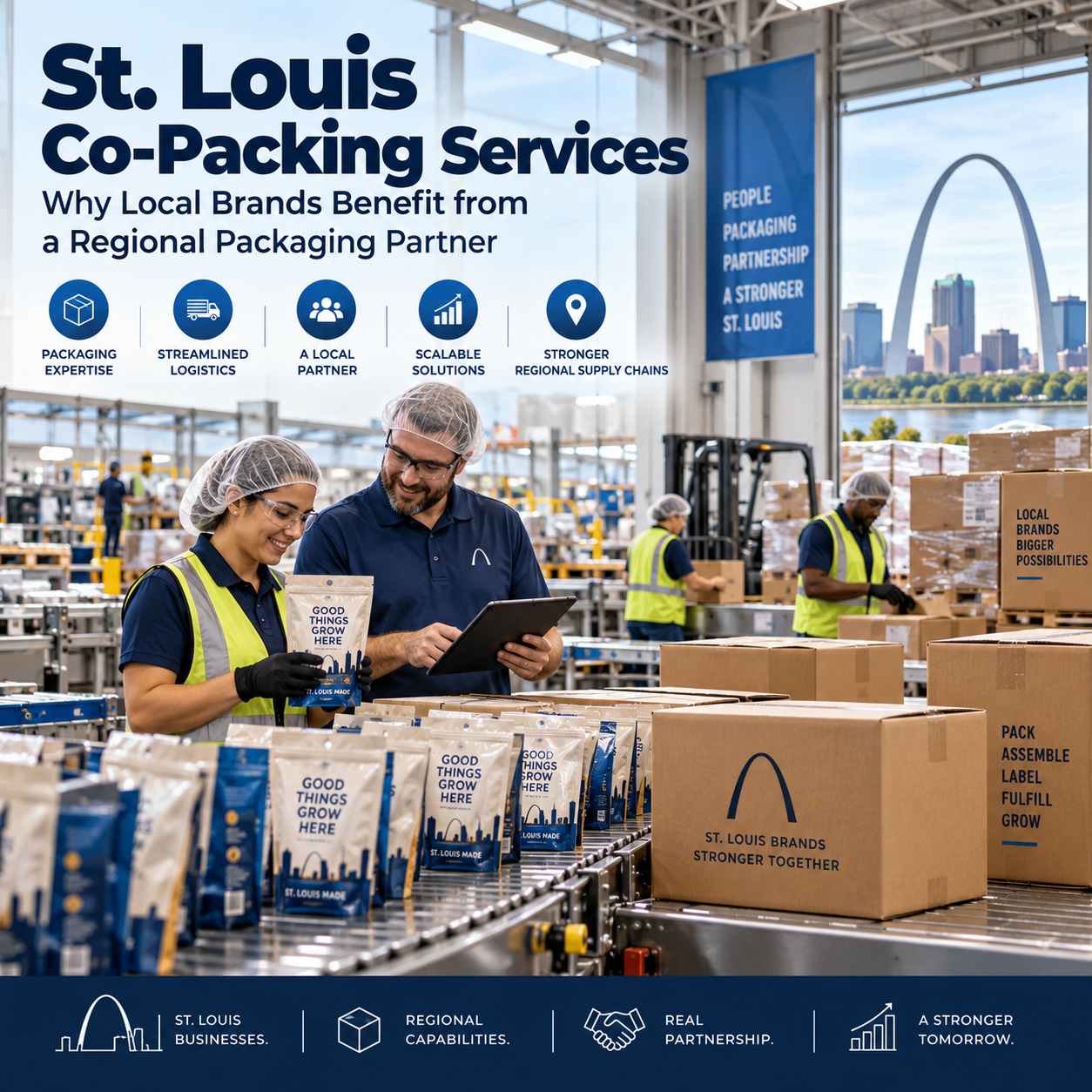

For growing businesses in St. Louis, Missouri, packaging is more than a final step before products reach customers. It’s a critical component of operational efficiency, supply chain management, brand reputation, and long-term profitability. As consumer expectations increase and distribution requirements become more complex, businesses must find smarter ways to package, assemble, and deliver their products without sacrificing quality or efficiency.
That’s where professional St. Louis co-packing services can make a significant difference.
Whether you’re a local manufacturer, emerging consumer goods brand, established retailer, or e-commerce business, working with a regional co-packing partner offers advantages that extend well beyond convenience. From reduced transportation expenses and faster turnaround times to improved communication and greater operational flexibility, local co-packing solutions can help businesses streamline their operations while positioning themselves for sustainable growth.
For companies throughout the St. Louis metropolitan area, including St. Charles, Chesterfield, Hazelwood, Maryland Heights, Earth City, and surrounding Missouri and Illinois communities, partnering with a local packaging provider can be a strategic business decision.
At Elite Printing & Packaging, Inc., we understand the importance of combining dependable packaging solutions with responsive service, operational efficiency, and a commitment to quality.
In this article, we’ll explore why choosing a regional co-packing partner in St. Louis can provide a competitive advantage and how businesses can determine whether outsourcing their packaging operations is the right move.
Co-packing, short for contract packaging, involves outsourcing certain packaging, assembly, labeling, or product preparation processes to a specialized third-party provider.
Rather than investing heavily in additional equipment, warehouse space, personnel, and internal packaging infrastructure, businesses can work with a co-packing company that provides the resources and expertise necessary to prepare products for distribution.
Professional contract packaging services in St. Louis, MO, may include:
Product assembly and kitting
Retail-ready packaging and product preparation
Labeling and relabeling
Shrink wrapping and bundling
Promotional packaging and multipacks
Secondary packaging
Repackaging and product configuration
Packaging inspection and quality control
Preparation of finished goods for distribution
The specific services available depend on the co-packing provider, product requirements, and project scope.
For businesses experiencing rapid growth, seasonal demand, or increasing operational complexity, outsourcing these processes can free internal resources and allow teams to focus on sales, product development, customer relationships, and business expansion.
However, not all co-packing partnerships deliver the same value. Geographic proximity, communication, capabilities, and operational reliability can significantly influence the success of an outsourcing relationship.
One of the most compelling advantages of choosing a local St. Louis co-packing company is the opportunity to reduce transportation-related expenses.
When businesses ship products or packaging materials to distant contract packaging facilities, transportation costs can quickly accumulate.
These expenses may include freight charges, fuel surcharges, additional handling, storage, and the cost of moving finished products back into the distribution network.
By partnering with a regional packaging provider, businesses may be able to shorten transportation distances and reduce unnecessary product movement.
Consider a manufacturer operating in St. Charles, Missouri, that ships products to an out-of-state co-packer before routing finished goods back to a St. Louis distribution center.
That process introduces additional transportation legs, handling requirements, and potential delays.
Working with a co-packing facility in the St. Louis area may allow the manufacturer to simplify the process considerably.
Potential benefits include reduced freight mileage, more predictable transportation scheduling, faster movement between facilities, and improved coordination between production and distribution.
The financial impact will vary depending on shipment volume, product characteristics, freight rates, and distribution destinations.
Nevertheless, eliminating unnecessary transportation steps can create meaningful efficiencies, particularly for companies moving large quantities of consumer products.
Speed is essential in today’s competitive marketplace.
Retailers operate on demanding schedules, e-commerce customers expect timely fulfillment, and manufacturers frequently face changing production requirements.
When packaging operations are located hundreds of miles away, even relatively minor changes can create significant scheduling challenges.
A regional co-packing partner can help businesses respond more quickly to changing requirements.
Imagine a St. Louis consumer goods company preparing for a major retail promotion.
A last-minute change requires updated labels, modified packaging configurations, or additional promotional bundles.
Working with a distant packaging provider may require extensive coordination, additional freight planning, and longer turnaround times.
A local partner can potentially offer more direct communication, easier material transfers, and greater visibility into production scheduling.
Regional proximity does not automatically guarantee faster service, but it can reduce logistical obstacles that often slow down packaging projects.
For businesses managing product launches, seasonal promotions, or unexpected demand increases, that flexibility can be especially valuable.
Successful co-packing partnerships depend on clear communication.
Packaging projects often involve detailed specifications, labeling requirements, production schedules, quality expectations, and shipping instructions.
When communication breaks down, the consequences can include costly rework, missed deadlines, incorrect packaging, and frustrated customers.
Working with a local contract packaging company in St. Louis creates opportunities for closer collaboration.
Regional partnerships make it easier to coordinate facility visits, review packaging samples, discuss production requirements, and address potential challenges before they become larger problems.
Instead of relying entirely on emails, phone calls, and remote meetings, businesses may have opportunities to work directly with the teams responsible for handling their products.
This can be particularly beneficial during initial project development, when packaging specifications and operating procedures are still being established.
Stronger communication can also support faster decision-making.
When unexpected challenges arise, an accessible packaging partner can help teams evaluate options and implement practical solutions.
Over time, these relationships can evolve beyond individual projects into long-term operational partnerships built around trust, consistency, and shared business objectives.
Supply chain visibility is increasingly important for manufacturers, retailers, and consumer goods companies.
Businesses need to understand where their products are, how packaging projects are progressing, and whether finished goods will be ready when needed.
Without reliable information, even well-planned operations can experience disruptions.
A regional co-packing provider may help improve visibility by creating opportunities for closer coordination between suppliers, production teams, packaging operations, and distribution partners.
When packaging activities are outsourced to distant facilities, businesses may have limited opportunities to observe operations firsthand.
Local partnerships can make it easier to arrange site visits, review production workflows, and discuss quality control procedures.
Businesses can also coordinate more directly on inventory availability, material requirements, packaging schedules, and finished-product movement.
However, geographic proximity should complement—not replace—formal inventory tracking, accurate reporting, and established operating procedures.
The strongest co-packing relationships combine accessible communication with dependable processes and measurable performance expectations.
For St. Louis businesses seeking to strengthen their supply chain operations, this combination can help reduce uncertainty and support more informed decision-making.
Building an internal packaging operation requires significant resources.
Depending on the products and processes involved, businesses may need dedicated production space, specialized machinery, trained personnel, material handling equipment, and quality assurance systems.
These investments can become particularly challenging for small and mid-sized businesses that are growing but have not yet reached the volume necessary to justify expanding their internal infrastructure.
Outsourcing to a professional co-packing company allows businesses to access established packaging resources without necessarily making those investments themselves.
For example, a St. Louis-based consumer products company may experience increasing demand for retail-ready multipacks.
Rather than purchasing additional equipment and hiring a permanent packaging team, the company could evaluate outsourcing the assembly and packaging process.
This approach may help reduce upfront capital requirements and limit the need for additional internal production space.
It can also allow management to allocate more resources toward product innovation, marketing, sales, and customer acquisition.
Of course, outsourcing introduces its own costs, including project setup, handling, transportation, and provider margins.
Businesses should compare the full cost of internal operations against the total cost of outsourcing before making a decision.
For many growing brands, however, access to specialized packaging expertise can provide a practical path toward operational scalability.
Demand is rarely consistent throughout the year.
Consumer brands may experience dramatic increases during holiday shopping periods, promotional campaigns, product launches, and major retail events.
Manufacturers may also encounter unexpected order increases or changing customer requirements.
Maintaining enough internal packaging capacity to accommodate peak demand can be expensive, particularly when equipment and personnel remain underutilized during slower periods.
A regional co-packing partner can offer an alternative.
Businesses can explore outsourcing specific projects, product configurations, or seasonal packaging requirements rather than expanding permanent internal operations.
Common examples include holiday gift sets, promotional multipacks, retail display preparation, limited-edition product bundles, and seasonal product relabeling.
For companies serving retailers throughout Missouri and the Midwest, this flexibility can help manage fluctuating workloads without placing unnecessary strain on internal teams.
A qualified co-packing provider should be able to discuss production capacity, scheduling requirements, lead times, and contingency planning.
These conversations are especially important before major promotional periods.
By establishing a relationship with a regional partner in advance, businesses can develop a more predictable process for managing future packaging needs.
St. Louis occupies an important geographic position within the United States, making it an attractive location for manufacturing, warehousing, logistics, and distribution operations.
The region provides access to major transportation corridors, including Interstates 70, 64, 44, and 55, along with rail networks, air cargo infrastructure, and Mississippi River transportation connections.
For companies distributing products throughout Missouri, Illinois, Kansas, Indiana, Kentucky, Tennessee, and surrounding states, the St. Louis region can serve as a practical operational hub.
Businesses using regional co-packing services may be able to coordinate packaging and distribution activities within the same broader logistics network.
This can help reduce unnecessary product movement and improve coordination among manufacturers, packaging providers, warehouses, and transportation partners.
For example, a company importing finished consumer products into a regional distribution center may need those products relabeled, bundled, or repackaged before shipment to retail customers.
Using a St. Louis-area co-packing partner can allow those activities to occur closer to existing distribution operations.
The result may be a simpler and more efficient supply chain, depending on the company’s specific transportation network.
For growing brands looking to expand throughout the Midwest, St. Louis provides a strong geographic foundation for regional packaging operations.
Packaging projects often require more than product assembly.
Businesses may also need printed labels, packaging materials, inserts, promotional components, or other branded elements.
When printing and co-packing are managed by separate vendors, additional coordination becomes necessary.
One company produces the printed materials, another receives and manages those materials, and a third party may handle distribution.
Every handoff creates another opportunity for scheduling conflicts, specification errors, or delays.
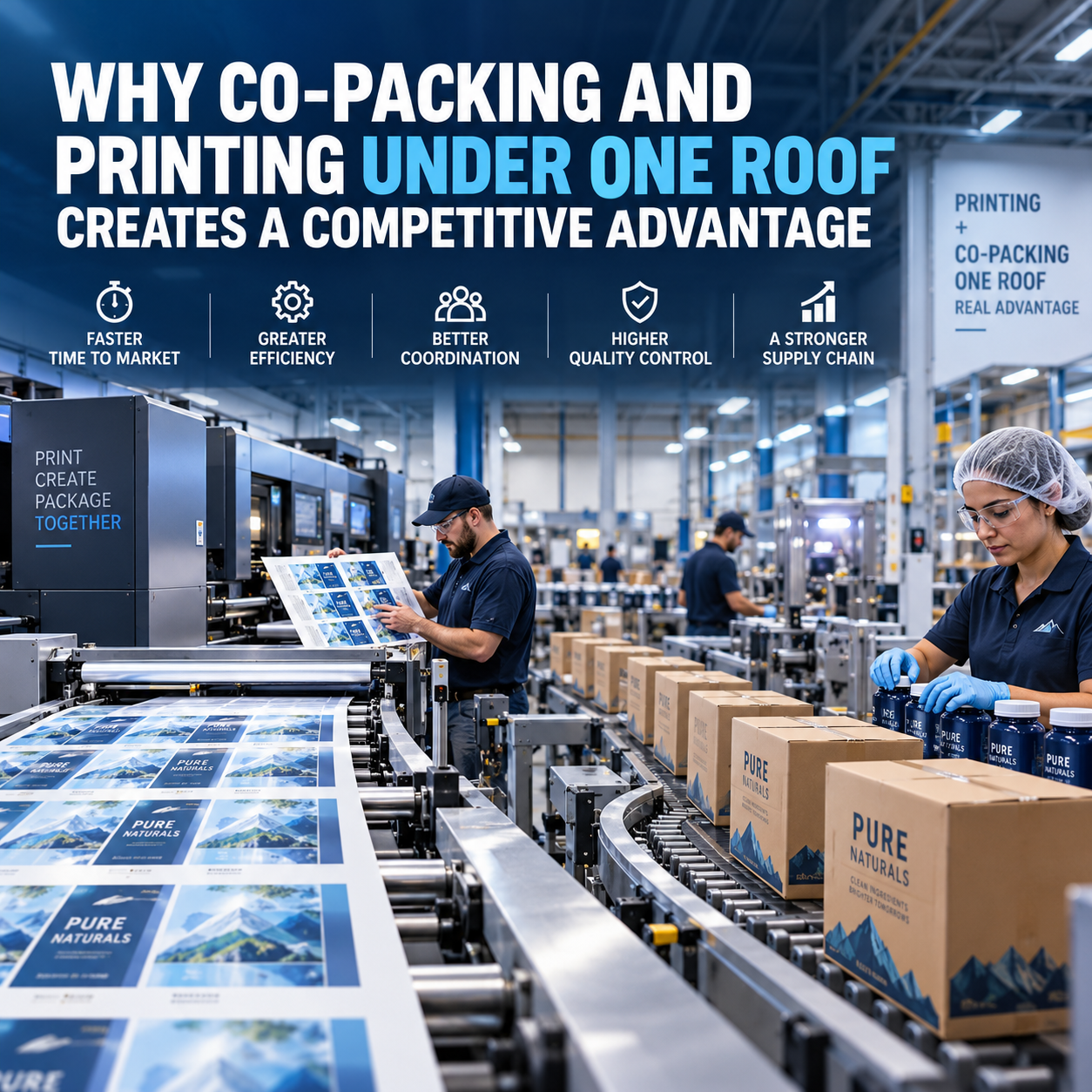
Working with a provider that offers both printing and co-packing services can simplify the process.
Businesses may benefit from coordinated production planning, fewer vendor relationships, more consistent packaging specifications, and reduced administrative complexity.
For example, a St. Louis brand preparing a promotional product bundle may require custom-printed labels, branded packaging components, product assembly, and final inspection.
Coordinating these requirements through an integrated packaging partner can help streamline project management.
At Elite Printing & Packaging, Inc., the combination of printing and packaging expertise supports a solutions-oriented approach to helping businesses manage their packaging needs.
Instead of treating printing and co-packing as unrelated activities, businesses can evaluate how the two processes work together to support product presentation, operational efficiency, and distribution readiness.
For brands managing multiple SKUs, frequent promotional changes, or evolving packaging requirements, this integrated approach can offer meaningful advantages.
Packaging plays a direct role in how customers perceive a product.
Incorrect labels, damaged cartons, inconsistent bundles, and poorly assembled retail displays can negatively affect the customer experience.
They may also create additional costs through product returns, rework, retailer deductions, or missed delivery requirements.
For this reason, quality control should be a central consideration when selecting a co-packing provider.
A reliable packaging partner should have documented processes appropriate to the products and services being handled.
These may include incoming material inspections, packaging specification reviews, in-process quality checks, final product inspections, and procedures for addressing nonconforming products.
For retail-focused brands, accurate labeling, correct product counts, consistent packaging presentation, and adherence to customer-specific requirements are particularly important.
A regional relationship can make it easier to review samples, discuss quality expectations, and address potential concerns directly.
However, businesses should still verify that the provider’s quality systems meet their particular requirements.
Products subject to specialized regulations may require additional controls, certifications, or facility capabilities.
Ultimately, choosing a co-packing partner should involve evaluating demonstrated quality practices rather than relying solely on location or pricing.
Choosing a regional co-packing company can also strengthen connections within the local business community.
St. Louis has a diverse economy that includes manufacturing, distribution, consumer products, healthcare, food-related businesses, and professional services.
These industries depend on interconnected networks of suppliers, logistics providers, manufacturers, and service partners.
When local companies collaborate, they can develop relationships that support regional business activity and long-term economic development.
A regional co-packing partnership may create opportunities for collaboration with other Missouri-based suppliers, transportation companies, printers, and manufacturers.
Businesses can also benefit from relationships with partners who understand the regional market and its operational characteristics.
For companies headquartered in St. Louis or operating throughout the metropolitan area, supporting regional service providers can align with broader business development and community engagement objectives.
The primary consideration should always be whether the provider can meet the company’s operational, financial, and quality requirements.
When those requirements are satisfied, working locally can deliver additional relationship and community benefits.
Not every contract packaging company is the right fit for every business.
Before selecting a provider, businesses should evaluate several important factors.
Packaging capabilities: Confirm that the provider can handle the required product types, packaging configurations, labeling processes, and assembly specifications.
Production capacity: Determine whether the facility can accommodate expected volumes, seasonal fluctuations, and future growth.
Quality assurance: Review inspection procedures, documented workflows, and the provider’s approach to preventing packaging errors.
Communication and responsiveness: Evaluate how the provider handles project updates, changes, production scheduling, and unexpected challenges.
Location and logistics: Consider the facility’s proximity to manufacturing locations, suppliers, warehouses, and distribution destinations.
Pricing transparency: Request a clear explanation of setup charges, labor costs, materials, minimum order requirements, storage, and other applicable expenses.
Long-term compatibility: Look for a partner interested in understanding your business objectives rather than simply processing individual packaging orders.
The right co-packing relationship should reduce operational complexity, not introduce additional management burdens.
For businesses seeking co-packing services in St. Louis, Missouri, choosing a partner involves more than finding available packaging capacity.
It requires identifying a company that understands the importance of reliable execution, consistent quality, clear communication, and efficient operations.
Located in Hazelwood, Missouri, Elite Printing & Packaging, Inc. serves businesses seeking printing and packaging solutions in the greater St. Louis region.
Our approach emphasizes the value of dependable business relationships and practical solutions that help companies manage their packaging requirements.
By bringing printing and packaging capabilities together, Elite provides businesses with an opportunity to simplify vendor coordination and explore more integrated packaging workflows.
Whether your company is evaluating outsourced packaging for the first time or looking to improve an existing process, choosing a regional partner can be an important step toward greater operational efficiency.
For manufacturers, consumer goods brands, retailers, and distributors throughout St. Louis and surrounding communities, having a packaging partner nearby can create opportunities for stronger collaboration and more responsive service.
Co-packing and contract packaging are generally used interchangeably. Both describe outsourcing packaging-related processes to a third-party provider. Services may include assembly, labeling, bundling, repackaging, and preparing products for retail distribution.
Co-packing costs depend on factors such as product volume, packaging complexity, labor requirements, materials, setup time, and project specifications. Businesses should request a customized quote based on their specific requirements.
Yes. Small and growing businesses may benefit from outsourcing packaging when internal labor, equipment, or warehouse capacity becomes a constraint. However, minimum order quantities and setup costs should be considered to determine whether outsourcing is financially practical.
Co-packing services can support consumer goods companies, manufacturers, retailers, e-commerce businesses, promotional product suppliers, and other industries requiring product assembly or secondary packaging. Specialized products may require additional facility qualifications.
Hazelwood is part of the greater St. Louis metropolitan area’s manufacturing and logistics network. Its location near major transportation infrastructure can be convenient for companies operating throughout St. Louis County, St. Charles County, and the surrounding region.
Choosing the right co-packing partner is an important business decision that can influence costs, operational efficiency, product quality, and customer satisfaction.
For businesses throughout the St. Louis metropolitan area, working with a regional packaging provider offers potential advantages that extend beyond geographic convenience.
Shorter transportation distances, easier communication, improved supply chain coordination, and greater access to packaging expertise can all contribute to a more efficient operation.
When printing and co-packing services are coordinated through one provider, businesses may also benefit from fewer operational handoffs and more streamlined project management.
As brands grow and packaging requirements become more complex, these advantages can become increasingly valuable.
Elite Printing & Packaging, Inc. is committed to helping businesses explore dependable printing and packaging solutions that support their operational needs.
If your company is looking for a trusted St. Louis co-packing partner, now is the time to evaluate how a regional packaging relationship could improve your business.
Ready to simplify your packaging operations?
Contact Elite Printing & Packaging, Inc. to discuss your co-packing requirements and discover how our St. Louis-area printing and packaging solutions can support your business.

Bring your vision to life with custom flexible packaging, labels, and retail-ready design.

Premium materials and finishes that elevate your brand.

Efficient, compliant, and versatile co-packing for pet and human products.

From warehouse to doorstep — done right, every time.
Bring your vision to life with custom flexible packaging, labels, and retail-ready design.
Premium materials and finishes that elevate your brand.
Efficient, compliant, and versatile co-packing for pet and human products.
From warehouse to doorstep — done right, every time.