
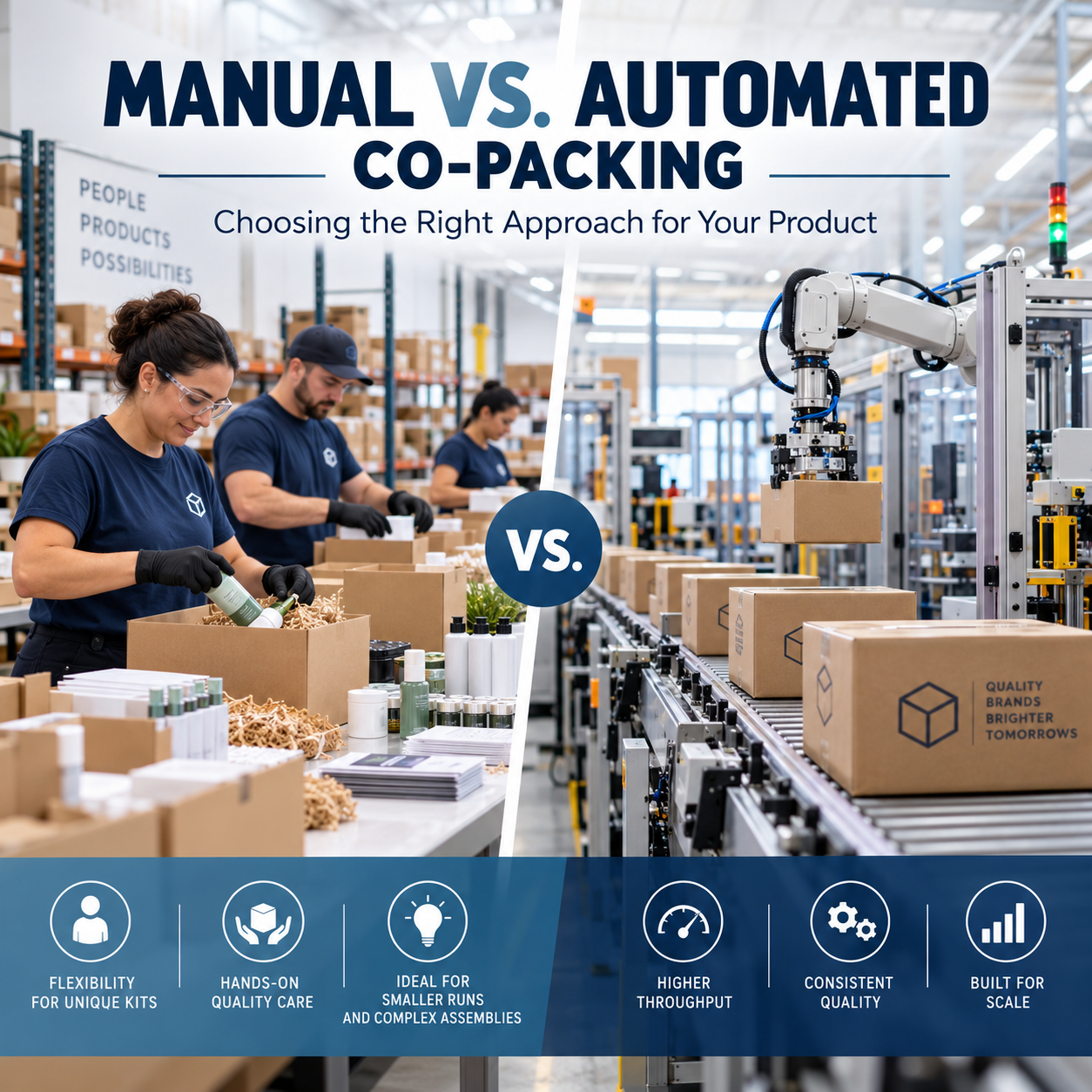

For manufacturers, consumer goods companies, and growing brands, one of the most important decisions in the packaging process is choosing between manual co-packing and automated co-packing.
In today’s competitive marketplace, packaging is no longer just about protecting a product. It’s about efficiency, presentation, scalability, cost control, and getting products into customers’ hands without unnecessary delays.
For manufacturers, consumer goods companies, and growing brands, one of the most important decisions in the packaging process is choosing between manual co-packing and automated co-packing.
Both approaches offer advantages, but selecting the wrong method can increase operational costs, create production bottlenecks, and limit your company’s ability to scale.
Some products require the precision, flexibility, and hands-on attention of manual packaging. Others benefit from the speed, consistency, and efficiency of automated packaging systems. Many businesses discover that a combination of both approaches delivers the greatest value.
At Elite Printing & Packaging, Inc., located in the St. Louis, Missouri, area, we understand that successful co-packing isn’t about forcing every product through the same process. It’s about identifying the right packaging solution for your product, production volume, and business objectives.
In this article, we’ll explore the differences between manual and automated co-packing, examine their benefits and limitations, and explain how to determine which approach best supports your company’s growth.
Co-packing, also known as contract packaging, involves outsourcing packaging-related operations to a specialized third-party provider.
Instead of investing in additional equipment, warehouse space, employees, and packaging infrastructure, businesses partner with a co-packing company to handle specific packaging activities.
Depending on the product and operational requirements, co-packing services may include:
Product assembly and kitting
Labeling and relabeling
Shrink wrapping and bundling
Retail-ready packaging
Promotional packaging and displays
Multi-product packaging
Quality inspections
Cartoning and final packaging preparation
For growing brands, outsourcing these responsibilities can help reduce operational complexity while allowing internal teams to focus on product development, sales, marketing, and customer relationships.
However, not every co-packing operation works the same way.
The two primary production approaches are manual co-packing and automated co-packing.
Understanding how each operates is essential when evaluating your packaging strategy.
Manual co-packing is a packaging process in which trained employees perform packaging tasks primarily by hand, often with assistance from basic tools or semi-automated equipment.
Rather than relying on a fully automated production line, employees handle activities such as product placement, assembly, sorting, labeling, and inspection.
Manual packaging is particularly useful for products requiring customization, specialized handling, or frequent packaging changes.
1. Greater flexibility for customized packaging
One of the biggest advantages of manual co-packing is its adaptability.
Businesses frequently introduce seasonal promotions, limited-edition products, gift sets, and customized packaging configurations.
Manual packaging teams can often adjust these operations without extensive equipment modifications.
For example, a consumer products company introducing a holiday gift bundle containing multiple products may find manual co-packing more practical than investing in specialized automated machinery.
2. Ideal for low-volume and specialty products
Automated packaging systems generally require sufficient production volume to justify setup, equipment, and operating costs.
Manual co-packing can be more economical for smaller production runs, specialty products, or packaging projects with irregular demand.
This makes manual packaging attractive for emerging brands testing new products or established manufacturers launching limited-edition merchandise.
3. Better handling of irregularly shaped products
Not every product fits neatly into standardized packaging machinery.
Products with unusual dimensions, fragile components, or complex assembly requirements may benefit from hands-on packaging.
Employees can adjust their handling techniques to accommodate variations that would otherwise require specialized equipment.
4. Easier adjustments during production
When packaging specifications change, manual operations can often adapt quickly.
Whether a customer needs an additional promotional insert, a different label placement, or a revised product configuration, manual packaging provides flexibility that highly specialized automated lines may not offer.
Despite its advantages, manual co-packing has several considerations.
Labor requirements generally increase as production volumes grow. Output rates may vary depending on product complexity, training, and workforce availability.
Manual processes also require documented procedures, supervision, and consistent quality checks to minimize errors.
For high-volume, repetitive packaging projects, automation may offer better long-term efficiency.
Automated co-packing uses specialized machinery, conveyor systems, and production equipment to complete packaging activities with reduced manual intervention.
These systems can perform repetitive tasks at high speeds while maintaining standardized packaging specifications.
Depending on the equipment and product requirements, automated packaging operations may include labeling, filling, sealing, wrapping, cartoning, and sorting.
Automation is particularly valuable when businesses require consistent output across large production runs.
1. Increased production speed
One of the most significant advantages of automated packaging is its ability to process large quantities of products efficiently.
Automated systems can perform repetitive tasks continuously, often producing significantly higher throughput than manual operations.
For manufacturers managing substantial order volumes, increased production speed can help shorten packaging lead times and support demanding distribution schedules.
2. Greater consistency and repeatability
Automated equipment is designed to perform specific tasks according to predefined settings.
When properly configured and maintained, automated systems can deliver consistent label placement, package dimensions, sealing, and other standardized operations.
This repeatability is particularly important for brands supplying national retailers that expect uniform packaging across thousands of units.
3. Lower labor requirements at scale
Although automated equipment involves setup and operating expenses, it can reduce the amount of direct labor required per packaged unit.
For businesses processing large quantities of standardized products, this may translate into lower unit packaging costs.
However, the financial benefit depends on production volume, equipment utilization, maintenance requirements, and changeover frequency.
4. Improved scalability
As demand increases, automated packaging systems may provide opportunities to expand output without increasing labor at the same rate.
This can help established manufacturers manage growth while maintaining predictable packaging operations.
Automation isn’t always the most practical choice.
Automated packaging systems may require significant initial investment, specialized tooling, maintenance, and technical expertise.
Frequent product changes can also increase downtime due to equipment adjustments and production changeovers.
Products with unusual shapes, delicate components, or complex packaging configurations may require customized machinery or additional manual handling.
For these reasons, automated co-packing should be evaluated based on the actual needs of the product rather than production speed alone.
When comparing manual and automated co-packing services in St. Louis, businesses should evaluate several operational factors.
Factor | Manual Co-Packing | Automated Co-Packing |
|---|---|---|
Production volume | Low to medium, or variable | Medium to high, consistent |
Flexibility | High | Depends on equipment |
Setup requirements | Typically lower | Often higher |
Labor involvement | Higher | Lower per unit at scale |
Production speed | Depends on staffing | Typically faster for repetitive tasks |
Customization | Excellent for complex projects | Best with standardized configurations |
Quality consistency | Depends on training and controls | Repeatable with proper setup |
Cost efficiency | Often better for short runs | Often better for long runs |
Neither method is inherently superior.
The best packaging solution depends on how your products are manufactured, packaged, distributed, and sold.
Selecting between manual and automated co-packing requires more than comparing packaging costs.
Businesses should evaluate their entire production and distribution strategy.
Production volume is often the first consideration.
If your company packages relatively small quantities or experiences unpredictable demand, manual co-packing may offer greater flexibility.
For example, a brand packaging 2,000 promotional kits for a seasonal campaign may not benefit from the setup requirements associated with automated equipment.
However, a manufacturer packaging hundreds of thousands of identical units each month may achieve greater efficiency through automation.
The key is understanding both current volume and anticipated growth.
Some products are naturally better suited for manual handling.
Multi-component kits, fragile merchandise, promotional bundles, and irregularly shaped products may require individual attention during assembly.
Conversely, products with uniform dimensions and standardized packaging requirements are often stronger candidates for automation.
Businesses should evaluate product characteristics before determining the appropriate packaging method.
Packaging decisions should consider the total cost of production, not simply the quoted price per unit.
Relevant expenses may include labor, equipment setup, packaging materials, storage, transportation, quality control, and production downtime.
Automated packaging may provide lower unit costs at high volumes, but frequent changeovers can reduce those savings.
Manual packaging may involve higher labor costs per unit while avoiding expensive equipment setup for shorter runs.
A qualified co-packing partner can help evaluate these tradeoffs and identify opportunities to reduce unnecessary expenses.
Packaging timelines can directly affect inventory availability and retail distribution.
Companies supplying major retailers often face strict delivery windows and packaging specifications.
Automated systems may be advantageous for large, repetitive orders with predictable schedules.
However, manual operations may offer faster startup for specialized projects or last-minute packaging changes.
The right solution should balance throughput with production flexibility and delivery reliability.
Packaging quality affects brand reputation, customer satisfaction, and retailer relationships.
Whether packaging is completed manually or automatically, businesses need established quality control procedures.
These may include verifying product counts, inspecting labels, confirming packaging configurations, and checking finished goods before shipment.
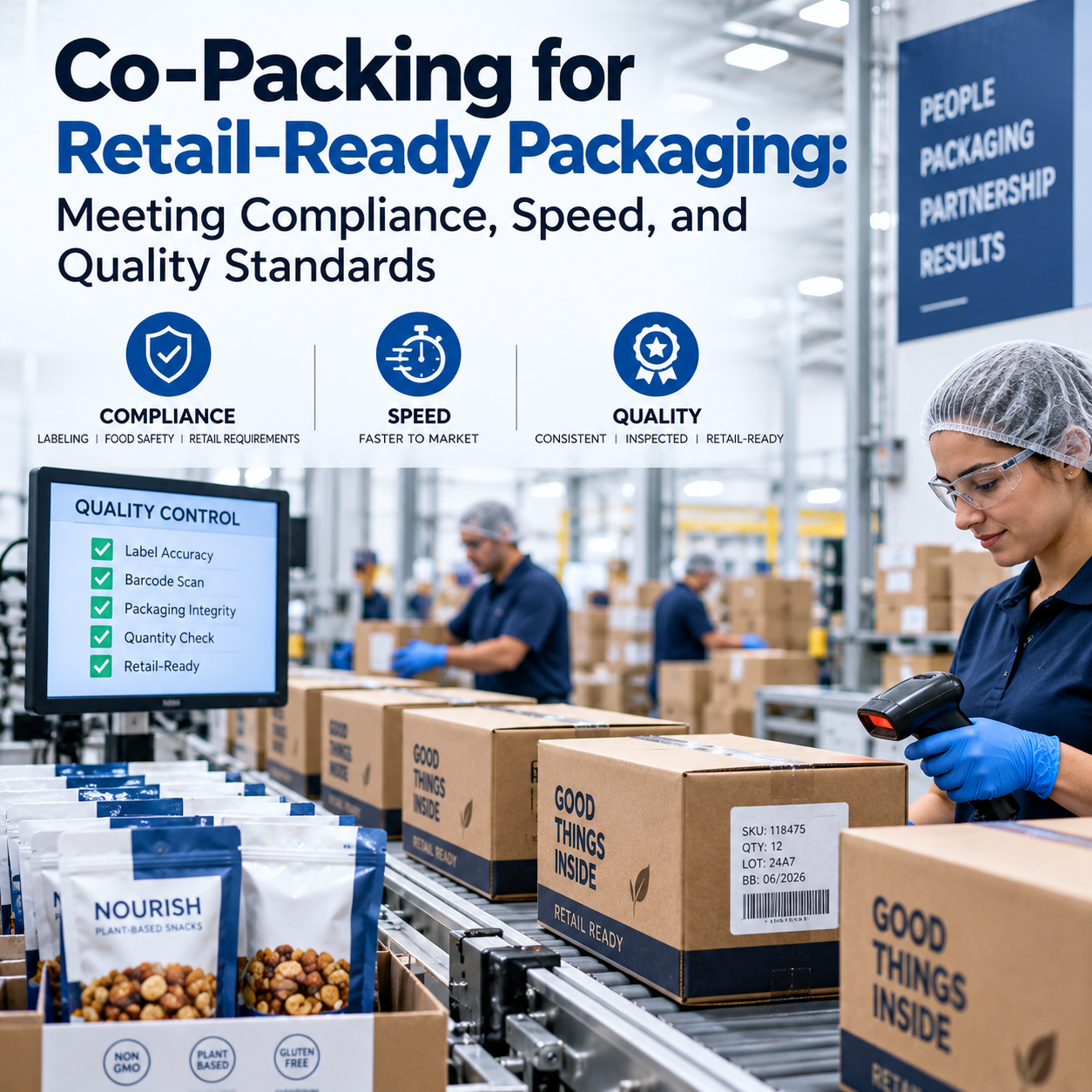
Retail-ready packaging projects may also require specific barcodes, carton configurations, labeling standards, or retailer-specific packaging guidelines.
Choosing a co-packing partner with strong quality management processes is just as important as choosing the packaging method itself.
Manual co-packing is often the preferred approach when flexibility and customization outweigh the need for maximum production speed.
Consider a pet products company preparing promotional bundles containing treats, toys, and branded inserts.
Each bundle may require multiple components arranged in a specific configuration.
If the promotion involves several variations or limited production quantities, manual packaging may be more efficient than configuring automated equipment for each version.
Other common applications include subscription boxes, specialty retail displays, sample kits, and seasonal promotional packaging.
For brands frequently introducing new products, manual co-packing can also reduce the operational challenges associated with packaging experimentation.
Automated co-packing is generally most effective when packaging specifications remain consistent across large production volumes.
For example, a consumer goods manufacturer producing standardized retail packages throughout the year may benefit from automated labeling, sealing, or cartoning.
Because the packaging configuration changes infrequently, the business can spread equipment setup costs across a larger number of units.
Automation may also be beneficial when production schedules are predictable and packaging throughput is a primary operational concern.
However, companies should avoid assuming that automation automatically guarantees lower costs.
Equipment efficiency, maintenance, changeovers, material compatibility, and production volume all influence the final economics.
For many businesses, the best answer isn’t choosing exclusively between manual and automated co-packing.
It’s combining both approaches.
A hybrid co-packing operation uses automated equipment for repetitive activities while incorporating manual labor for tasks requiring flexibility, customization, or detailed inspection.
For example, an operation might use automated equipment to apply labels or seal packages, followed by manual assembly of promotional bundles and final quality checks.
This combination can offer several advantages.
Improved operational flexibility: Businesses can accommodate different packaging configurations without automating every step.
Better resource utilization: Repetitive tasks can be supported by equipment while employees focus on activities requiring judgment or specialized handling.
Scalable production: Companies may be able to increase throughput by automating selected bottlenecks as order volumes grow.
More adaptable packaging workflows: Hybrid solutions can support both standardized products and customized promotional projects.
For growing brands, a hybrid approach can provide a practical path toward greater efficiency without requiring a complete transition to automation.
Choosing the correct packaging method is only part of building an efficient supply chain.
The company responsible for executing that process plays an equally important role.
A reliable co-packing partner should understand your product requirements, production schedules, quality expectations, and distribution objectives.
Rather than simply accepting packaging instructions, an experienced provider should help identify potential operational challenges and recommend practical solutions.
This may involve reviewing packaging configurations, improving workflow efficiency, coordinating materials, or identifying opportunities to reduce unnecessary handling.
For manufacturers and consumer brands, the goal is to establish a packaging relationship that reduces internal workload while supporting reliable production.
Businesses throughout Missouri and the Midwest can benefit from partnering with a co-packing company in the St. Louis metropolitan area.
St. Louis offers access to major interstate corridors and transportation infrastructure connecting regional and national distribution networks.
For companies with manufacturing operations, suppliers, or distribution facilities throughout the Midwest, regional co-packing can help simplify coordination and potentially reduce transportation complexity.
Working with a local provider can also make facility visits, production reviews, and communication more convenient.
For businesses seeking co-packing services in St. Louis, MO, evaluating local expertise alongside operational capabilities can help create a more responsive packaging strategy.
At Elite Printing & Packaging, we understand that every product presents different packaging challenges.
A packaging solution that works for one manufacturer may not be appropriate for another.
That’s why choosing a co-packing partner should begin with understanding the product, required packaging configuration, order volume, and operational objectives.
Whether your business needs hands-on product assembly, custom kitting, retail-ready packaging, or a more efficient packaging workflow, the goal should always be the same: delivering quality packaging while reducing unnecessary complexity.
Located in Hazelwood, Missouri, Elite Printing & Packaging serves businesses seeking dependable packaging solutions in the greater St. Louis region.
We believe a strong packaging relationship should deliver more than completed orders. It should provide communication, accountability, quality, and confidence in the process.
Businesses evaluating manual, automated, or hybrid co-packing solutions should work with a partner willing to discuss the practical advantages and limitations of each approach.
The right solution isn’t necessarily the fastest or most automated.
It’s the one that makes the most sense for your product and your business.
Manual co-packing can be more cost-effective for small production runs, customized packaging, and projects requiring frequent changes. Automated co-packing may offer lower per-unit costs for large, repetitive production runs. The actual cost depends on volume, labor, setup requirements, and packaging complexity.
Manual co-packing is well suited for promotional kits, gift sets, subscription boxes, fragile merchandise, specialty products, and packaging configurations involving multiple components.
Businesses should evaluate automated packaging when they have consistent production volumes, standardized packaging requirements, repetitive tasks, and sufficient demand to justify equipment setup and operating costs.
Yes. Hybrid co-packing combines automated processes with manual assembly, inspection, or customization. This approach can improve efficiency while maintaining flexibility for complex packaging projects.
Look for a co-packing provider that understands your product requirements, offers relevant packaging capabilities, maintains documented quality control procedures, and communicates clearly about production timelines and costs. Businesses should also evaluate the provider’s experience, capacity, and ability to accommodate future growth.
Manual and automated co-packing both play important roles in modern packaging operations.
Manual packaging provides flexibility, customization, and adaptability for specialized projects. Automated packaging offers speed, repeatability, and potential cost advantages for high-volume production.
Hybrid solutions can combine the strengths of both methods.
Ultimately, the right co-packing approach depends on your product, production volume, packaging complexity, budget, and long-term growth strategy.
Choosing the right packaging partner is just as important as selecting the production method.
A dependable co-packing provider should help simplify operations, protect product quality, and support your business as demand evolves.
Whether you’re launching a new product, expanding into retail, or evaluating ways to improve packaging efficiency, Elite Printing & Packaging is ready to discuss your needs.
Contact Elite Printing & Packaging today to explore packaging solutions tailored to your products, production requirements, and business goals.

Bring your vision to life with custom flexible packaging, labels, and retail-ready design.

Premium materials and finishes that elevate your brand.

Efficient, compliant, and versatile co-packing for pet and human products.

From warehouse to doorstep — done right, every time.
Bring your vision to life with custom flexible packaging, labels, and retail-ready design.
Premium materials and finishes that elevate your brand.
Efficient, compliant, and versatile co-packing for pet and human products.
From warehouse to doorstep — done right, every time.