

Order volumes increase. Retail relationships expand. More SKUs enter the product line. Seasonal promotions become larger. Inventory becomes harder to coordinate. Warehousing requirements grow. Meanwhile, customers and retailers continue to expect accurate orders, consistent product quality, and reliable delivery.
For many mid-sized brands, growth creates an interesting problem: the systems that helped the company reach its current size may not be capable of supporting where the business is headed next.
Order volumes increase. Retail relationships expand. More SKUs enter the product line. Seasonal promotions become larger. Inventory becomes harder to coordinate. Warehousing requirements grow. Meanwhile, customers and retailers continue to expect accurate orders, consistent product quality, and reliable delivery.
At this stage, packaging and fulfillment can quickly shift from routine operational functions into significant supply chain bottlenecks.
That is where an experienced co-packing partner can make a difference.
For growing companies in St. Louis and throughout the Midwest, outsourcing packaging, assembly, warehousing, and fulfillment can create a more flexible supply chain without requiring the brand to continually invest in additional labor, equipment, and warehouse space.
At Elite Printing & Packaging, we help businesses simplify these operational challenges through scalable co-packing and packaging solutions designed to keep products moving efficiently from inventory to finished goods.
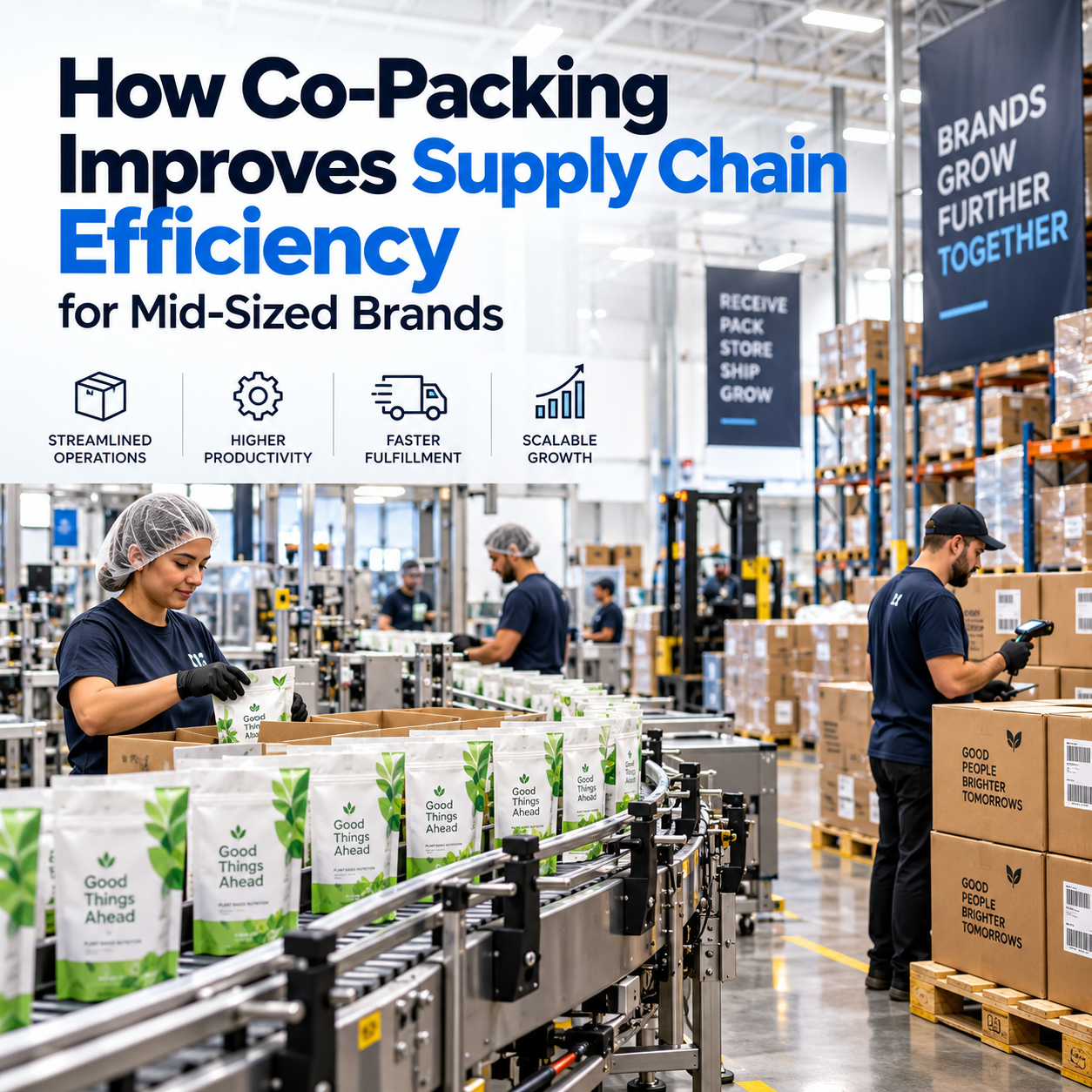
Here is how the right co-packing strategy can improve supply chain efficiency for mid-sized brands.
Co-packing, short for contract packaging, involves outsourcing certain packaging and product preparation operations to a specialized third-party partner.
Depending on the project, a co-packer may provide services such as:
Product assembly
Kitting
Labeling and relabeling
Repackaging
Shrink wrapping
Display assembly
Retail-ready packaging
Promotional packaging
Inventory management
Warehousing
Order preparation
Fulfillment and distribution support
Rather than investing internally in all the people, equipment, space, and processes required to perform these activities, brands can utilize the infrastructure of an established co-packing operation.
For a mid-sized business, that can create significant operational flexibility.
A smaller company might be able to manage packaging with a relatively simple operation. Products arrive, employees package them, orders are prepared, and shipments leave the facility.
Growth makes that process considerably more complicated.
Imagine a brand that previously managed five SKUs and now manages 25. It sells through several retail chains, an e-commerce channel, distributors, and direct wholesale relationships.
Each channel could have different packaging requirements.
Retailer A might require a specific case pack.
Retailer B may require unique labels.
Retailer C may need products assembled into promotional displays.
E-commerce orders could require entirely different packaging.
Suddenly, packaging is connected to inventory planning, purchasing, labor scheduling, warehouse capacity, retailer compliance, transportation, and customer satisfaction.
A weakness in one area can affect the entire supply chain.
The goal of co-packing is not simply to put products into packages faster. A strong co-packing relationship can help make the entire flow of products more efficient.
One of the biggest challenges for growing brands is capacity.
A company may have enough production capacity to manufacture thousands of additional units but lack the labor or packaging equipment required to prepare those units for sale.
This creates a bottleneck.
Finished or semi-finished inventory begins accumulating while packaging operations struggle to keep pace.
Outsourcing packaging allows brands to increase packaging capacity without building an entirely new internal operation.
Instead of purchasing equipment, finding additional warehouse space, and recruiting temporary workers, brands can shift packaging projects to an established co-packer.
This helps products continue moving through the supply chain rather than waiting for internal capacity to become available.
Building packaging capacity internally requires significant investment.
Companies may need:
Packaging equipment
Warehouse space
Production lines
Maintenance
Supervisors
Packaging employees
Temporary labor
Material handling equipment
Inventory systems
Training
Quality-control processes
Many of these expenses exist whether packaging lines are operating at full capacity or not.
That can become especially problematic for companies with seasonal or unpredictable demand.
A co-packing relationship allows brands to shift portions of these fixed operational costs toward variable costs tied more closely to actual packaging volume.
For a growing company, this can improve capital efficiency.
Instead of investing heavily in infrastructure that may only be fully utilized during peak periods, the business can allocate capital toward product development, sales, marketing, acquisitions, technology, or other growth initiatives.
Demand rarely remains perfectly consistent.
Retail promotions, holidays, new product launches, seasonal purchasing patterns, and unexpected customer orders can create major swings in packaging volume.
An internal packaging department designed for average demand may become overwhelmed during these peaks.
Building an internal operation capable of handling maximum possible demand, however, can leave equipment and employees underutilized during slower periods.
Co-packing creates another option.
Brands can use outsourced packaging capacity to help absorb demand spikes without permanently expanding internal infrastructure.
For example, a brand preparing for a major holiday promotion may need hundreds of thousands of products assembled into special retail packages within several weeks.
Hiring and training a temporary workforce internally can be difficult.
A capable St. Louis co-packing company can provide the labor, equipment, space, and processes needed to execute the project while the brand’s internal team remains focused on its core operation.
Inventory is one of the most important components of supply chain efficiency.
Too little inventory creates stockouts.
Too much inventory consumes warehouse space and working capital.
Poor inventory visibility can create even larger problems.
A co-packing partner that combines packaging with warehousing and inventory management can help consolidate several steps within the supply chain.
Instead of shipping products between multiple facilities for storage, packaging, assembly, and fulfillment, companies may be able to complete several of those activities within the same operation.
Consider a typical fragmented supply chain:
Manufacturer → Warehouse → Packaging Facility → Distribution Center → Retailer
Every transfer creates additional handling, transportation, scheduling, and opportunities for delays.
A more integrated model could look like:
Manufacturer → Co-Packing & Warehousing Facility → Retailer
Reducing unnecessary product movements can improve efficiency while simplifying supply chain management.
Location matters when selecting a co-packing partner.
St. Louis offers an advantageous central location for companies distributing products throughout the United States.
Its position in the Midwest provides convenient access to major transportation corridors and distribution networks serving markets across the country.
For brands shipping nationally, working with a co-packing company in St. Louis, Missouri can provide a strategically positioned operational hub.
Instead of moving inventory to facilities located far from major customer markets, companies can position packaging and distribution activities closer to the center of their transportation network.
That can help simplify freight planning, shorten certain transit routes, and improve overall distribution flexibility.
Labor availability remains one of the most unpredictable components of packaging operations.
Recruiting, training, scheduling, and retaining packaging employees takes time and management resources.
Demand fluctuations make the challenge even greater.
A packaging department may need 15 employees during normal operations but 40 during a major retail promotion.
Maintaining those additional employees year-round may not make financial sense.
Trying to hire them immediately before a major project introduces another risk.
Co-packing transfers much of this responsibility to the packaging provider.
An established co-packer already has systems for workforce management, training, supervision, production scheduling, and quality control.
That allows the brand to access additional labor capacity without becoming responsible for managing every individual working on the packaging project.
Speed matters, but consistency matters just as much.
Retailers and consumers expect products to arrive correctly packaged every time.
An incorrectly applied label, missing component, incorrect case quantity, or improperly assembled display can result in rejected shipments, rework, additional transportation expenses, and damaged retailer relationships.
Professional co-packers develop standardized operating procedures designed to reduce these errors.
These processes may include:
Documented work instructions
Quality checkpoints
Product inspections
Packaging specifications
Lot tracking
Inventory controls
Production reporting
Final shipment verification
For mid-sized brands experiencing rapid growth, implementing this level of process discipline internally can require significant time and resources.
Working with an experienced packaging partner allows companies to leverage established processes immediately.
Selling products through major retailers introduces another level of supply chain complexity.
Retailers may establish strict requirements involving labeling, packaging dimensions, case quantities, pallet configuration, barcodes, displays, shipping documentation, and delivery windows.
Failure to meet these requirements can result in chargebacks, shipment rejection, rework, or delays.
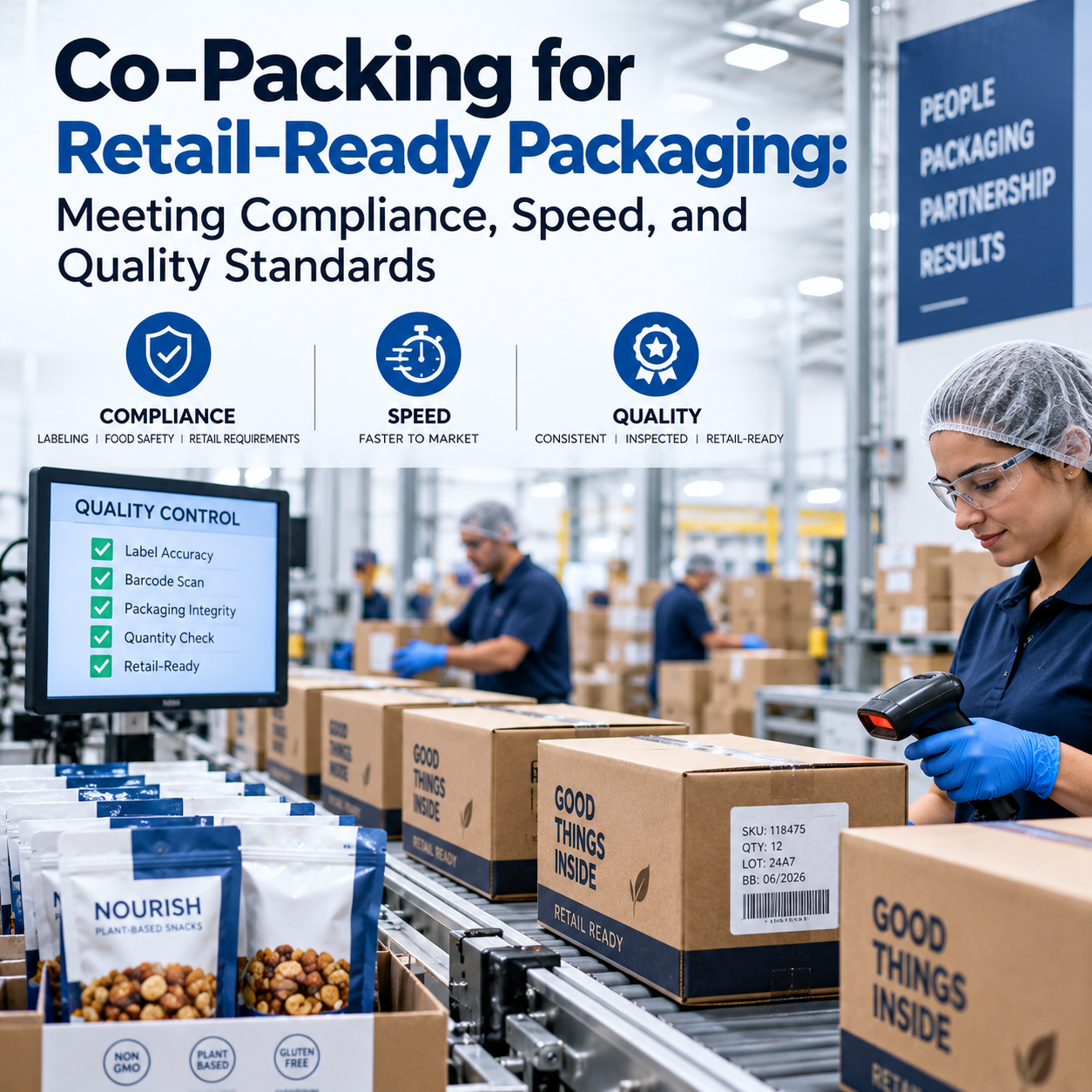
An experienced co-packer familiar with retail-ready packaging can help brands prepare products according to retailer specifications before they enter the distribution network.
This becomes increasingly valuable as brands expand into additional retail channels.
Instead of internal teams learning every packaging requirement through trial and error, the company can rely on a packaging partner accustomed to managing complex packaging programs.
Launching a new product involves far more than manufacturing it.
The product must also be packaged, labeled, assembled, stored, and shipped.
If packaging capacity becomes the final bottleneck, a product can be manufactured and ready to sell but still miss its planned launch date.
Co-packing provides additional infrastructure that can help companies move from production to market faster.
This is particularly useful when testing new products.
Rather than purchasing specialized packaging equipment before knowing whether a product will succeed, a brand can outsource the initial packaging operation.
If demand increases, packaging capacity can scale with the product.
This gives companies more flexibility when introducing new SKUs or entering new retail channels.
Vendor complexity can quietly create supply chain inefficiency.
A company might use one vendor for packaging materials, another for labeling, another for assembly, another for warehousing, and another for fulfillment.
Each vendor introduces another:
Purchase order
Shipment
Invoice
Contact
Schedule
Quality-control process
Potential delay
Working with a co-packing provider capable of handling multiple services can simplify that network.
Instead of coordinating several vendors, brands can consolidate more responsibility with one strategic packaging partner.
Fewer handoffs can mean better communication, improved accountability, and easier supply chain management.
Efficient supply chains depend on accurate data.
Companies need visibility into:
Inventory levels
Production quantities
Packaging output
Finished goods
Order status
Shipping schedules
When packaging operations are poorly organized, this information can become difficult to track.
An experienced co-packing partner should provide clear communication and reporting around inventory and production.
This gives brands better visibility into where products are within the packaging process and when finished goods will be available.
Better visibility improves planning throughout the organization.
Purchasing teams can make better inventory decisions. Sales teams can provide customers with more accurate timelines. Operations teams can plan future production more effectively.
Every hour a leadership team spends solving packaging problems is an hour that cannot be spent growing the company.
For mid-sized brands, management resources are especially valuable.
Executives and operations leaders should be focused on areas such as:
Product development
Sales
Customer relationships
Strategic partnerships
Market expansion
Financial performance
They should not constantly be troubleshooting packaging labor shortages, relabeling projects, missed shipments, or warehouse congestion.
The right co-packing partner takes operational problems off the brand’s desk rather than creating additional ones.
That is the difference between simply hiring a vendor and building a true supply chain partnership.
Outsourcing does not automatically make sense for every company.
If packaging volumes are extremely low and internal operations have significant unused capacity, keeping packaging in-house may remain the most economical option.
However, several warning signs indicate that outsourcing may deserve consideration.
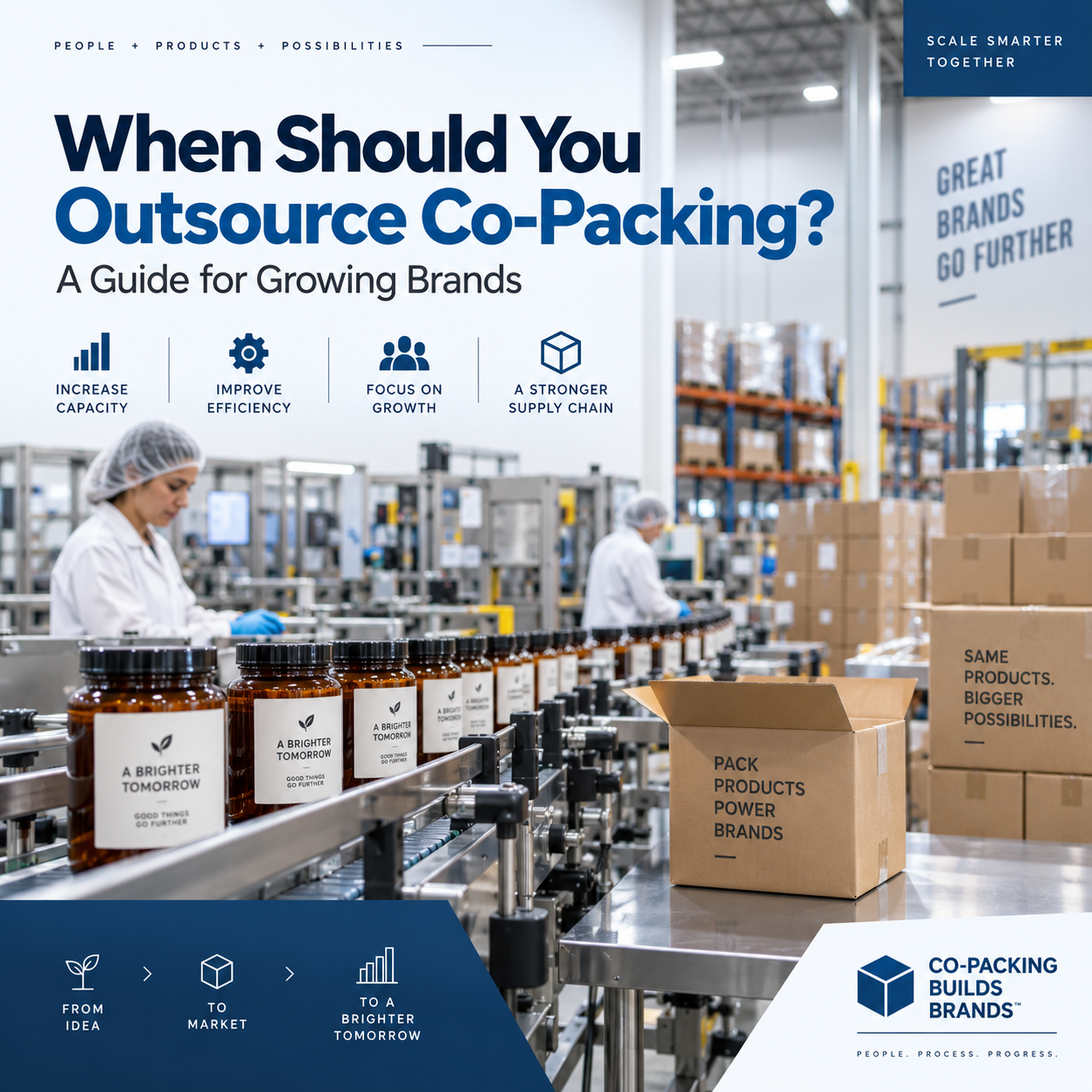
Your company may be ready for a co-packing partner when:
Packaging capacity is limiting sales growth.
Seasonal demand overwhelms internal operations.
Warehouse space is becoming constrained.
Packaging labor is increasingly difficult to manage.
Retailer requirements are becoming more complex.
New product launches are creating operational bottlenecks.
Your company needs specialized packaging equipment.
Management spends too much time solving packaging problems.
Products are moving between too many vendors or facilities.
Packaging delays are affecting customer relationships.
When several of these issues occur simultaneously, packaging may no longer be a standalone operational challenge. It may be limiting the efficiency of the entire supply chain.
Not every co-packer provides the same capabilities.
Before outsourcing, brands should evaluate potential partners carefully.
Look beyond price per unit.
A slightly lower packaging price provides little value if the vendor creates inventory problems, misses deadlines, produces inconsistent quality, or requires constant supervision.
Evaluate factors such as operational capacity, quality-control procedures, communication, facility organization, inventory management, packaging capabilities, scalability, retail experience, warehousing, fulfillment support, and geographic location.
Most importantly, determine whether the company approaches the relationship as a transactional packaging job or as an operational partnership.
A strong co-packer should make your supply chain easier to manage.
Supply chain efficiency is not created by optimizing one isolated activity.
It comes from improving how products move through the entire operation.
For mid-sized brands, co-packing can eliminate bottlenecks, improve packaging capacity, reduce infrastructure requirements, support seasonal demand, simplify inventory management, improve retail compliance, and create greater operational flexibility.
The right partner can also reduce the amount of time your internal team spends managing packaging problems.
Elite Printing & Packaging provides co-packing, packaging, warehousing, and related solutions for businesses in St. Louis and beyond. Our goal is simple: help our customers solve operational challenges and keep products moving.
If packaging is slowing down your growth or making your supply chain more complicated than it needs to be, it may be time to rethink your approach.
Contact Elite Printing & Packaging today to discuss your co-packing needs and discover how the right packaging partner can help build a more efficient, scalable supply chain.

Bring your vision to life with custom flexible packaging, labels, and retail-ready design.

Premium materials and finishes that elevate your brand.

Efficient, compliant, and versatile co-packing for pet and human products.

From warehouse to doorstep — done right, every time.
Bring your vision to life with custom flexible packaging, labels, and retail-ready design.
Premium materials and finishes that elevate your brand.
Efficient, compliant, and versatile co-packing for pet and human products.
From warehouse to doorstep — done right, every time.