

As an e-commerce business owner, fulfillment often starts out simple: orders come in, you (or your team) pick, pack, and ship. It’s hands-on, cost-conscious, and gives you full control.
But as your business grows, fulfillment quietly turns into one of the biggest operational bottlenecks—and one of the most expensive mistakes if handled too late.
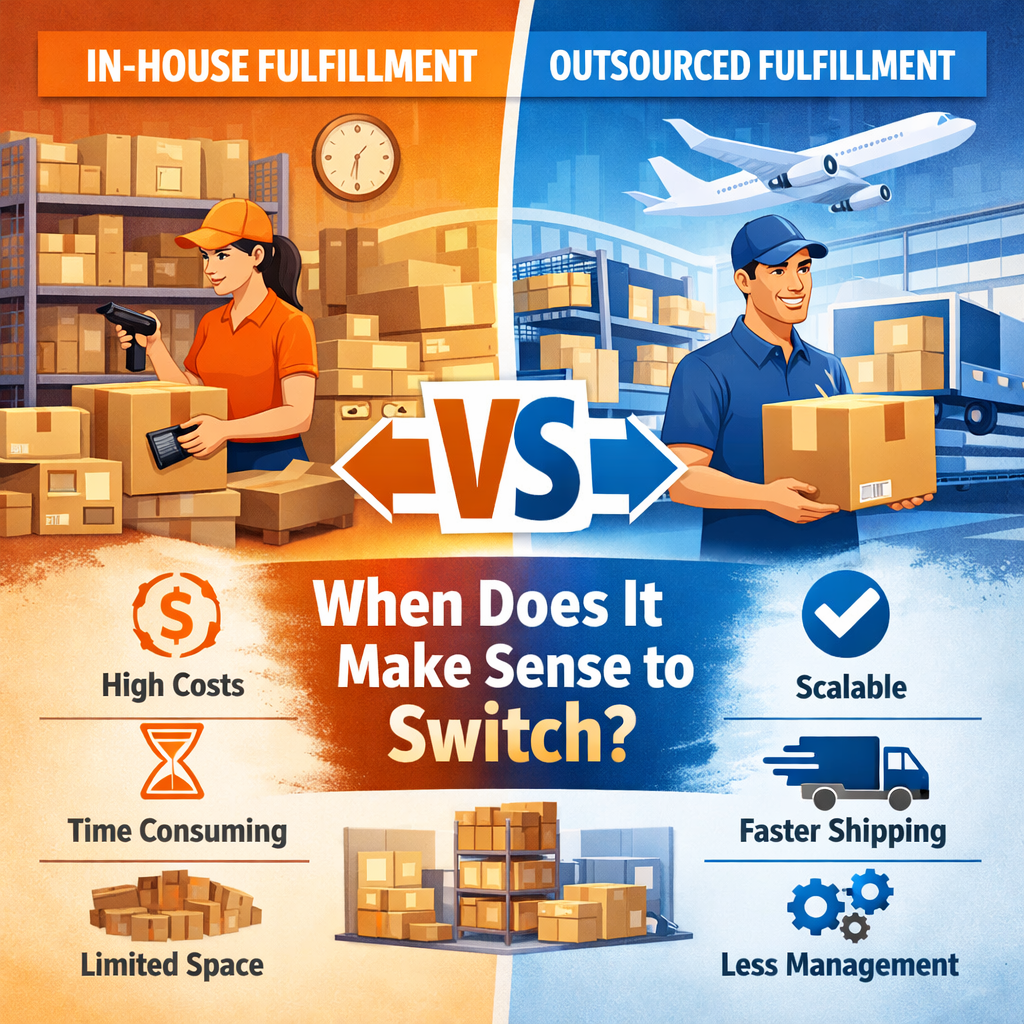
So the big question becomes: Should you keep fulfillment in-house, or is it time to outsource?
As an e-commerce business owner, fulfillment often starts out simple: orders come in, you (or your team) pick, pack, and ship. It’s hands-on, cost-conscious, and gives you full control.
But as your business grows, fulfillment quietly turns into one of the biggest operational bottlenecks—and one of the most expensive mistakes if handled too late.
So the big question becomes: Should you keep fulfillment in-house, or is it time to outsource?
This article breaks down both options in detail, explores the true costs behind each model, and helps you identify the clear signals that it’s time to make the switch.
In-house fulfillment means your business manages every step of the fulfillment process internally. That includes:
Inventory storage
Order picking and packing
Label printing and shipping
Returns management
Staffing and training
Warehouse equipment and software
This model is most common for startups and early-stage e-commerce brands because it feels manageable—and initially, it is.
1. Maximum Control
You oversee every order, every package, and every customer interaction. If something goes wrong, you can address it immediately.
2. Lower Costs at Small Volumes
When order volume is low, outsourcing often costs more per order than doing it yourself—especially if you’re using existing space and minimal labor.
3. Faster Process Changes
Need to add a free sample, handwritten note, or new packaging insert? You can implement changes instantly without coordination delays.
4. Deep Product Knowledge
Your team knows the product, branding, and customer expectations inside and out.
While in-house fulfillment works early on, many businesses underestimate how quickly costs scale—and not just financially.
Hiring fulfillment staff isn’t just hourly wages. You’re also paying for:
Payroll taxes
Training time
Overtime during peak seasons
Turnover and rehiring
Management oversight
As order volume increases, labor quickly becomes unpredictable and expensive.
Garages turn into storage units. Storage units turn into warehouses. Warehouses turn into long-term leases.
If fulfillment is happening in the same space as your office or production, it eventually restricts growth instead of enabling it.
Founders and leadership teams often spend hours a day troubleshooting fulfillment instead of focusing on:
Marketing
Product development
Customer acquisition
Strategic partnerships
If fulfillment is consuming leadership bandwidth, it’s already costing more than you think.
In-house fulfillment scales in steps—not smoothly. Every growth spurt requires:
New hires
More shelving
Additional equipment
Process rework
This creates stress during peak seasons instead of confidence.
Outsourced fulfillment means partnering with a third-party fulfillment provider (often called a 3PL) that handles storage, picking, packing, shipping, and returns on your behalf.
You send inventory to their facility, integrate your e-commerce platform, and orders are fulfilled automatically as they come in.
Outsourced fulfillment scales with demand. Whether you ship 100 orders or 10,000, the infrastructure is already in place.
Peak season doesn’t require panic hiring or last-minute process changes.
Instead of managing fluctuating labor and overhead, costs are typically based on:
Storage
Pick and pack fees
Shipping rates
Value-added services
This makes forecasting and cash-flow planning far more reliable.
Fulfillment partners often have:
Multiple shipping carrier relationships
Negotiated shipping rates
Strategic warehouse locations
This results in faster delivery times and lower shipping costs for customers.
Most fulfillment providers offer warehouse management systems (WMS) that integrate with Shopify, WooCommerce, Amazon, and other platforms—without you needing to invest in software or IT support.
Outsourcing fulfillment allows leadership to focus on growth-driving activities instead of operational firefighting.
This is only true if you choose the wrong partner. Many fulfillment providers specialize in custom packaging, branded inserts, and kitting—often executing brand standards more consistently than in-house teams under pressure.
At low volume, yes. At scale, outsourcing often reduces total fulfillment cost when you factor in labor, space, software, shipping rates, and management time.
Mistakes happen everywhere. The difference is that professional fulfillment providers have SLAs, quality controls, and dedicated teams focused solely on fulfillment accuracy.
There’s no universal order number—but there are clear indicators.
At this range, fulfillment complexity increases significantly. Labor, space, and process strain start to show.
If product launches, promotions, or marketing campaigns are limited by fulfillment capacity, you’re operating with a ceiling you don’t need.
Overflowing inventory, missed shipments, delayed orders, and constant reorganization are all warning signs.
If holidays and promotions create anxiety instead of opportunity, your fulfillment model isn’t scaling with your business.
When owners and executives are troubleshooting orders, something is broken—not working.
| Factor | In-House Fulfillment | Outsourced Fulfillment |
|---|---|---|
| Control | High | Medium–High (with right partner) |
| Scalability | Limited | High |
| Upfront Investment | High | Low |
| Labor Management | Your responsibility | Provider-managed |
| Technology | Your responsibility | Included |
| Shipping Rates | Retail or negotiated | Typically discounted |
| Time Required | High | Low |
Some brands don’t switch overnight—and that’s okay.
A hybrid approach may include:
In-house fulfillment for custom or high-touch orders
Outsourcing standard SKUs or subscription orders
Gradually shifting volume as confidence builds
This allows businesses to test outsourced fulfillment without fully committing on day one.
If you decide to outsource, the provider matters just as much as the decision itself.
Look for a partner that:
Understands your product category
Offers transparent pricing
Scales with your growth
Supports kitting, assembly, or co-packing if needed
Acts like an extension of your team—not just a vendor
The right fulfillment partner doesn’t just ship boxes—they help remove friction from your entire operation.
In-house fulfillment isn’t wrong. For many brands, it’s exactly the right choice early on.
But the moment fulfillment becomes a bottleneck—financially, operationally, or mentally—it’s time to reevaluate.
Outsourced e-commerce fulfillment isn’t about giving up control.
It’s about gaining leverage.
And knowing when to make that switch can be the difference between controlled growth and constant chaos.

Bring your vision to life with custom flexible packaging, labels, and retail-ready design.

Premium materials and finishes that elevate your brand.

Efficient, compliant, and versatile co-packing for pet and human products.

From warehouse to doorstep — done right, every time.
Bring your vision to life with custom flexible packaging, labels, and retail-ready design.
Premium materials and finishes that elevate your brand.
Efficient, compliant, and versatile co-packing for pet and human products.
From warehouse to doorstep — done right, every time.