
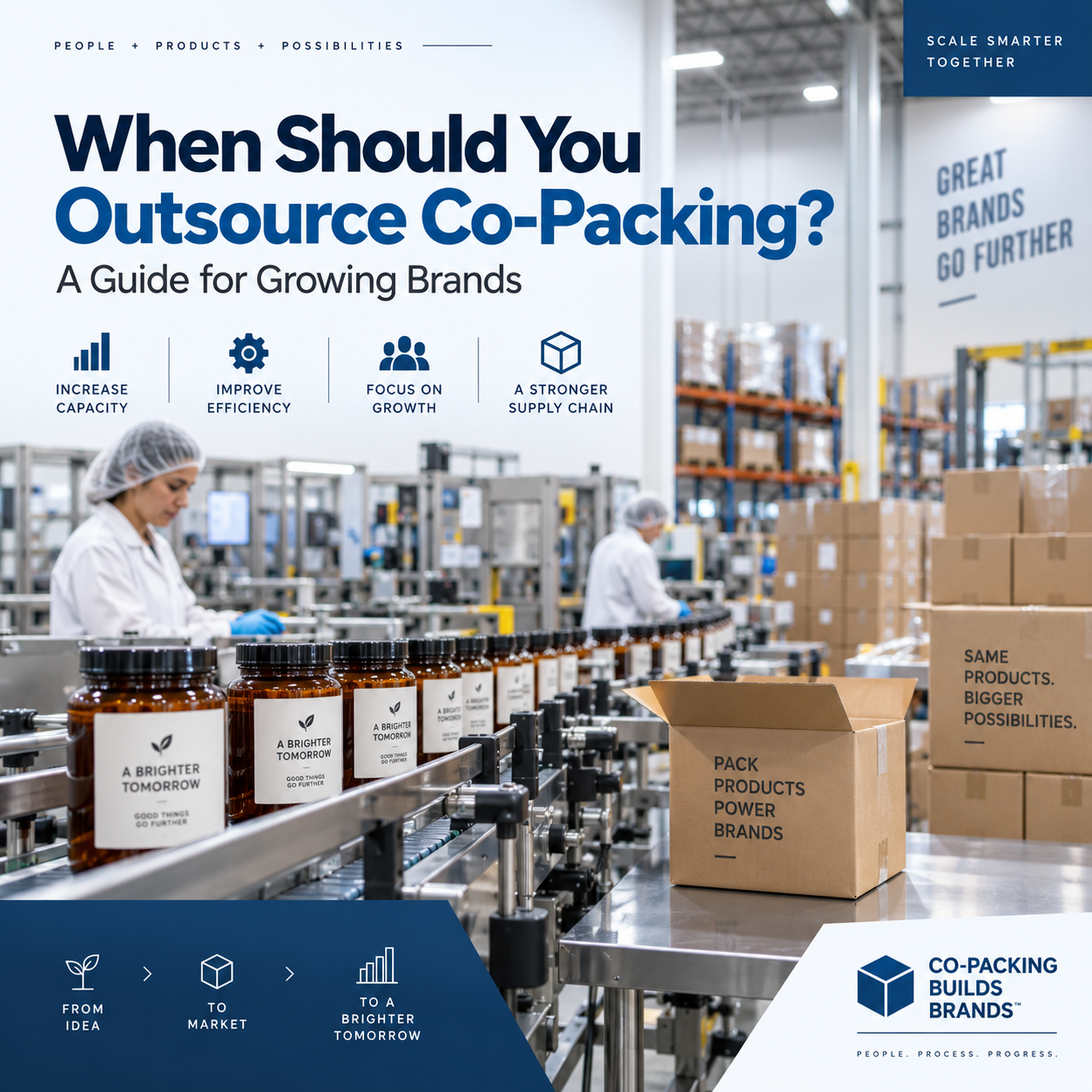
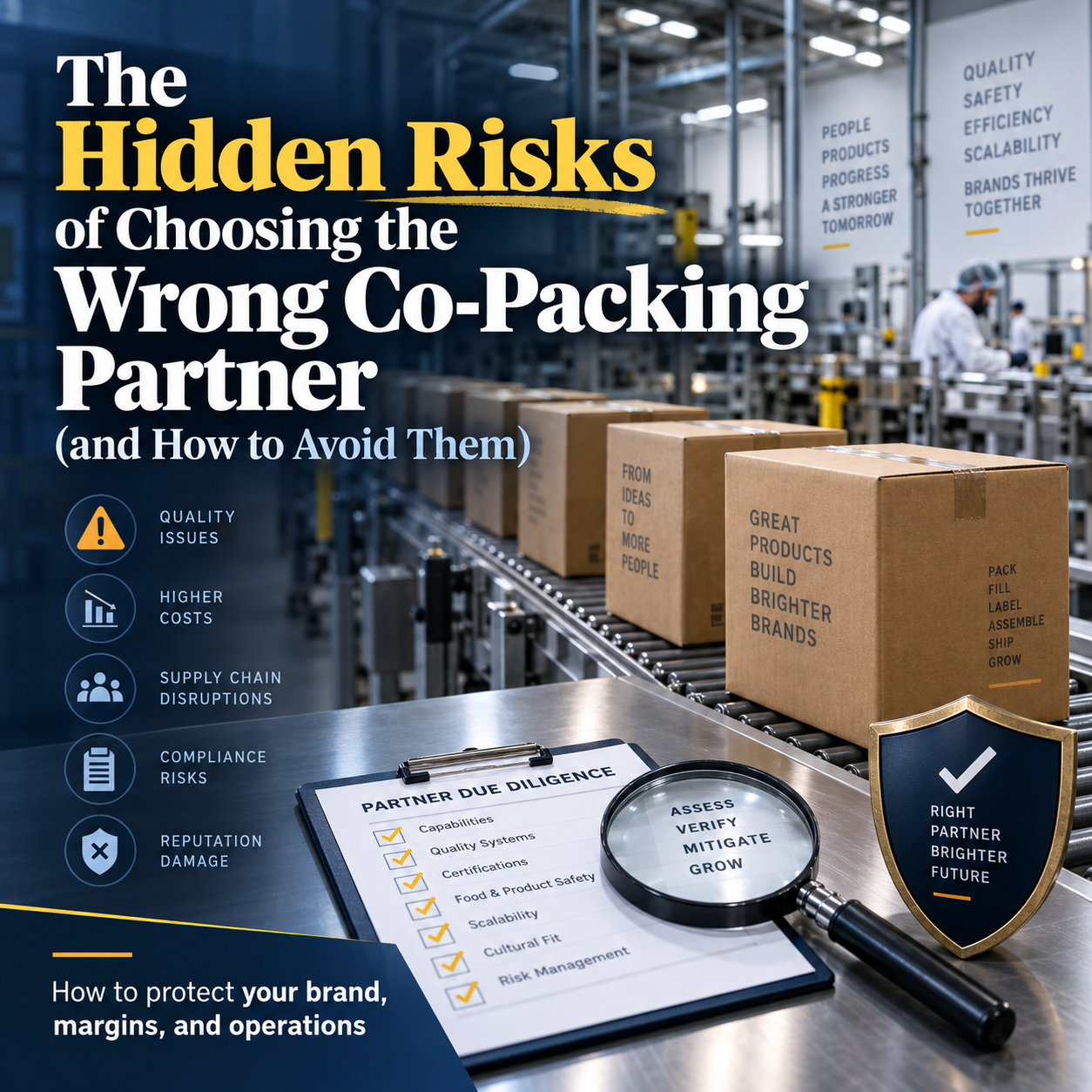


Growth is usually a good problem to have—until your production floor, employees, warehouse space, and equipment can no longer keep up.
Growth is usually a good problem to have—until your production floor, employees, warehouse space, and equipment can no longer keep up.
For manufacturers, consumer packaged goods companies, food brands, pet product companies, retailers, and other businesses that depend on packaging, there comes a point when handling everything internally may no longer be the most efficient option.
That is when an important question emerges:
When should you outsource co-packing?
The answer is not simply “when your company gets bigger.” Outsourcing co-packing makes the most sense when internal packaging begins limiting your ability to grow, fulfill orders, control costs, maintain consistency, or focus resources on the parts of your business that generate the most value.
For companies searching for co-packing in St. Louis, MO, understanding the right time to outsource can help prevent production bottlenecks before they become major business problems.
Here are the signs that it may be time to consider a professional co-packing partner.
Co-packing, also known as contract packaging, is the process of outsourcing some or all of a company’s packaging operations to a third-party provider.
Depending on the project, a co-packing company may assist with activities such as:
Product assembly
Kitting
Labeling
Cartoning
Bundling
Repackaging
Display assembly
Promotional packaging
Variety packs
Retail-ready packaging
Fulfillment preparation
Other labor-intensive packaging processes
Instead of investing in additional employees, equipment, warehouse space, and infrastructure, a company can rely on an experienced co-packing provider to perform these functions.
The objective is not simply to move work outside your facility. The right outsourcing strategy should help your business become more scalable, efficient, predictable, and focused.
One of the clearest signs that it is time to outsource co-packing is when customer demand begins exceeding your internal packaging capacity.
Perhaps your company could comfortably package 10,000 units per week, but new customers have increased demand to 25,000 or 50,000 units.
Suddenly, your operation may need more:
Employees
Packaging lines
Equipment
Warehouse space
Supervisors
Training
Quality control
Inventory management
What initially appears to be a production problem can quickly become a capital and labor problem.
Outsourcing gives businesses access to additional production capacity without necessarily building that capacity internally.
For growing companies in St. Louis and throughout Missouri, a nearby contract packaging partner can provide another option when increased volume begins putting pressure on existing operations.
Packaging can be labor-intensive.
Hiring employees is only the beginning. Businesses must also recruit, interview, onboard, train, schedule, supervise, and retain those employees.
When labor availability becomes unpredictable, production can become unpredictable too.
Imagine receiving a large purchase order only to discover that you do not have enough employees available to package the product on schedule.
Missing that deadline can create consequences far beyond labor costs.
Delayed shipments can affect:
Customer relationships
Retail commitments
Promotional launches
Distribution schedules
Inventory availability
Revenue
When your management team is spending significant time solving staffing problems just to keep packaging moving, outsourcing may become a more attractive option.
A reliable St. Louis co-packing company can provide additional packaging capacity without requiring your organization to continuously expand its internal workforce every time demand increases.
Not every business experiences steady production volume throughout the year.
Some companies have large seasonal spikes surrounding:
Holidays
Retail promotions
Product launches
Summer demand
Back-to-school campaigns
Gift sets
Special events
Major customer orders
Hiring full-time employees and purchasing equipment to handle your highest-volume month may not make financial sense if much of that capacity sits unused during slower periods.
Co-packing can create greater flexibility.
Instead of designing your entire operation around peak demand, you may be able to outsource additional packaging volume when required.
This can be especially valuable for companies that need short-term packaging capacity in St. Louis or additional labor to support seasonal projects without permanently increasing overhead.
Space is expensive.
As companies grow, packaging operations often begin consuming areas that could otherwise be used for manufacturing, raw materials, finished goods, equipment, or additional inventory.
Before signing another warehouse lease or expanding your facility, consider whether packaging needs to remain inside your building.
Outsourcing some packaging functions may allow your company to avoid or postpone a major real estate investment.
Ask yourself:
Are we expanding our facility because our core operation requires more space—or because packaging is consuming the space we already have?
The answer can dramatically change the economics of outsourcing.
A contract packaging solution may allow you to redirect valuable square footage toward operations that are more strategically important to your business.
Every organization has limited resources.
If executives, operations managers, warehouse managers, and supervisors are constantly dealing with packaging schedules, temporary labor, equipment problems, rework, and shipping deadlines, those resources are not being used elsewhere.
Your company’s competitive advantage may be:
Developing products
Manufacturing
Building retailer relationships
Sales
Marketing
Product innovation
Distribution
Customer service
It may not be packaging.
Outsourcing non-core packaging activities can allow internal teams to concentrate on areas where they create the most business value.
The question becomes:
Is packaging something we need to own internally, or is it something we simply need completed correctly and on time?
For many organizations, that distinction becomes increasingly important as the company grows.
Winning a large retailer, distributor, or enterprise customer can transform a business.
It can also expose weaknesses in your operations very quickly.
A major purchase order might require:
Significantly greater packaging volume
New product configurations
Retail displays
Multipacks
Variety packs
Promotional packaging
Different labeling
Specialized kitting
Tight delivery schedules
Your manufacturing operation may have enough capacity to produce the product while packaging becomes the bottleneck preventing it from shipping.
That is an ideal situation to evaluate outsourced co-packing.
Rather than allowing packaging limitations to restrict sales opportunities, a co-packing provider can potentially provide the additional capacity needed to support larger programs.
Companies sometimes assume that doing packaging internally must be cheaper.
That is not always the case.
To accurately compare internal packaging against outsourcing, businesses should calculate the total cost of packaging, not just hourly wages.
Internal expenses may include:
Employee wages
Payroll taxes
Benefits
Recruiting
Training
Supervisors
Overtime
Temporary staffing
Equipment purchases
Equipment maintenance
Utilities
Warehouse space
Insurance
Materials handling
Quality control
Rework
Downtime
Once all of these expenses are included, the cost difference between internal packaging and contract packaging may look very different.
The goal is not necessarily to find the lowest cost per unit.
The better question is:
Which approach creates the best combination of cost, scalability, reliability, quality, and operational flexibility?
As volume increases, maintaining consistent packaging becomes more difficult.
Rushing to meet deadlines can result in:
Incorrect labels
Poorly sealed packages
Missing components
Incorrect quantities
Damaged cartons
Inconsistent assembly
Rework
Customer complaints
Packaging is often one of the final things a customer sees before interacting with your product.
That makes packaging quality part of your brand experience.
One packaging mistake may appear minor, but repeated problems can damage retailer and customer confidence.
If your organization is struggling to maintain consistent quality while increasing production volume, working with an experienced contract packaging company in St. Louis may provide another way to scale while maintaining more structured processes.
Increasing internal packaging capacity typically requires investment.
A business may need additional:
Packaging equipment
Conveyors
Warehouse space
Material handling equipment
Technology
Employees
Management
Before making those investments, companies should consider how long the additional capacity will actually be needed.
If demand is uncertain, outsourcing can provide flexibility without immediately committing capital to permanent infrastructure.
This can be particularly important when testing:
New products
New retailers
New packaging configurations
Promotional programs
Seasonal programs
New geographic markets
Instead of building an entire operation around projected demand, a company can potentially scale its packaging resources alongside actual demand.
Sometimes the most important warning sign is not found on a spreadsheet.
You can see it inside the organization.
Orders keep increasing, but employees are constantly working overtime. Warehouse space is disappearing. Supervisors are putting out fires. Production schedules keep changing. Customers are requesting faster turnaround times.
Growth begins creating stress throughout the operation.
That is often the point when businesses should evaluate what functions truly need to remain internal.
A co-packing partner should not simply provide additional hands.
The relationship should help remove operational pressure and allow your business to grow without every new customer creating another internal crisis.
Outsourcing is not automatically the right solution for every company.
Very low production volumes may sometimes be more economical to manage internally.
For example, a startup producing a few hundred units may not yet have enough volume to justify professional contract packaging.
Companies should also consider whether:
Production volume is consistent enough
Packaging specifications are finalized
Products are ready for commercial scale
Margins can support outsourced production
Forecasting is reasonably reliable
There is enough recurring volume
The key is finding the point where the operational and financial benefits of outsourcing begin exceeding the cost of continuing to handle packaging internally.
When comparing options, avoid looking only at the co-packer’s quoted price.
Instead, compare the outsourced cost with the fully burdened internal cost.
For internal packaging, calculate expenses related to labor, management, space, equipment, maintenance, utilities, training, overtime, temporary staffing, quality issues, and downtime.
Then consider costs that are harder to quantify.
For example:
What does a delayed order cost?
What does lost production capacity cost?
What is the cost of turning down a major customer because your packaging operation cannot handle the volume?
What is the value of management time spent solving packaging problems?
The answers can reveal the true business case for outsourcing.
Location can play an important role when selecting a co-packing provider.
Companies located in or shipping through the St. Louis region may benefit from working with a nearby partner because physical proximity can make communication, inventory movement, project coordination, and production oversight easier.
Searching for co-packing in St. Louis, Missouri can be particularly valuable for companies that want convenient access to their packaging partner rather than shipping products across the country for every project.
A local relationship can also make facility visits and production discussions more practical.
When evaluating a St. Louis contract packaging provider, consider factors such as:
Available capacity
Relevant packaging experience
Quality processes
Communication
Inventory management
Scalability
Turnaround expectations
Project management
Facility organization
Ability to support your anticipated growth
The lowest quote is not always the best long-term solution.
A dependable co-packing relationship should help protect your production schedule, your customers, and ultimately your brand.
Before outsourcing your packaging operation, ask potential providers questions such as:
What types of co-packing projects do you regularly handle?
Can your operation scale if our volume increases?
How do you manage inventory and materials?
What quality checks are built into production?
How are production schedules communicated?
How do you handle unexpected volume increases?
Who will manage our account or project?
What information do you need before providing pricing?
Can we visit your facility?
A strong co-packing relationship should be built around transparency, communication, consistency, and realistic expectations.
There is no universal minimum volume because every product and packaging process is different. Businesses should compare their fully burdened internal packaging costs with outsourcing costs while also considering capacity, labor availability, space, and future growth.
It can be, but cost should be evaluated beyond labor alone. Equipment, warehouse space, management, overtime, recruiting, downtime, and quality issues can significantly increase the true cost of internal packaging.
Yes. Seasonal demand is one of the common reasons businesses evaluate contract packaging because outsourcing can provide additional production capacity without permanently increasing internal labor and infrastructure.
It depends on volume and economics. Some early-stage companies may benefit from handling small quantities internally until consistent demand develops. Outsourcing typically becomes more attractive as production volume, complexity, and operational requirements increase.
Look for a St. Louis co-packing company with relevant experience, adequate capacity, strong communication, clearly defined quality processes, organized inventory management, and the ability to scale alongside your business.
The best time to evaluate outsourcing is often before packaging becomes a serious bottleneck.
If your company is struggling with labor, warehouse space, production capacity, seasonal volume, large customer orders, inconsistent packaging quality, or rising operational costs, it may be time to explore contract packaging.
Outsourcing does not mean giving up control of your operation.
When structured correctly, it can mean allocating your resources more strategically.
For companies looking for co-packing solutions in St. Louis, MO, Elite Printing & Packaging can be part of the conversation when evaluating how to increase packaging capacity and support continued growth.
Instead of waiting until your operation is overwhelmed, evaluate your options early.

Bring your vision to life with custom flexible packaging, labels, and retail-ready design.

Premium materials and finishes that elevate your brand.

Efficient, compliant, and versatile co-packing for pet and human products.

From warehouse to doorstep — done right, every time.
Bring your vision to life with custom flexible packaging, labels, and retail-ready design.
Premium materials and finishes that elevate your brand.
Efficient, compliant, and versatile co-packing for pet and human products.
From warehouse to doorstep — done right, every time.