

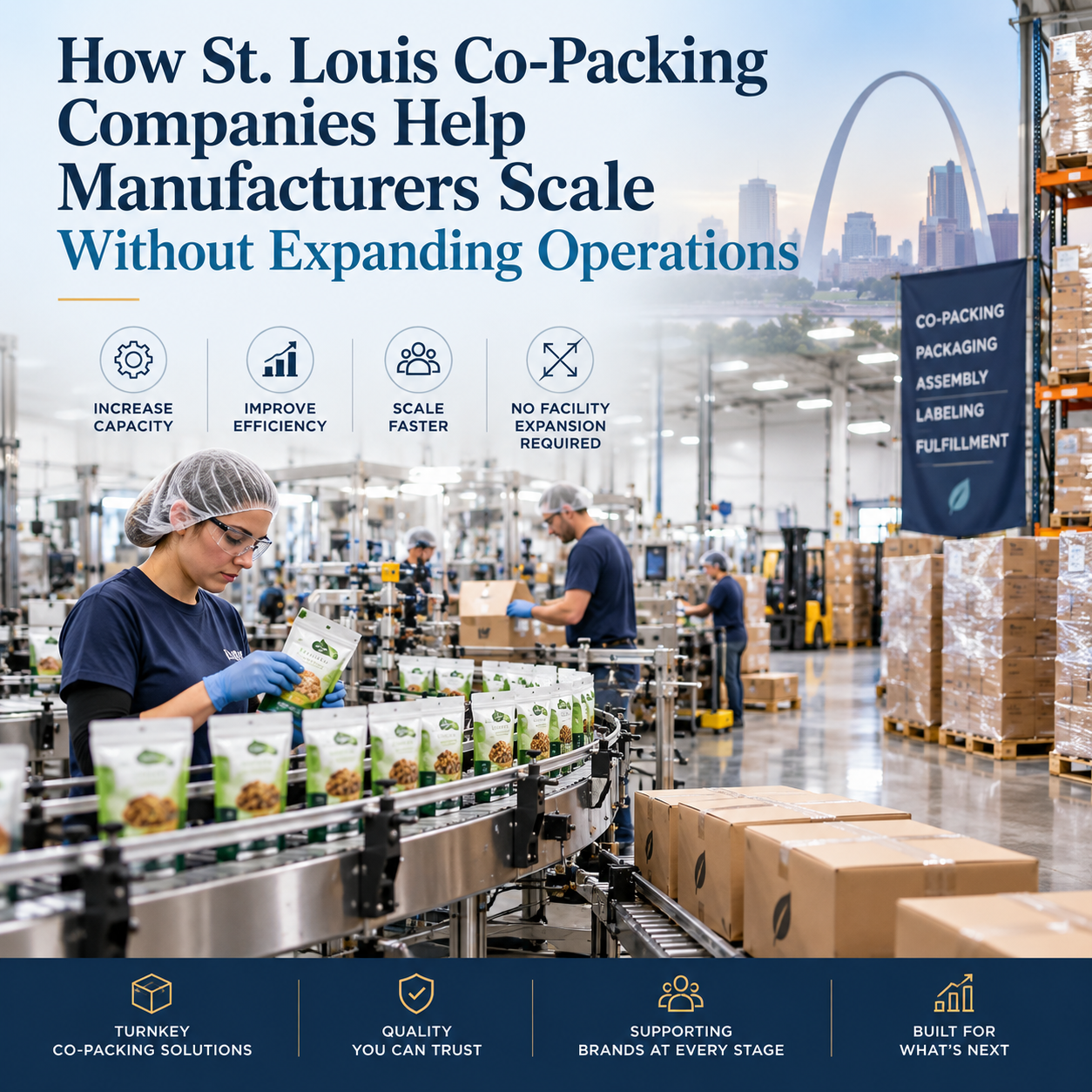

More orders, new retail accounts, expanded distribution, additional SKUs, and larger production runs are all signs that your brand is moving in the right direction. But as your business grows, the partners that helped you reach your current stage may not always be equipped to support what comes next.
Growth is usually a good problem to have.
More orders, new retail accounts, expanded distribution, additional SKUs, and larger production runs are all signs that your brand is moving in the right direction. But as your business grows, the partners that helped you reach your current stage may not always be equipped to support what comes next.
Your co-packer is one of the most important operational partners in your supply chain. The right co-packing company can help you increase production capacity, control costs, maintain product quality, meet deadlines, and scale efficiently.
The wrong co-packer can become a bottleneck.
Missed production windows, inconsistent communication, inventory problems, limited capabilities, and increasing costs can quietly slow growth and create problems throughout your organization.
The challenge is knowing when normal operational growing pains have become signs that your brand has outgrown its current co-packer.
Here are seven warning signs that it may be time to reevaluate your co-packing relationship and look for a partner that can better support your next stage of growth.
One of the clearest signs that you have outgrown your current co-packer is simple: they cannot reliably produce enough product to meet your demand.
When you first partnered with your co-packer, your production requirements may have been relatively manageable. Perhaps you were producing smaller batches, servicing regional customers, or operating with only a handful of SKUs.
As your brand grows, everything changes.
You may suddenly need:
If your co-packer is consistently telling you that production capacity is unavailable, your orders are being pushed back, or lead times are getting longer, your growth could eventually exceed their operational capabilities.
Production capacity should support sales growth—not restrict it.
For example, imagine landing a major retail account that dramatically increases your monthly order volume. That opportunity should be exciting. But if your co-packer cannot accommodate the increased production schedule, you may struggle to fill orders, meet retailer deadlines, or maintain inventory levels.
In extreme cases, limited production capacity can even force brands to decline new business opportunities.
A scalable co-packing partner should have the equipment, labor, production space, and operational flexibility necessary to increase capacity alongside your brand.
If your sales team is constantly checking with your co-packer before accepting new orders, it may be time to explore a partner with greater production capacity.
Longer lead times are another common indicator that your co-packing operation is struggling to keep pace with your business.
Every co-packing project requires planning. Materials must arrive. Production schedules must be coordinated. Equipment must be prepared. Labor must be allocated. Products must be packed, inspected, palletized, and prepared for shipment.
Some lead time is unavoidable.
But consistently increasing lead times can signal deeper operational problems.
You may begin noticing that production runs that previously required two weeks now require three or four. Rush jobs may become nearly impossible. Scheduling future production may require increasingly long notice.
These delays can create problems across your entire supply chain.
Longer co-packing lead times may result in:
For fast-growing brands, supply chain agility becomes increasingly important.
Retailers, ecommerce customers, distributors, and wholesalers expect products to remain available. When demand suddenly increases, your production partner should have enough flexibility to respond.
If your co-packer’s schedule is consistently booked months in advance or your production runs are repeatedly being delayed, the partnership may no longer align with your growth trajectory.
The best co-packing relationships provide predictable production scheduling and transparent communication about capacity.
You should understand when your products will enter production, when they will be completed, and when finished goods will be available for shipping.
If those timelines become increasingly uncertain, it may be time to investigate alternatives.
Scaling production should never require sacrificing quality.
Unfortunately, quality issues sometimes begin appearing when a co-packer is operating near its maximum capacity.
Employees may be rushed. Production lines may be overloaded. Preventative maintenance may be delayed. Inspection procedures may become inconsistent.
The result can be an increase in packaging or production defects.
Depending on your product and packaging format, quality issues may include:
Even relatively small packaging defects can create major downstream consequences.
A leaking pouch, incorrectly labeled product, or improperly sealed container does more than create a manufacturing problem.
It can damage your brand reputation.
Customers rarely distinguish between your company and your manufacturing partners. When they receive a damaged or incorrectly packaged product, your brand receives the complaint.
Retailers may also impose chargebacks, reject shipments, or require corrective action.
Quality should become more consistent as your brand grows, not less.
A strong co-packing partner should have clearly defined quality assurance procedures, documented production processes, experienced operators, inspection checkpoints, and strong accountability systems.
If you are spending more time reviewing defects, resolving production errors, issuing credits, or addressing customer complaints, your current co-packing relationship deserves closer examination.
Growing brands rarely stay operationally simple forever.
You may start with one packaging format and eventually expand into several.
For example, a brand that originally required only basic pouch filling may eventually need:
If your co-packer offers only a limited range of services, your supply chain can quickly become fragmented as your packaging needs grow.
You may find yourself shipping products between multiple vendors just to complete a finished package.
One vendor handles filling.
Another applies labels.
Another assembles promotional packs.
Another stores finished goods.
Another manages fulfillment.
Every additional partner introduces additional shipping costs, handling, scheduling coordination, inventory transfers, and opportunities for mistakes.
Working with a co-packing partner that offers multiple packaging capabilities under one roof can dramatically simplify operations.
It can also make it easier to launch new products.
Instead of searching for a new packaging vendor every time your marketing or product development team introduces a new format, you can work with an existing partner that already understands your products and operational requirements.
If your current co-packer frequently responds to new packaging requests with “we don’t do that,” your brand may have outgrown their capabilities.
Strong communication is critical in co-packing.
Your co-packer is responsible for handling products, packaging materials, production schedules, inventory, and delivery deadlines that directly impact your customers.
You should not have to chase them for updates.
Warning signs of communication problems include:
As order volumes and project complexity increase, communication becomes even more important.
A co-packing relationship should feel collaborative.
Your partner should proactively communicate potential issues, production timelines, material shortages, scheduling conflicts, and opportunities for operational improvements.
Problems happen in manufacturing. The difference between a strong co-packer and a weak one is often how those problems are communicated and resolved.
A good partner may contact you and say:
“We noticed a potential issue with your packaging material before production started. Here are two options for resolving it.”
A weaker partner may say:
“Your production run is delayed because the packaging didn’t work.”
The first approach helps solve problems.
The second simply reports them.
If your team is spending excessive time managing your co-packer instead of managing your business, the relationship may no longer be working efficiently.
Price matters in co-packing—but focusing exclusively on the lowest unit cost can be misleading.
The real question is whether your overall packaging operation is becoming more efficient as production volume increases.
Ideally, scaling should create opportunities for greater efficiency.
Larger production runs may improve equipment utilization. Better material purchasing may reduce costs. More streamlined production processes may reduce labor requirements.
If your volume is growing but your overall packaging costs continue increasing disproportionately, it is worth examining why.
Hidden costs may include:
This is why brands should evaluate total cost rather than simply comparing per-unit co-packing prices.
A slightly higher production rate from a more efficient partner may ultimately lower your total operational cost if that partner reduces waste, improves throughput, eliminates extra transportation, and prevents quality problems.
Experienced co-packers can also identify opportunities to redesign processes.
Perhaps changing the size of a master carton improves pallet efficiency.
Maybe modifying packaging materials improves machine speeds.
Perhaps combining multiple packaging operations eliminates unnecessary handling.
A strong co-packing partner should actively look for ways to help improve your overall operation.
If your current provider simply increases prices without helping identify operational efficiencies, it may be time to evaluate alternatives.
The biggest difference between a basic co-packer and a great co-packing partner often has nothing to do with equipment.
It is how they approach your business.
Some co-packers simply execute work orders.
You send them instructions. They run the project. They send an invoice.
That relationship may be perfectly adequate during the early stages of a business.
But as your company grows, operational decisions become more complicated.
A strategic co-packing partner should help you solve problems.
They may recommend improvements to packaging materials, production layouts, shipping configurations, inventory planning, or assembly methods.
They should ask questions such as:
Can we improve production throughput?
Can we reduce packaging waste?
Can we eliminate unnecessary handling?
Can we reduce overall packaging costs?
Can we simplify fulfillment?
Can we prepare for upcoming retail expansion?
Can we increase production capacity before the next major sales cycle?
Your co-packer has visibility into your production operation that very few outside partners have.
That experience can become incredibly valuable when your partner is actively invested in improving your business.
If conversations with your current co-packer rarely extend beyond scheduling and pricing, you may be missing opportunities to optimize your supply chain.
Growing brands often need more than a vendor.
They need a manufacturing and packaging partner capable of helping them scale.
Recognizing that your brand has outgrown its co-packer is only the first step.
The next challenge is choosing a partner that can support where your business is headed—not simply where it is today.
When evaluating co-packing companies, consider factors such as production capacity, equipment capabilities, quality systems, communication, warehouse space, operational flexibility, industry experience, fulfillment support, and scalability.
Ask potential partners about the largest production volumes they routinely manage.
Discuss your growth projections.
Explain potential new products or packaging formats you expect to launch.
Ask how they manage production scheduling during high-demand periods.
You should also explore whether the co-packer provides complementary services that could simplify your supply chain.
For example, combining co-packing, kitting, labeling, assembly, warehousing, and fulfillment with one partner may eliminate multiple transportation steps and reduce operational complexity.
The goal is not simply finding someone capable of running your current project.
The goal is finding a partner capable of growing with your business.
One reason companies remain with an underperforming co-packer is the fear of changing suppliers.
Transitioning production can seem complicated.
Equipment must be tested. Materials must be transferred. Processes must be documented. Production schedules must be coordinated.
However, with proper planning, switching co-packers can be managed gradually.
Many companies begin by transferring a single SKU, production run, or packaging project.
This allows both teams to validate production processes before expanding the relationship.
A structured transition may include:
An experienced co-packing company should be able to help guide this process.
The objective is to minimize risk while building confidence in the new production relationship.
Your co-packer plays a critical role in your ability to scale.
When production capacity, quality, communication, packaging capabilities, or overall cost efficiency begin limiting your business, those problems should not be ignored.
The seven signs are often easy to recognize once you know what to look for:
Your production volume is exceeding capacity.
Lead times are getting longer.
Quality problems are increasing.
You need additional packaging capabilities.
Communication has become difficult.
Overall costs keep increasing.
And your co-packer no longer feels like a strategic partner.
Any one of these issues may be manageable.
Several occurring simultaneously may indicate that your business has simply outgrown the relationship.
At Elite Printing & Packaging, Inc., we help brands solve complex co-packing and packaging challenges with flexible production capabilities, experienced teams, and scalable solutions designed around each customer’s operation.
Whether you need additional production capacity, new packaging capabilities, kitting, labeling, assembly, fulfillment support, or a more reliable co-packing partner, the right solution begins with understanding your operational needs.
If your current co-packer is struggling to keep up with your growth, contact Elite Printing & Packaging today to discuss your next project and discover how the right co-packing partner can help your business scale.

Bring your vision to life with custom flexible packaging, labels, and retail-ready design.

Premium materials and finishes that elevate your brand.

Efficient, compliant, and versatile co-packing for pet and human products.

From warehouse to doorstep — done right, every time.
Bring your vision to life with custom flexible packaging, labels, and retail-ready design.
Premium materials and finishes that elevate your brand.
Efficient, compliant, and versatile co-packing for pet and human products.
From warehouse to doorstep — done right, every time.